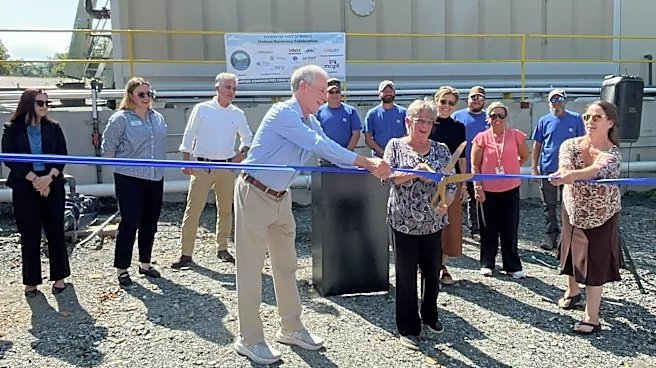








HOT SPRINGS - The North Carolina Department of Environmental Quality was in Hot Springs Sept. 15 to celebrate the collaborative effort to restore the town's water and sewer infrastructure following Tropical Storm Helene.
Mayor Abby Norton, the town board and state officials celebrated the town's purchase of a property for its future wastewater treatment plant. In 2023, Norton said building a new wastewater treatment plant in Hot Springs was at the top of her list of goals when she was elected in 2019.
Helene ravaged Hot Springs when it made landfall in September 2024, causing severe flooding from the French Broad River and Spring Creek that devastated the downtown area, damaged the historic spa, and destroyed roads, bridges and homes.
In May, the
town finalized purchase of a 36-acre tract, 955 River Road, for $800,000, or slightly more than $22,000 per acre. The town's current setup of two package plants will eventually be transported to the new property, with a new sewer line running under the French Broad River, Maintenance Supervisor Jeremy Trantham told The News-Record Sept. 15.
The current wastewater treatment plant will be converted into a lift station, and the new treatment plant site will sit higher than the flood plain.
Background
In 2023, the town received word it was eligible to receive nearly $4 million from the North Carolina Collaboratory at UNC Chapel Hill, in partnership with the UNC Environmental Finance Center, for a proposed wastewater project. The Collaboratory determined Hot Springs' wastewater treatment plant project was eligible to receive grant funding under the Innovative Highly Treated Wastewater Pilot Program, Norton said.
In April 2025, the Hot Springs Town Board approved two package plants, which includes $96,000 for technical assistance for one year. A sewer package plant is a self-contained, pre-engineered wastewater treatment system, typically housed in a single unit or modules, designed to treat wastewater on-site. These plants are prefabricated off-site and then shipped for installation, offering a compact, efficient, and often more cost-effective solution compared to traditional, field-erected plants.
According to Norton, the $2.2 million was paid by the UNC Collaboratory. McGill Associates, the engineering firm working with Hot Springs, recommended the town accept Integrative Water Services' bid for the two package plants totaling nearly $2.2 million.
In September 2025, the N.C. Department of Environmental Quality announced Hot Springs would receive $10 million through its Clean Water State Revolving Fund program, including $5 million for its wastewater system.

Celebrating partnerships
DEQ Secretary Reid Wilson and Gov. Josh Stein visited Hot Springs and Marshall to outline DEQ's North Carolina Flood Resiliency Blueprint, which will form the backbone of a state flood planning process to increase community resilience to flooding throughout North Carolina’s river basins.
"Last time I was here, these two package plants had just arrived. So it's really great to be back here and see them fully operating," Wilson said. "This is a really important project to this community, and it is a testament to the resilience of the people of Hot Springs and the power of strong partnerships."
According to Wilson, DEQ disbursed more than $17 million to Hot Springs for Helene-related water and sewer projects: including $3.5 million for an emergency bridge loan, $200,000 for technical assistance and roughly $13.6 million for drinking water and sewer system improvements.
In an emotional address to attendees, Norton said in the face of the town's challenges in the aftermath of Helene, local and state organizations stepped up for Hot Springs.
"While the storm tested our infrastructure, our resources and our resolve, it also revealed the strength that comes from partnership," she said. "When Hot Springs needed help, you answers the call. Today's gathering is a reminder that meaningful progress happens when local communities and state and federal partners share a common vision."
Keith Webb, McGill and Associates' vice president who has worked with the town on water infrastructure projects for years, called Sept. 15 "a great day for Hot Springs and Madison County."
"This helps us get tourism back," Webb said, adding that the current wastewater treatment plant was built in 1969. "This town thrives on tourism."
Forrest Gilliam, former Marshall town administrator and current legislative director for Stein's Governor's Recovery Office for Western North Carolina (GROW NC) recognized Norton, and said he was "proud of her leadership," and recognized the four-person town maintenance crew for their work.
Jeff Warren, the UNC Collaboratory's executive director, said the project afforded the Collaboratory the unique opportunity to connect the expertise of North Carolina's universities with needs across the state.
"This project is a great example of why that matters, not only because of what it means for Hot Springs, but because what is learned here has the potential to inform solutions for rural communities facing similar infrastructure challenges," Warren said.
"The investments being made in infrastructure, environmental stewardship, public safety and economic opportunity will benefit our residents for generations to come. To each of you: thank you for believing in Hot Springs," said Norton, fighting back tears. "Thank you for standing with us during difficult times, and for continuing to invest in our future."
Johnny Casey is the Madison County communities reporter for The Citizen Times and The News-Record & Sentinel. He can be reached at 828-210-6074 or jcasey@citizentimes.com.
This article originally appeared on Asheville Citizen Times: DEQ, Hot Springs celebrate partnerships in emotional sewer plant ribbon cutting