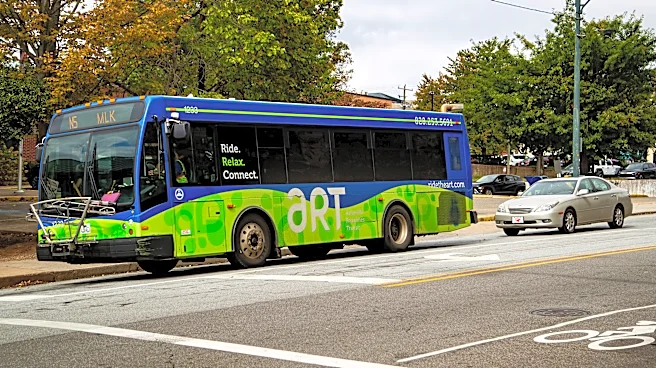








The next big change to Asheville’s beleaguered bus system might start small — micro, to be precise.
Asheville City Council members and local transit advocates alike have shown enthusiasm for “microtransit
.” Instead of relying entirely on large buses that travel on fixed routes with set schedules, a microtransit system uses smaller vehicles that riders can call on demand, similar to a taxi or rideshare service.Its boosters say that microtransit could help Asheville get some riders to their destinations more efficiently, improving the system’s overall frequency. Council member Sage Turner has called it “the solving piece” for local transit. The city’s Multimodal Transportation Commission has also encouraged council “to seek a non-fixed route aspect
of service” as it tweaks public transportation.
But city staff and Portland-based consultant Jarrett Walker & Associates, which recently completed a $300,000 study of Asheville’s transit system, chose not to examine microtransit in detail before proposing controversial changes to bus routes. And the national union that represents many Asheville transit workers has said microtransit offers a “false promise” of better service.
How might microtransit help?
Among microtransit’s biggest local champions is Bill Loftis, who serves on the Multimodal Transportation Commission and its transit subcommittee. A longtime supply chain management consultant focused on transportation, Loftis said small, on-demand vehicles are a cost-effective way for transit networks to reach inconvenient “pockets of demand.”
He pointed to destinations like the Omni Grove Park Inn and the Mountain Area Health Education Center’s Biltmore campus, both of which would have lost service under Asheville’s new routes. Instead of a large bus extending a route to those important but out-of-the-way stops — which reduces its frequency — a less expensive, on-demand vehicle could shuttle riders to and from the bus line as needed.

By taking a different approach to that “last mile” problem, suggests Loftis, the city could increase how often its main buses serve major corridors like Charlotte Street and Patton Avenue. He argues that would be a lower-cost way for the city to progress toward its 2036 vision, which says Asheville residents should be able to easily live “without a car and still enjoy economic, academic, and social success.”
Loftis said he recently presented his non-fixed route options in a two-hour meeting with the managing director of the Grove Park Inn, along with Vice Mayor Antanette Mosley and Council member Kim Roney. “I think they understood that, if we go through the complexity of putting these pieces together, this might be a solution that gives us increased frequency and maintains — and possibly expands — coverage within our budget limitations,” he told the Citizen Times.
Who’s using microtransit already?
Other jurisdictions throughout the Southeast have launched pilot microtransit programs, including Charlotte and Spartanburg, S.C.. The N.C. Department of Transportation has been supporting efforts throughout the state using a $10.4 million federal grant.

The closest of those pilots is in McDowell County, which launched the McDowell Express microtransit service in 2025. The program serves residents of Marion and Old Fort.
Some cities have completely replaced their bus system with microtransit. Wilson, for example, implemented the RIDE on-demand service and eliminated its buses in 2020.
Why hasn’t Asheville tried microtransit yet?
The possibility of microtransit was in the scope of work for the “comprehensive operational analysis” the city commissioned in March 2025. But Turner, who advocated for the study at council, told the Citizen Times she was “shocked to learn” that staff and consultants hadn’t given it a substantive look.
“I was told the expenses could be too high, starting a new method of transportation would need significant study and staffing, and it wasn’t feasible at the time,” Turner said. “We have amazing staff, and Jarret Walker is considered a leading transit firm; at the time, I accepted that they likely knew more than I about the complexities of the subject and used their best judgement to kill it so early. That said, we still need to study it.”
In response, city spokesperson Kim Miller provided a response from Asheville’s transportation department. Staffers noted that Jarrett Walker had considered microtransit in a July 2025 report. The consultancy wrote that on-demand trips could be more expensive than fixed-route service and generally served fewer riders per hour.
The local chapter of the Amalgamated Transit Union, which represents many of Asheville’s bus drivers and mechanics, is also skeptical of microtransit. ATU Local 128 President Steve Sprague referenced a 2025 report from the national union, “The False Promise of Microtransit,” and said he had both environmental and efficiency concerns with the concept.
What’s next for microtransit in Asheville?
Asheville transportation staff hasn’t ruled out further study of microtransit. They wrote that work on the draft network plan had created “a baseline” for further conversations on how to enhance bus service.
“Among the aspects that would require further research are cost and equity considerations,” staffers wrote. “Staff looks forward to the continued exploration of ideas through conversations with community partners and by monitoring the approach of similarly challenged cities.”
The city did not provide a timeline for those discussions. As previously reported by the Citizen Times, transit advocates expect no substantive action on the bus system to come before the end of the midterm election season.
Daniel Walton is the City Government Watchdog Reporter for the Asheville Citizen Times. Email him at dwalton@gannett.com.
This article originally appeared on Asheville Citizen Times: Can 'microtransit' help Asheville's buses run better?