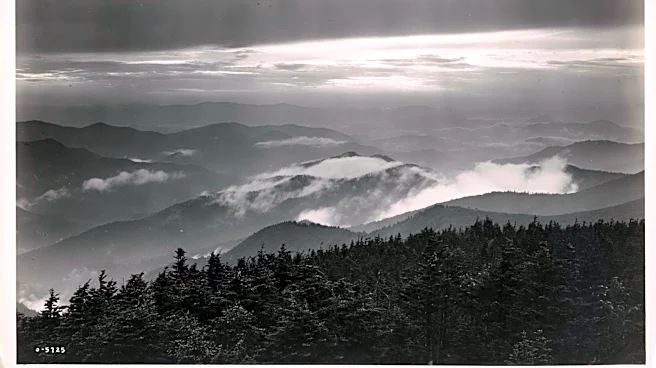





In search of George Masa’s lost work, Angelyn Whitmeyer collects old photos from every place she can find them. She has documented thousands of the famed photographer’s images from all eras of his life, particularly after he was smitten with the Smoky Mountains about a hundred years ago.
Whitmeyer is not an academic, per se. As a young woman, she started her work life as a teacher of first and second grade. Eventually, she moved into an accounting career. Those two professions underpin what has now become more than a hobby in retirement. Like a teacher, she wants to share; like an accountant, she is good at finding things.
Those “things” in this case are the photos Masa took as an amateur and professional photographer, mostly after his arrival
in Western North Carolina in 1915. He died in Asheville in 1933 of tuberculosis.

“For him, hiking and taking photos were just so intertwined,” Whitmeyer said during a pause in her research. “I think that his deep appreciation for nature obviously was one of his hallmarks. He was at the right place at the right time for that kind of work. I don't know that anybody else could have done what he did.”
Whitmeyer has been looking for originals, reproductions, and published versions of his print photography since 2019. She became curious about noteworthy local photographers, including Masa, after teaching a continuing education course on accomplished female photographers.
Masa was on her shortlist of renowned locals, but his personal life was somewhat of a mystery. His work, however, was powerful. As a Japanese immigrant in the pre-Depression era, details about his life have been patchy until the last few years, even though his photos, particularly those of the Great Smoky Mountains, are larger than life. He’s been described as the Ansel Adams of the region. The Asheville newspaper at the time declared in a headline: “Few Men Have Ever Known Smokies as Well as Photographer Masa.”

Whitmeyer has been diligently working in the background while a recent groundswell of interest in Masa’s work has come from photography enthusiasts, Smokies history buffs, and academic researchers. Several books, including Smokies Life’s George Masa: A Life Reimagined (Smokies Life 2024) and documentaries such as A Life Reimagined: The George Masa Story (Bonesteel Films 2026)chronicle a growing understanding of the man, his interests, and his life before the Smokies.
Whitmeyer has done her own investigating with little fanfare. She creates PDFs of Masa’s photographs, using as source material original photos, when she can find them, or postcards, print publications, negatives, photographic prints, slides, and other media, found in a myriad of places. The exactitude of her research is precisely described in the database she created for the research, GeorgeMasaPhotoDatabase.com. Though a dot-com site, the database is intentionally non-commercial. It’s more aptly a scholarly dot-passion-project. The information is free.

“It is meant to be a publicly available ‘catalogue raisonné’ of George Masa’s printed works,” Whitmeyer said.
Her scrupulous work habits and meticulous methods so far have borne an impressive collection. Launched in 2023, her database has grown from about 4,000 to 6,600 “data points,” which include the photos themselves—about 2,700—as well as subsequent uses of those images. Currently, her appendix of locations where Masa’s work has been published runs 19 pages, and she is finding more instances every week. On the day we spoke, she had discovered three new photos, each from an Asheville Citizen-Times collection recently archived at the University of North Carolina Asheville.
“I think the most interesting [find] recently for me was from a person in England who mailed me and said, ‘My grandfather was in the States at the time with George Masa, and he was in the hiking club, and he met George Masa, and he bought some photos from George Masa,’” she said.

In the same vein as Masa, who devised his own numbering system to catalogue his photos, Whitmeyer has created a cataloguing system to organize her database. In addition to the customized code, the database includes a photo number (if assigned by Masa), a description, size, date, media type, and source. If a photo was used more than once, she lists all the known locations of its use.
“ I think there are similarities that he and I have in that he was detail-oriented also,” she said. “He was meticulous with what he did. He was very careful about how he lined up his photos in his camera. The kind of equipment he was using, it took some skill to do.”

For others who also find Masa intriguing, Whitmeyer’s work is a boon. Janet McCue, a retired Cornell University librarian and coauthor of George Masa: A Life Reimagined, is always eager to see the products of Whitmeyer’s quest.
“Angelyn is a wonderful combination of avid collector and dogged researcher,” McCue said. “We are always delighted when Angelyn announces a new ‘find.’ Her database is a labor of love. How lucky are we to be the recipients of her largesse.”

It’s common for Whitmeyer to spend a few hours each day sitting at a library or university collection or at her own desk in Asheville, sorting through the latest leads. She’s known by name at the Special Collections of UNC Asheville, and likely several other institutions, where she is often found sitting at the end of a long conference table, peering from polished eyeglasses at new images with calm seriousness. Her tools are an Apple laptop, a scanner, and her keen eye for Masa’s work.
When she receives or finds a new Masa photo, she categorizes it by subject, scans the image, creates a PDF description sheet, and uploads the document to her database with its metadata—anything known about the image or its source. She keeps a working document on the site called “Comments on Photographs and Collections,” more than 100 pages in length, detailing her research process and significant observations.
Over the years, surviving prints of Masa’s photos ended up in many hands and resting places. Now, no fewer than 32 collections or institutions hold photographic files, including Smokies Life.

“Despite all these collections,” wrote retired UNC Asheville archivist Gene Hyde in an essay and Q&A with Whitmeyer about the lost work, “it was widely known that Masa took a lot of photographs that were generally considered missing or lost. How many Masa photographs there were, and where all of them were, was always a bit of a mystery.”
Whitmeyer has come across plenty of photos that could be Masa’s, and she sets those aside for possible deeper research later to find definitive data to make that call. Knowing Masa’s style, she can usually discern whether they are most likely his, but not always. For those mysteries, she looks forward to finding the right documentation to give the artist his due.

Explore Angelyn Whitmeyer’s database at GeorgeMasaPhotoDatabase.com. Find the Smokies Life biography of Masa and other stories about the photographer on SmokiesLife.org/tag/George-Masa/. Whitmeyer welcomes inquires to the mailing address on her database.
Jennifer Fulford is the editorial team manager for the 29,000-member Smokies Life, a nonprofit dedicated to supporting the scientific, historical, and interpretive activities of Great Smoky Mountains National Park by providing educational products and services such as this column. Learn more at SmokiesLife.org, or reach the author at jennifer@smokieslife.org.
This article originally appeared on Asheville Citizen Times: Word from the Smokies: A researcher’s ongoing pursuit of George Masa’s missing photos