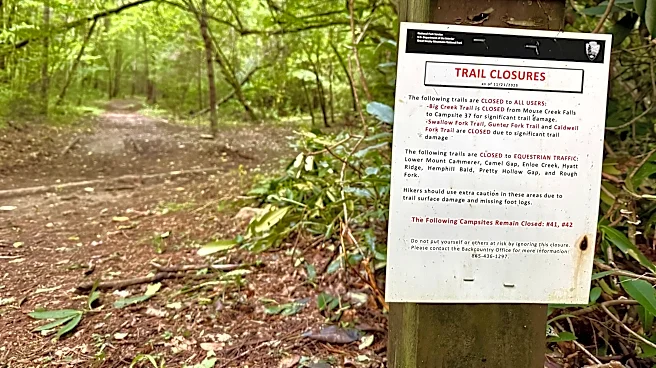







ASHEVILLE – Deep in the backcountry of the Great Smoky Mountains National Park, at the end of a long gravel road, hikers are still finding signs at trailheads with a simple message — “closed.”
On Sept. 27, 2024, Tropical Storm Helene laid waste not only to lives, businesses, homes and municipal infrastructure, but also scarred the public lands that draw people to Western North Carolina and sustain its multi billion-dollar tourism economy.
The destruction isn’t confined to a handful of backcountry trails; it also includes portions of the Appalachian Trail, long sections of the Blue Ridge Parkway, campgrounds, picnic areas, major trail systems and multiple bridges or crossings that simply no longer exist in their pre-Helene form.
The lingering damage
is not measured in miles alone, and nobody from the National Park Service wants to talk about it — federal employees paid to serve as spokespersons for the Park, the Parkway and the AT did not return multiple interview requests from the Citizen Times.
Make the Smokies great again
The Caldwell Fork Trail winds through more than 6 miles of increasingly scarce old-growth forests, past slime-slicked mossy stone walls still guarding the eroding foundations of long forgotten homesteads in Haywood County’s Cataloochee Valley.
According to the Park Service, the trail is closed because rockslides and debris still obstruct the path. The absence of several log bridges, washed away during Helene, has made normally tenuous water crossings inadvisable, if not downright dangerous.

Caldwell Fork Trail remains among the clearest examples of Helene’s lasting damage in the Park. Gunter Fork and Swallow Fork trails remain closed as well, while damage continues to affect Big Creek, Boogerman, Rough Fork and other trails around Cataloochee and the park’s eastern backcountry. Several campsites also remain closed.
The Park is America’s most visited National Park, drawing more than 12 million visitors in 2024. Straddling the North Carolina-Tennessee border, the 816 square-mile enclave is ringed with gateway communities that depend on the park’s continuing operations — Cherokee, Bryson City and Maggie Valley in North Carolina and Cosby, Gatlinburg and Townsend in Tennessee.
The Park is also an economic driver for the region’s largest cities, Asheville and Knoxville, and accounts for 2.1% of North Carolina’s gross domestic product.

A September 2025 report issued by the Department of the Interior shows that in 2024, the Park was responsible for 340,000 jobs that generate $56 billion in local economic impact from $29 billion in visitor spending.
The bulk of the spending, more than $11 billion, went to lodging. The second-largest category, with $5.7 billion in receipts, was restaurants. Retail, recreation, transportation and gasoline made up almost all of the rest. That spending contributes nearly $200 million in county-level tax revenue.
Facilities owned or maintained by the federal government are not eligible for the Federal Emergency Management Agency’s Public Assistance program, thus Congress is largely responsible for funding national parks, but has never really taken the job seriously — as of Sept. 30, 2025, the Park Service reported a $24 billion maintenance backlog, system-wide. More than $300 million of that is needed for the Park.

Absent congressional funding, in 2023 the Park Service decided to pass the cost onto taxpayers in the form of a parking fee. But the $300 million is only for deferred maintenance, not damage from Helene.
Park spokesperson Katie Liming told Knox News on Aug. 28, 2025 that the park suffered around $30 million in damages, but didn’t return inquiries from the Citizen Times about the status of funding or ongoing work.
Blue Ridge blues
The 469-mile Blue Ridge Parkway links the Park to another of the Park Service's gems, Shenandoah National Park in Virginia. Neither a National Park nor a park in the traditional sense, the Parkway is a “National Parkway” and is really more of a slow, meandering drive along the spine of Southern Appalachia interspersed periodically with overlooks and picnic areas. Commercial services are extremely rare, making the role of its gateway communities all the more critical.
In 2024, 16.7 million visitors to the Parkway spent more than $1.5 billion in those gateway communities, supporting 15,679 jobs and generating nearly $1.9 billion in economic output, according to NPS. As with the Park, the largest share of that spending goes to lodging and restaurants (66%) and amounts to just over a billion dollars annually.
Damage to the Parkway was substantial, with destroyed sections outside of Asheville and Cherokee isolating other legs of the road.
“That restricted the usual type of traveler that we get,” said Bruce O’Connell, who since 1978 has run the historic Pisgah Inn, a 51-room hotel and restaurant on the Parkway in Transylvania County. O’Connell said that drive-by day trippers stopped showing up, leaving purpose-driven visitors to find their way from nearby Waynesville or Candler.

Congress provided $2.3 billion in supplemental disaster funding to the Park Service after Helene and other 2024 disasters. Of that, about $1.7 billion was specifically identified for the Parkway; the broader appropriation also covered disaster-related repair and reconstruction at other Park Service units.
As of fall 2025, the Park Service had completed repairs in 13 areas — including major slope reconstruction, drainage and culvert repairs, pavement and guardrail replacement, debris removal and temporary stabilization — and reopened more than 400 miles of roadway, but large swaths of the Parkway remain closed.
The Little Switzerland-to-Mount Mitchell corridor from Mitchell County to Yancey County remains one of the largest disruptions along the Parkway, where stretches of roadway remain unusable.

The damage extends north toward Linville Falls, where the campground, picnic area and several trails remain closed, and includes closures at Crabtree Falls, Craggy Gardens and other popular stops. In some closed sections, the Park Service continues to prohibit not just vehicles but also hiking and other recreation.
As of August 15, the Park Service was racing to complete the rest of the repairs along the Parkway. Of the remaining 46 projects, 21 are scheduled for completion in fall 2026, while 25 are scheduled for late 2026.
The Parkway's external affairs specialist did not return multiple inquiries from the Citizen Times about the status of funding or ongoing work.

AT a crossroads
Like the Parkway, the Appalachian Trail is not really a park, nor is it a National Park. It is not simply a roadway, either; the AT is a 2,190-mile National Scenic Trail that stretches from Maine to Georgia and draws nearly 17 million visitors across 14 states each year, including between 1 million and 2 million in North Carolina alone.
Economic impact is difficult to gauge considering the decentralized nature of the AT, but it is easy to see when swarms of trail-weary wanderers descend upon the small, isolated gateway communities — like Hot Springs in Madison County — that sustain hikers, who can spend as long as 7 months on the trail.
The AT is federally overseen by the Park Service but maintained through a partnership with the U.S. Forest Service, state agencies, volunteer clubs and the Appalachian Trail Conservancy.
A 2025 report produced by the ATC found Tropical Storm Helene damaged more than 800 miles of the AT, forcing 430 miles to close and affecting 81,500 acres across four states. Wind and flooding toppled massive trees, washed out bridges, eroded or destroyed trail tread, damaged shelters, trailheads and signs while battering adjacent trail towns.
The Chestoa Bridge over the Nolichucky River near Erwin, Tennessee remains perhaps the most conspicuous Helene scar on the AT, where hikers still have to leave the trail’s normal route because the bridge swept away by the storm has not yet been replaced. In February 2025, Tennessee officials and FEMA announced a $9.8 million partnership to replace the bridge, but the status of reconstruction remains unclear.
“It’s been two years without a bridge,” said Terry Wise, owner of nearby Uncle Johnny’s Hostel.
For Wise, the delay has become part of daily business. The hostel was founded in 1998 to serve AT hikers near the Chestoa crossing. Wise, who hiked the trail in 2021, bought the hostel in January 2022 and spent the next few years renovating it.

Helene destroyed the hostel’s old store, several cabins and its main hostel space, forcing the business to close for about five months. Wise said the lost southbound hiking season cost him tens of thousands of dollars in business before he rebuilt.
The missing bridge sends hikers on a four-mile road detour, which Wise said still affects his business.
“I don’t think it helps,” he said.
Farther north, a section near Iron Mountain Gap reopened July 29, but Cherry Gap Shelter has not yet been replaced and restrictions continue in the Roan Highlands. Even along reopened portions of the trail, hikers can still encounter erosion, fallen trees, debris, damaged water access and heavily altered trail conditions.
Park Service officials didn’t respond to multiple inquires from the Citizen Times about the status of funding or ongoing work, however, Anne Sentz, Smokies and N.C. regional manager of the Appalachian Trail Conservancy, did.
“It’s not just necessarily getting out there and just fixing things immediately,” Sentz told the Citizen Times Sept. 3. “We’re using data that we’re gathering in the field to drive those longer-term projects that are really going to be what hikers notice.”
The ATC is a nonprofit organization that helps manage, protect and advocate for the Appalachian Trail, coordinating with the National Park Service, U.S. Forest Service, state agencies, local trail clubs and thousands of volunteers. Its work includes trail maintenance, conservation, planning and securing resources for projects along the 2,000-plus-mile trail and its surrounding lands.
Sentz said the overall goal of the ATC right now is not simply restoration, but making the trail better able to withstand erosion, heavy use and future storms.
“What we’re really doing now is trying to go back and look at areas through this lens of sustainability,” she said.
That work is being supported by federal money from the Forest Service and Park Service, along with private donations to ATC’s post-Helene AT Resiliency Fund. The money is paying for additional field staff, seasonal professional trail crews and complex rehabilitation projects, but federal dollars come with restrictions and do not always cover every need.
“Just because we have federal funding doesn’t always mean that it fills all those gaps,” Sentz said.
The long way back
One of the ways North Carolina measures economic activity on a county level is through sales and use tax collections numbers reported by the state’s Department of Revenue.
Across the 14 western counties hit hardest by Helene, September-November collections fell 8%, from about $227.5 million in 2023 to $209.3 million in 2024.
The strongest immediate declines were in many of the same counties where Helene heavily damaged public lands and recreation infrastructure — Avery fell 10.6%, Buncombe 15.6%, Haywood 4.5%, Mitchell 13.3%, Transylvania 7.4%, Watauga 8.2% and Yancey 6.7%. Those counties include major portions of the AT, the Parkway and the Park.

The strongest finding may actually be the recovery. Every county that declined in 2024 rebounded in 2025, and most surpassed 2023 collection levels, suggesting the sharp economic interruption associated with Helene was largely temporary at the countywide sales-tax level.
No recovery, however, can erase the months and months of below-average tourism spending in the region.
Buncombe County lodging sales improved substantially from 2025 but remained below levels recorded in fiscal years 2022, 2023 and 2024. From July 2025 through April 2026, lodging sales totaled nearly $468 million, about 9% less than during the same period in fiscal year 2024, before Helene struck.

Recent reporting from the Citizen Times shows most Western North Carolina small businesses remain below pre-storm revenue levels, according to Mountain BizWorks’ 2026 survey of more than 700 businesses.
Three in four businesses reported lower earnings, while 42% were still below 80% of their pre-Helene revenue. Reduced tourism, weak cash flow, staffing challenges and inflation remain major obstacles.
Even so, 80% of respondents said they were confident their businesses would eventually recover despite the fact that many of the world-famous public lands that draw millions of visitors to the region still bear the indelible mark of an extreme weather event two years ago. The aid that has come has been too little, and in some cases, too late.
To date, the Republican-led North Carolina General Assembly has offered small businesses plenty of low-interest, long-term loans, however direct grant support to affected entities has been slim; the state has contributed $20 million to the Western North Carolina Small Business Initiative II, which was combined with philanthropic money from Dogwood Health Trust and the Duke Endowment.

All told, that initiative distributed $55 million in grants to 2,182 small businesses, with individual awards of up to $50,000.
Democratic Gov. Josh Stein sought forgivable loans for small businesses as part of the state budget passed on July 2, but lawmakers left that proposal out of the final spending plan while approving other Helene recovery funding.
The signs still say “closed” in places like Caldwell Fork, where Helene tore through the mountains, but beyond the washed-out bridges and debris-choked trails, hikers are returning, businesses are hanging on and communities are adapting not only to what happened, but to what will happen when — not if — the next storm comes.
Cory Vaillancourt is the Helene Recovery/Investigations Reporter for the Asheville Citizen Times. Find him on X at @The_CoryV or on Signal, via email at cvaillancourt@citizentimes.com or at 912-508-5640.
This article originally appeared on Asheville Citizen Times: Two years later, Helene scars linger across WNC public lands