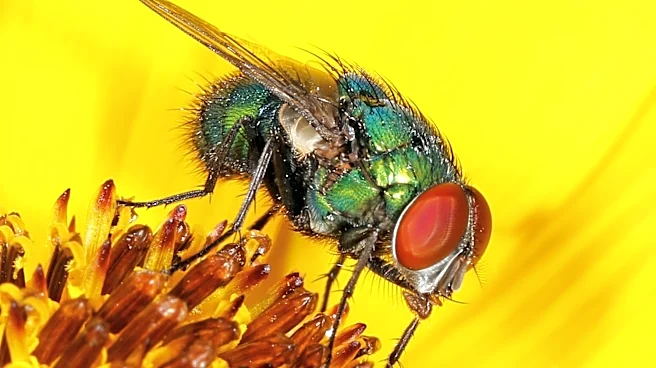




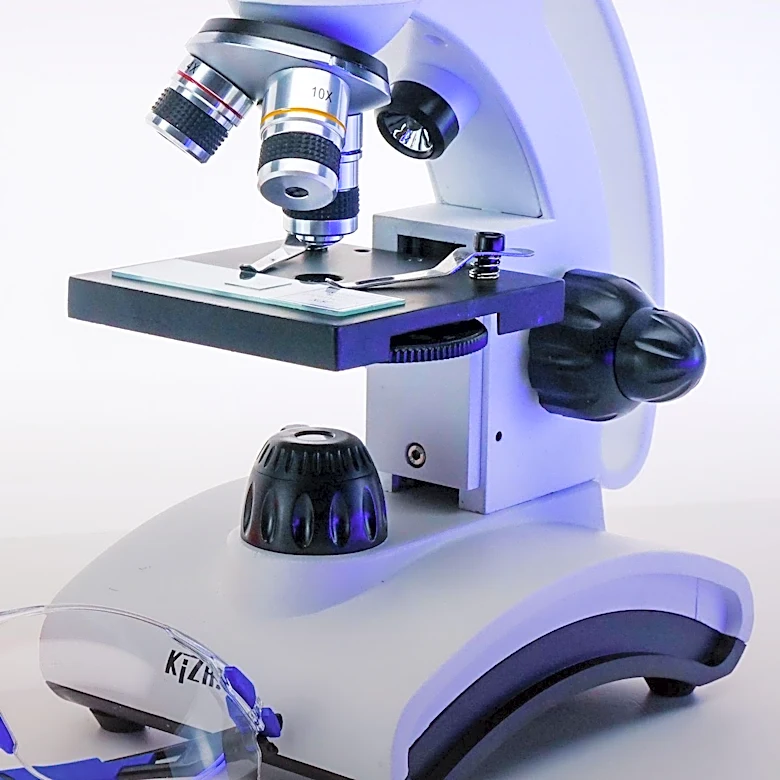




For Makhali Voss, going to the lab is synonymous with checking into a hotel. After a day spent capturing thousands of blow flies—using aged chicken liver as bait—the University of Tennessee graduate student sets up her mobile DNA analysis lab on whatever desk or table she finds in her room. Then, she gets to work.
“You have to get pretty creative when you are trying to do this kind of work in the field,” she said. “Because if you think you’ve brought everything you needed, you didn’t.”
UT’s Knoxville campus has a fully equipped molecular DNA laboratory, located, at maximum, just a couple hours away from any of Voss’ sampling sites in Great Smoky Mountains National Park. In many ways, it would be simpler to drive back and analyze her samples in the
comfort of a lab that doesn’t have to be unpacked and repacked with every use. But perfecting this on-the-go setup is as much the focus of Voss’ work as the results themselves.
With her advisor Charity Owings, Voss is using the Smokies as an outdoor lab to hone techniques for better monitoring disease pathogens in remote areas across the globe.

“There are lots of very scary zoonotic pathogens that are emerging in different parts of the world, and we need more people that are out there trying to survey for them in the wild,” said Owings, a board-certified forensic entomologist who holds a PhD in biology from Indiana University–Purdue University Indianapolis. “We don’t know when these outbreaks happen until people start dying or there’s a mass die-off of animals. If we can have people surveying some of these areas before these outbreaks happen and see what’s circulating in the wildlife before it spills over to humans, that is really what the long-term goal of this method is for.”
The humble blow fly, she believes, holds the key to success.
Carrier of clues
A research interest of Owings’ since her undergraduate years, the blow fly has never had much of a fan club. Blow fly species, of which there are about 1,500 worldwide, can be found on every continent except Antarctica and are known mainly for their propensity to feed on feces and dead carcasses—and feared for their ability to transmit some of the pathogens they encounter there.

“But you can also look at that in a different way,” said Owings.
When a blow fly—whether larva or adult—feeds on a carcass, it also ingests biological and chemical information from that animal. When resources are plentiful, most adult blow flies remain within a radius of less than two miles. Analyzing the molecular information inside these tiny creatures offers the opportunity to understand interactions between local species in a way that would otherwise be extremely expensive and time-consuming.

Though once “terrified” of insects, Owings quickly became fascinated with them after creating an insect collection for an undergraduate biology class. She then got involved with blow fly research while completing her bachelor’s degree at Texas A&M University but “just kept having more questions.” She sought to answer them, first as a graduate student and then as a PhD candidate investigating blow fly genetics, with Great Smoky Mountains National Park as one of her research sites.
The research involved studying the numbers and types of animal carcasses available to the blow flies in her study areas, but finding dead animals on the landscape is a challenging task. So Owings had an idea: since blow flies carry DNA segments from the creatures they consume, why not use the flies themselves as the source of this information?
“It’s blossomed from there,” she said, “looking at that environmental aspect of the fly as its own unique discipline and not as a supplemental question to be answered for something else.”

Initially, Owings focused her analysis on vertebrate species. Though vertebrates are an extremely well-studied group in the Smokies, her results still yielded some surprises.
“I actually found two flies in the Smokies that had guinea pig DNA,” said Owings.
She was confused by the result—there are no wild relatives of guinea pigs in the US—and presumed it to be some sort of mistake. When repeating the analysis yielded the same result, she asked for insight from Paul Super, who was then the park’s science coordinator, and he offered a couple possibilities. Perhaps someone had released a domestic guinea pig into the park, or maybe those particular flies had ventured outside the park and found a guinea pig there. Owings concluded that her method had not failed; rather, it had proven that it was capable of detecting even very rarely occurring species.

Sifting through samples
Now, with funding from the National Geographic Society, Owings and Voss are applying these methods to much smaller organisms: disease-causing pathogens. Since beginning the effort in 2025, Voss has made six sampling trips to the Smokies and collected thousands of flies, resulting in millions of DNA reads. Through multiple rounds of data collection and analysis, Owings and Voss have worked to refine the process and increase the accuracy of their results.
“The easy part is getting the flies and doing wet lab work,” said Owings. “The hard part is what we’re in now, which is the data analysis.”
Voss is currently parsing through the data from her three most recent trips using bioinformatic software, which will eventually generate a list of species whose DNA was present. Next, the scientists will determine which species qualify as pathogens—a tedious and time-consuming process. Owings expects it will be a couple months before they have a solid idea of what those data show.

“The answer right now is, we have a lot of micro-organisms that have been detected in the flies,” she said.
After completing the analysis, the scientists will conduct targeted surveys focused on any pathogens of interest that showed up in the results. The turnaround on these surveys will be much faster; instead of analyzing the entire microbial diversity contained in each sample, the scientists will need to screen for only a few select species.
Advancing the method
Long-term, Owings hopes her work will result in methods that are simple, fast, and low-cost enough that even non-scientists without access to advanced equipment will be able to monitor for the diseases of most concern to their community. Africa, for example, often sees outbreaks of devastating diseases such as Ebola and African swine fever. Developing an easy method to monitor for the microorganisms that cause these diseases would help communities know when to increase precautions, potentially saving lives.

“The long-term goal is putting this technology and these methods in the hands of people who are on the front lines of disease outbreaks and pandemics,” Owings said.
While cheap compared to other types of lab equipment, the Bento Lab that Voss takes with her on the road is still an investment, priced at about $1,600. Eliminating that up-front cost would make testing even more accessible, so Owings is also exploring the possibility of creating dipstick tests for certain pathogens. Similar to commonly used tests indicating pregnancy or COVID-19 infection, they would rely on unique proteins associated with specific pathogens, changing color when the protein is detected in a sample.
The researchers are also testing a method that would eliminate the need to capture flies at all. When blow flies land on the aged chicken liver trap, they leave behind excrement. Owings and Voss are investigating whether they can get the same results from testing the excrement as they do from testing the captured flies. Success would further increase the method’s accessibility.

“The Smokies is great because it’s so big and diverse, and it’s so accessible for us,” Owings said. “It’s a really good place to test methods like this. If it works here, it’s feasible to think it could work not just in other areas of the US, but in other parts of the world. It’s a good outdoor research lab for us to do these proof-of-concept experiments.”
Makhali Voss presented her blow fly research during the 2026 Park Science Colloquium held March 5. To see her presentation as well as a variety of other recent research conducted in the Smokies, visit DLiA.org/event/2026-colloquium/. Organized by Discover Life in America, the Park Science Colloquium is held annually in March.
Holly Kays is the lead writer for the 29,000-member Smokies Life, a nonprofit dedicated to supporting the scientific, historical, and interpretive activities of Great Smoky Mountains National Park by providing educational products and services such as this column. Learn more at SmokiesLife.org, or reach the author at hollyk@smokieslife.org.
This article originally appeared on Asheville Citizen Times: Word from the Smokies: Blow flies could hold the key to preventing disease outbreaks