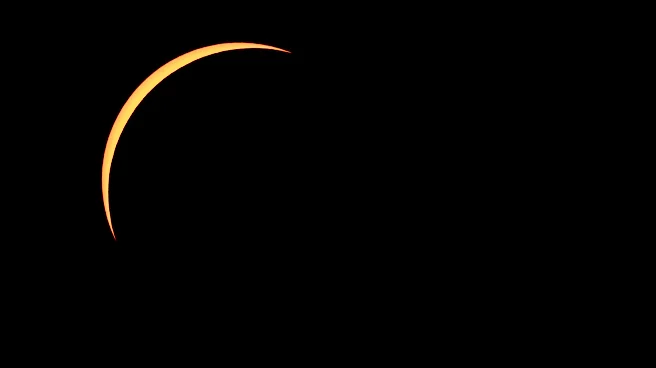

There is a total solar eclipse on the way this week, but not everyone is going to be able to observe it in person.
This year, the total solar eclipse is mainly visible from parts of Europe on Wednesday,
Aug. 12, but Americans won't be so lucky as many were in 2024.
The last total solar eclipse visible from the U.S. occurred April 8, 2024, with totality visible from several states, including Arkansas, Illinois, Indiana, Kentucky, Maine, Michigan, Missouri, New Hampshire, New York, Ohio, Oklahoma, Pennsylvania, Tennessee, Texas and Vermont, between 12:06 and 2:16 p.m. on the day of the eclipse.
In 2024, the Asheville area saw only a partial eclipse of roughly 84.71% obscuration beginning at around 1:47 p.m. and ending at around 4:32 p.m. Despite the partial visibility, visitors from across the state flocked to Western North Carolina, as the westernmost region of the state was the area where the greatest obscurity was visible.
Here's what to know about where a partial eclipse will be visible in the U.S., more astronomical events coming up this year in North Carolina and more.
Is there a total solar eclipse in 2026? When is the 2026 total solar eclipse?
The 2026 solar eclipse will be at its darkest at 1:46 p.m. EST on Aug. 12, 2026.

Where will the 2026 solar eclipse be visible? Will the solar eclipse be visible from the U.S.?
Though there will be a total solar eclipse in 2026, totality will be visible only in Greenland, Iceland, northern Russia, the Atlantic Ocean, Spain and a small corner of Portugal, according to NASA. Apart from Alaska, Maine will be the U.S. state in which the eclipse is most visible, though it will still only see just under 30% obscuration.
A partial solar eclipse of a maximum of slightly less than 2% obscuration will be visible in the furthest northeastern areas of N.C. beginning at just after 1:30 p.m. and ending at around 2 p.m., according to data from TimeandDate.com.
The eclipse will not be visible from Western N.C., unfortunately for Asheville area astronomy fans.
When is the next solar eclipse visible from the U.S.? From NC?
The next total solar eclipse that will be visible in U.S. states outside of Alaska will take place Aug. 22, 2044. Totality will be visible mainly in the western region of the U.S., with states in the path of totality including Montana, North Dakota and South Dakota.
The next total solar eclipse during which totality will be visible in North Carolina will take place May 11, 2078. Totality will also be visible from other southern states, including Alabama, Florida, Georgia, Louisiana, Mississippi, South Carolina, Texas and Virginia.
Meteor showers in 2026
Remaining meteor showers in 2026 include:
- Perseids meteor shower: Aug. 12-13
- Draconids meteor shower: Oct. 8-9
- Orionids meteor shower: Oct. 21-22
- Leonids meteor shower: Nov. 17-18, 2026
- Geminids meteor shower: Dec. 13-14
- Ursids meteor shower: Dec. 22-23
Supermoons in 2026
Following the Jan. 3, 2026 supermoon, the Old Farmer's Almanac lists two remaining supermoons in 2026:
- Beaver Moon, Nov. 24, 2026
- Cold Moon, Dec. 23, 2026
Iris Seaton is the trending news reporter for the Asheville Citizen Times, part of the USA TODAY Network. Reach her at iseaton@citizentimes.com.
This article originally appeared on Asheville Citizen Times: There is a total solar eclipse this week. Will you see it in U.S., NC?