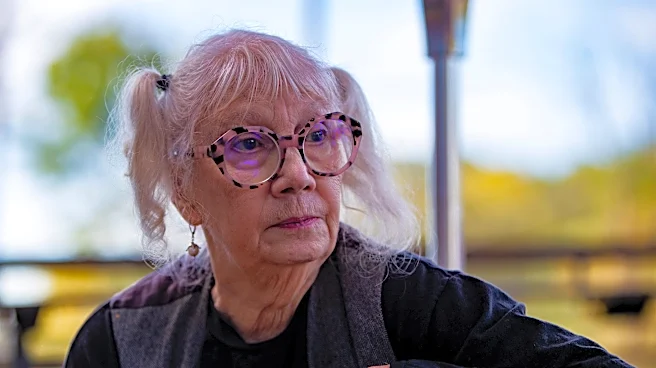




ASHEVILLE - Before Tropical Storm Helene struck Western North Carolina, Fleta Monaghan had a gallery and art school in the thriving River Arts District. On the day Helene came, Monaghan was at her home in Fairview.
"It was completely unexpected. I thought maybe we'd get maybe 12 to 18 inches in our building, and I'd have to replace drywall," she told the Citizen Times Sept. 30.
Instead, the floodwaters entered her second floor. Everybody whose work was housed in the building lost it all.
"It was just devastating," Monaghan said.

Monaghan, who was one of more than 500 artists whose studios were displaced by Helene, spoke Sept. 30 as part of a press conference organized by the Washington D.C. based Climate Action Campaign, a coalition formed with
the intent of driving federal action to combat the climate crisis.
Monaghan told those gathered at the River Arts District's Asheville Cotton Mill Studios that while she was able to reopen her art school, "we're barely breaking even now."
The gallery, which supported the school, is gone.
"Governments like the one we have now, … arts and intellectuals are the first to be targeted," she said. "I knew back in 2016, the arts were going to be in trouble. I did not know that we were going to have climate effects hit us as hard as they did here."
Asheville Mayor Esther Manheimer said during the press conference that Helene "paralyzed" Asheville's way of life when it swept through two years ago.

She said that rebuilding over the past two years has revealed that Americans are "more vulnerable than ever" to severe weather.
"And recovery efforts need to be fully funded to ensure people's safety and recovery, but that cannot happen if Washington continues to weaken the recovery and response efforts in place of these climate disasters," she said.
Jeffrey Burroughs, president of the River Arts District Artists, highlighted the resilience of the River Arts District Artists. He said that after hundreds of artists were displaced by Helene, artists found temporary studios, galleries reopened in new locations, people shared equipment and space, and artists created markets, temporary retail spaces, events and new ways for artists to sell their work.

"And slowly, people started coming back. They bought art. They ate in our restaurants. They stayed in our hotels. They walked through the studios and galleries again," he said. "And that's important, because the arts are not something that sit on the sidelines of Asheville's economy."
He said that many artists and businesses are still rebuilding, more than two years later.
"Resilience is not a substitute for investment," he said. "The fact that a community can pick itself up does not mean it should have to do so alone."
Jannette Montenegro said that when she purchased the Cotton Mill Studios in 2017, there were eight artists working in the building, and her son ran a food truck on the property.

"I remember seeing the news stories coming out about how a hurricane was going to hit North Carolina in Asheville," she said. "We thought, we're originally from Miami, so we know hurricanes. Hurricanes don't make it to the mountains."
"Unfortunately, we were very mistaken," she added. "No one had any idea what was coming."
Her building flooded, and once it was cleaned up, she had a decision to make.
"We decided that this building was worth saving and being part of the community," she said.
Today, artists once again operate out of the historic cotton mill. The building has been renovated with the possibility of another flood in mind. Its electrical equipment has been moved to the second story, with outside units on the roof.
"So two years later, lots of meetings with city officials, with inspectors, with local contractors, we're open," she said. "Six months ago, our lovely artists started filling the building, and about two and a half weeks ago, our son returned with his business," a Cuban restaurant, she said.
"I think we've prepared the building for the next 100 years," she added. "The building has been refurbished to withstand the next flood, which hopefully doesn't happen, at least not in our lifetime."
Kara Fohner is the Public Safety Reporter for the Asheville Citizen Times. Email her at kfohner@usatodayco.com or call her at 980-241-8671.
This article originally appeared on Asheville Citizen Times: Asheville artists reflect on 'devastating' recovery in RAD