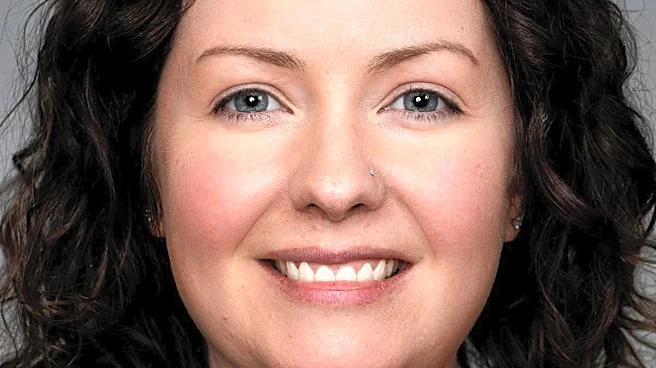

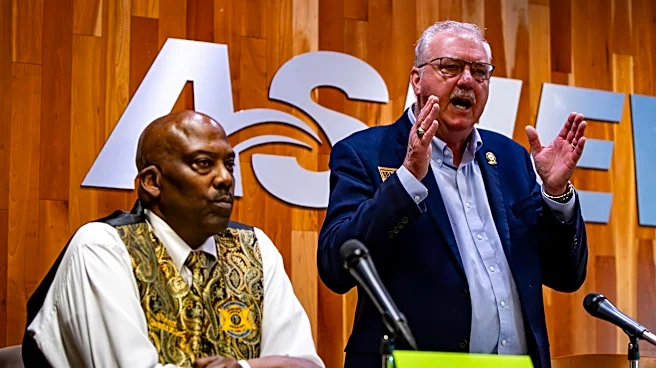

ASHEVILLE - Democratic state House Rep. Lindsey Prather and Republican challenger Anthony Penland agree Western North Carolina families are being squeezed by rising costs and that Tropical Storm Helene recovery remains unfinished.
Where they differ is over how much Raleigh should dictate to local governments, how North Carolina should spend education dollars and what state government can do to lower costs.
Prather, a former Buncombe County teacher seeking a third term in House District 115, has spent much of her legislative tenure pushing measures on wages, child care, housing, utility costs and public education. Penland, the longtime Swannanoa fire chief and former Buncombe County commissioner, is putting his public safety career and first-hand
experience during Helene out in front of his campaign.
Prather narrowly won re-election in 2024, defeating Republican Ruth Smith 51.46% to 48.54%, according to State Board of Elections results. The district's 2016-2022 performance overall was 45.1% for Democrats and 52.5% Republican, according to nonpartisan political mapping website davesredistricting.org.

Property tax amendment splits candidates
One of the clearest differences between the candidates comes on a constitutional amendment appearing on the Nov. 3 ballot.
The amendment would require the General Assembly to enact laws limiting increases in property tax levies by local governments, although it does not establish the limits itself and allows lawmakers to create exceptions. Penland said he will vote for it. He pointed to homeowners on fixed incomes whose homes have appreciated dramatically even after their mortgages were paid off, potentially leaving them with property tax bills they struggle to afford.
"I had to talk to a guy who lived in the Fairview community, who basically says he leases his house from the county," Penland told the Citizen Times Sept. 25.
Prather said she will vote against the amendment, arguing lawmakers already possess the power to address property taxes and that the proposal would further shift authority from local governments to Raleigh.
“I mean, we went over a year beyond the deadline of when we were supposed to pass a state budget,” she said. “And now legislators want to tell local governments how to do their budget? Yeah, no. It’s absolutely absurd.”
If voters approve the amendment, Prather said she would work to ensure whatever limits lawmakers ultimately create leave local governments enough flexibility to meet their obligations.
Both candidates said affordability extends far beyond property taxes.
Penland suggested lawmakers examine eliminating or reducing taxes on groceries and gasoline. Prather pointed to legislation she has supported involving utility costs, state earned-income and child tax credits, child care subsidies, housing programs and wages. She said she would refile proposals in 2027, including legislation establishing a $15 state minimum wage, with an $11 minimum for employers with less than $400,000 in annual receipts.
She also said North Carolina should update income limits for existing property tax relief programs and make greater use of the North Carolina Housing Finance Agency.

Affordable housing remains a statewide challenge
The candidates also approached Western North Carolina's long-running housing shortage differently.
Prather said she believes private developers often cannot make affordable housing financially viable, particularly in Western North Carolina, where developable land is limited and expensive.
She said the state could provide more matching grants, infrastructure funding and incentives for public-private partnerships while working with local governments on denser development where water, sewer, transportation and other infrastructure already exist.
"Affordable housing isn't affordable housing if it's way out in the boonies and there's no bus line and you have to drive 30 minutes to get to a job and there's no grocery stores near you," Prather told the Citizen Times Sept. 23.
Prather said she generally supports existing building regulations but is willing to consider targeted changes, including proposals allowing some smaller multifamily buildings to use a single staircase under additional safety requirements.
Penland thinks lawmakers should work with builders and local governments to reduce barriers to construction while ensuring "affordable housing" means more than simply moving someone from a house into a smaller apartment. He said rising property taxes can worsen the housing problem by forcing people out of homes they already own.
Helene compounded the shortage, Penland said, by destroying homes while leaving some owners paying mortgages on houses that no longer exist.
Helene recovery remains unfinished
For Penland, Helene is also personal. He has spent 36 years with the Swannanoa Fire Department, beginning as a volunteer in 1990 before becoming a full-time firefighter in 1995 and chief in 2001.
Swannanoa was among the communities devastated by the September 2024 storm, and Penland said rebuilding homes and businesses would remain a priority if he goes to Raleigh.
"I am not going to forget what happened on that September day in 2024," Penland said. "I was a part of the response side of that, and I want to make sure that I champion the recovery side of that."
Penland said he still passes campers sitting where homes once stood and wants state officials to identify what is preventing those residents from rebuilding.
Prather said lawmakers should have directed more recovery funding toward measures providing more direct relief to families and employers.
“We had advocated for more of that money to go to things like rental assistance and grants for small businesses, which certainly would have helped,” she said.
School vouchers divide candidates
The candidates also diverged on Opportunity Scholarships, North Carolina's program providing state money toward private school tuition. Awards for the 2026-27 school year range from $3,574 to $7,942, depending on household income.
Penland supports school choice but said there should be an income limit for scholarship recipients.
He also said policymakers should examine why families leave public schools rather than treating vouchers as a stand-alone issue.
Prather argued that hundreds of millions of dollars directed toward private schools should instead be invested in public education, saying inadequate state support forces counties to rely more heavily on local property taxes.
Candidates pledge transparency, weigh Flock cameras and data centers
The candidates were closer on legislative transparency; a 2023 state budget provision made individual legislators custodians of their own records and effectively gave them discretion over whether to release many legislative communications.
Prather said she voted against the change and has filed legislation to restore public access requirements.
"Anything that I do in the name of the public and the office of District 115, folks should have access to," she said.
Penland also committed to releasing his emails, calendar and communications with lobbyists and donors, if elected.
"If you're always doing the right thing, what do you got to hide?" he said.
Both also acknowledged the public safety value of automated license plate readers while expressing concern about misuse. Penland cited a case in which a Flock camera helped authorities identify a vehicle connected to a bank robbery. Officers who misuse the system for unauthorized purposes, he said, should face discipline and potentially termination.
Prather said decisions about locally operated systems generally belong with local governments, where residents have greater access to decision makers, but said unanswered questions remain about safeguards, audits and requirements for officers to document why they search the system.

Data centers produced another area of partial agreement. Both candidates said residents should not subsidize the enormous electricity or water demands of the facilities.
Prather said she personally would welcome a moratorium but does not believe Raleigh should necessarily impose one statewide. Her legislation would instead establish a statewide framework while preserving local decision-making, requiring cost-based electric rates, full payment for utilities and on-site clean generation capacity equal to at least 25% of projected peak electricity demand while prohibiting local tax incentives or subsidies for data centers.
Penland stopped short of supporting a statewide moratorium, saying state and local officials should work together to determine whether a proposed project fits its community.
"I don't want to see a data center in my neighborhood," Penland said. "Absolutely not."
National politics hang over House 115 race
The candidates offered different perspectives on whether dissatisfaction with national politics will affect a state legislative race like theirs.
Penland acknowledged national political conditions could influence voters but said his campaign is focused on state issues and his record of public service.
"I want folks to know that I'm running for the state of North Carolina, to fight for the state of North Carolina," Penland said.

Prather said she has heard dissatisfaction with Republicans and President Donald Trump while campaigning door to door, but noted that many voters who might be moving away from Republicans nationally already supported her in 2024.
She said the larger effect could appear in other legislative districts Democrats are trying to capture.
For voters in District 115, however, the contest presents a choice between two candidates whose résumés are rooted in Buncombe County but whose approaches to Raleigh differ substantially.
Cory Vaillancourt is the Helene Recovery/Investigations Reporter for the Asheville Citizen Times. Find him on X at @The_CoryV or on Signal, via email at cvaillancourt@citizentimes.com or at 912-508-5640.
This article originally appeared on Asheville Citizen Times: NC House 115 candidates split on taxes, school vouchers