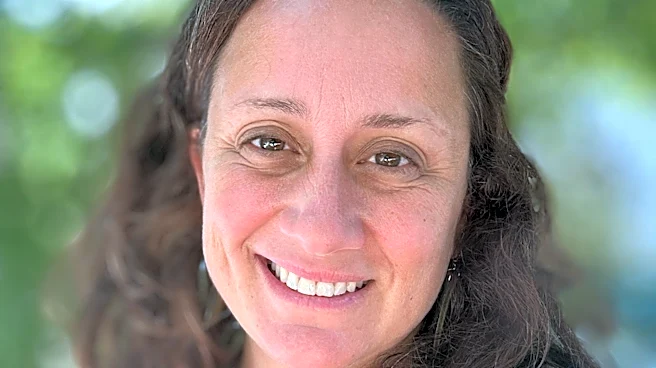






ASHEVILLE - When Hannah Furgiuele heard that a bear thatinjured a womaninside her home was going to be euthanized by the NC Wildlife Resources Commission, she felt she needed to take action.
"She's a bear that's been in my yard all season, and we haven't had any issues. I understand that things escalated with a neighbor, and a lot of misinformation was going around about that. It hit a point for me where I felt like I needed to do something, Furgiuele said.

Furgiuele, who lives in North Asheville, named the bear Dolly, after Dolly Parton, and launched a campaign to "pardon Dolly." She wants to see the bear go to a sanctuary.
"Humans are the ones that are having bad behavior here, not the bear. Bears are just doing what bears do," she said.
Blair
Meeks, a content creator based in Asheville, agreed. Meeks has been supporting Furgiuele in her campaign to save Dolly.
"I would love to see her relocated to a captive sanctuary, because I think the NC Wildlife (Resources) Commission, they will not relocate an adult habituated bear to a wilderness area," Meeks said. "We'd really like her to be relocated and to become a story and catalyst for change in our community, just to get people talking about it and learning the things they can do to help protect bears."

The Wildlife Resources Commission announced in August that on Aug. 18, a Buncombe County resident encountered a female black bear inside her house and was injured as the bear tried to exit the home. The woman was treated at a local hospital and released.
The commission said that the bear no longer feared humans. A spokesperson for the commission said Sept. 15 that the commission was still looking for the bear. When they find it, they intend to euthanize it. Since the incident on Aug. 18, the bear has tried to break into four other homes, according to the Wildlife Resources Commission.
Additionally, Ashley Hobbs, Special Projects Biologist for the Wildlife Resources Commission, told the Buncombe County Board of Commissioners Sept. 15 that 38% of statewide calls about bears come from Buncombe County each year, which ends up being between 800 and 1,000 calls a year from a single county. The second highest number of calls comes from Henderson County, where people make between 100 and 150 calls a year, Hobbs said.
Since 2017, 11 people in Buncombe County have been injured by a bear, out of 18 statewide. Hobbs told the Citizen Times Sept. 16 that it is becoming more common for bears to literally break into homes in Buncombe County, at times breaking out the glass in garage doors to get in.
Bears are also breaking into cars, Hobbs said, "to the point where I tell people, 'check your insurance and make sure you have coverage.'"
"It is becoming more dangerous for people, and then the bear aspect, when we have bears repeatedly forcing entry into homes, that puts them at risk of having to be put down," she said.
Hobbs has worked for the Wildlife Resources Commission's BearWise program since 2019, and she was assigned to Buncombe County in 2023. Buncombe County is the only county in the state that has a dedicated biologist from the Wildlife Resources Commission. Hobbs was assigned to Buncombe County because of the high number of human-bear interactions that occur each year, and her work days include community outreach and education. When a person is caught intentionally feeding a bear, Hobbs knocks on their door to ask them to stop.
"It's kind of a mix, but it's all very, very busy," Hobbs said.
Since 2017, over 30 bears have been euthanized for human safety, Hobbs said. Hobbs also said that relocating bears doesn't work. She cited a study from the University of Tennessee, which stated that only 20% of bears that are relocated survive relocation. She also said that putting a wild bear into a sanctuary is very stressful for the animal, and that relocation often does not lead to the outcome the public thinks they're getting.
"I cannot relocate these bears somewhere else. That's not an effective option. I cannot take them into captivity. That's not humane for the animal," Hobbs told the Board of Commissioners. "I only have the choice to put that bear down when they reach a point in their behavior that is an impact on human safety. That's a people-caused problem, but the bears end up with the consequences."
"We've reached a point now where people and bears are in danger in Buncombe County. If things continue as they are, this is the trend that we will continue to see," Hobbs added.
The city of Asheville has more than 2,500 bear-resistant trash cans, and 469 residents remain on the waitlist, city spokesperson Kim Miller said.
New bear carts are not currently being funded under the FY27 budget, but funding from the FY26 budget was reallocated to allow for the purchase of two loads of bear carts, with just over 200 per delivery, Miller said. The first of those two loads is expected to be delivered in October.
"As we near the end of next year’s budget cycle, around March 2027, we will evaluate whether funding is available to possibly purchase more carts for those remaining on or added to the waitlist," Miller said.
In Buncombe County, there are 2,800 bear carts deployed, an increase year over year by 800 carts, Dane Pederson, the county's Solid Waste director, told the Board of Commissioners in the Sept. 15 briefing. The average turnaround once a cart is ordered is two weeks, Pederson said.
Hannah Furgiuele said that her campaign to save Dolly led her to research other bears around the country who were successfully pardoned.
"There's been a number of cases where a governor has stepped in," she said, which inspired her to put public pressure on the office of Governor Josh Stein.
"I'm hopeful that having kind of an outlet for people to put pressure on policy makers, it might lead to some infrastructural change," she said. "Clearly we need infrastructure that supports people in being better able to coexist with bears."
Kara Fohner is the Public Safety Reporter for the Asheville Citizen Times. Email her at kfohner@usatodayco.com or call her at 980-241-8671.
This article originally appeared on Asheville Citizen Times: Resident fights to save 'Dolly' the bear from death