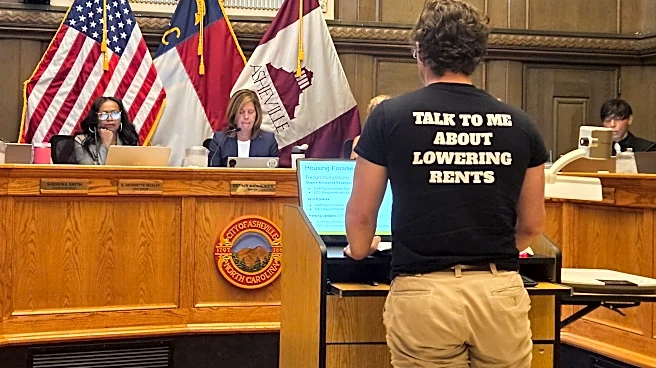









Three changes to Asheville’s development laws, passed unanimously by Asheville City Council on Aug. 25, aim to help the city’s housing become denser and more flexible.
As presented to Council by Chris Collins, the city’s interim director of planning and urban design, the shifts to Asheville’s Unified Development Ordinance align with existing city plans for affordable and “missing middle” housing.
Collins said the policies would “encourage responsible growth by promoting small-scale residential development.” Taken together, the new rules allow duplexes to be built in most Asheville neighborhoods, increase the maximum size of “accessory dwelling units” like backyard cottages, and eliminate parking minimums.
All of the 17 public commenters who spoke
at a public hearing on the matter were in support. Representatives from environmental nonprofits such as MountainTrue and the Sierra Club, as well as pro-density groups like Asheville for All and Strong Towns, joined forces to push for the changes.

“Density is how people with less money outcompete people with more money for the same land,” said Asheville for All organizer Spencer Karges. Failing to update zoning laws, he argued, would signal “that this town is only for the rich, that the price of admission or the price to stay is a $500,000 single-family home.”
Allowing duplexes by right
Prior to Council’s vote, Collins said, duplexes could legally be built on less than half of properties in Asheville city limits. The change opens up that right to 99 percent of city properties, including residential neighborhoods and mixed-use River Arts District zones.
The new development ordinance would also allow residential lots with duplexes to be split, creating more opportunities for homeownership. During the public hearing, resident Eva Snyder said that her family, who currently rent their home, would gladly accept a smaller living space for proximity to downtown.
“We would also love to eventually own our first home,” Snyder said. “I see the potential two-unit, townhome typology as a smaller and less land-intensive housing product that we might one day be able to afford.”
However, as Mayor Esther Manheimer noted during an Aug. 20 agenda briefing, many Asheville subdivisions have neighborhood covenants that supersede the city’s zoning laws. Those private agreements in places, like Oak Forest in South Asheville and Lakeshore in North Asheville, often restrict landowners from building more than one unit per lot.
“While this looks like a sweeping change in terms of allowing duplexes throughout the city, in reality, there will be a lot of places where this won’t apply,” the mayor explained.
Embiggening ADUs
Asheville property owners can now build larger accessory dwelling units than they could before. The zoning amendment boosts the maximum size of these ADUs from 800 to 1,000 square feet, as long they remain smaller than the primary residence on the same lot.
The city had wanted to raise that cap even further, to 1,200 square feet, but was prevented from doing so by state law. Senate Bill 445, ratified in mid-August, says local governments must set their ADU maximum between 800 and 1,000 square feet.
During the Aug. 20 briefing, Collins said staff were “really surprised” by the legislature’s move. Manheimer suggested that lawmakers had capped the size at the behest of “more moderate to conservative towns” that regarded larger ADUs as a progressive zoning change.
“I see them as such a great solution for aging in place,” added Council member Sage Turner. “So perhaps when some of these folks working on these restrictions age in place, they’ll wish they’d had that extra 200 square feet.”

Council also considered tweaking the ordinance to allow ADUs to be built higher if they are located farther from property lines. But Vice Mayor Antanette Mosley said many residents of the city’s legacy neighborhoods were opposed to the “slim-tall” building profiles such a provision might encourage, as previously reported by Asheville Watchdog. Members ultimately decided to enact a 25-foot height restriction on ADUs.
Ending parking minimums
Although Asheville had been exploring its own end to parking requirements earlier this year, the language passed by Council was required by North Carolina’s legislature. House Bill 162, which became law in July, prohibits most local governments from requiring off-street parking for new development.

Collins suggested that the move wouldn’t immediately have major impacts on the city. He noted that Asheville already doesn’t require parking in certain parts of downtown and that a zoning change last year slashed parking minimums along “transit-supportive corridors.”
In both cases, however, developers chose to include a good deal of parking voluntarily. Projects along the transit corridors, for example, had a total of 228 parking spaces — 181 more than required by city code.
Daniel Walton is the City Government Watchdog Reporter for the Asheville Citizen Times. Email him at dwalton@gannett.com.
This article originally appeared on Asheville Citizen Times: Duplexes, bigger backyard homes now allowed under Asheville zoning changes