





Diane Lang calls herself a “nature gossip.”
“I’m not a biologist. I’m not a scientist. But when I learn something fun about nature, I just have to tell people,” she said.
Children’s books are her preferred medium, and her newest title, So Many Salamanders!, is dedicated to spreading the news about the Smokies’ incredible diversity of salamander species. Illustrated by Katy Tanis, the book is published by Smokies Life with editing from Frances Figart and design from Karen Key. It introduces each of the 31—or possibly 32, if you count the long-unseen green salamander—species found in Great Smoky Mountains National Park.

“Reading through the book, kids will get not only a sense of all the different species we have and where they might live, but then
seeing all the illustrations of them side by side they will get a sense of diversity—why does this one look different than that one, and how that might relate to their habitat and ecology,” said Jon Cox, the park’s wetland biology technician. “It’s not just a diversity of species, but a diversity of appearances and niches and lifestyles, which is pretty cool.”

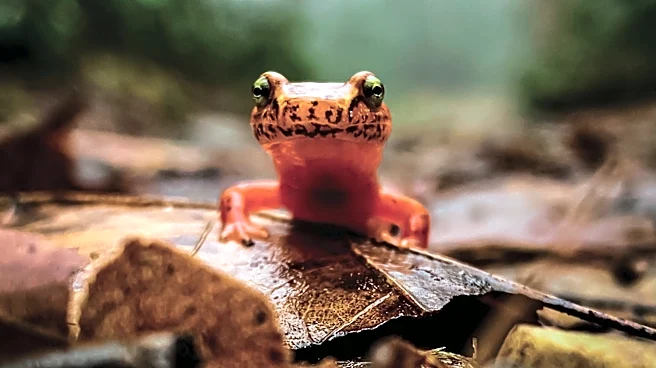
From the plume-like, maroon gills of the aquatic mudpuppy to the spotted reddish-orange skin of the rare cave salamander to look-alikes Smoky Mountain black-bellied salamander and Pisgah black-bellied salamander—only distinguished as two different species in 2022, and only with the help of DNA analysis—the park’s salamanders offer plenty of fodder for fascination. This incredible diversity is possible due to the wide range of elevations and ecosystems found in the Smokies.
As Lang writes:
“This Salamander ‘heaven’
Is a Smokies claim to fame,
More salamanders living here
Than any place you’d name.
All of these amphibians,
These salamander kin,
Love the Smoky Mountains.

It’s where they all fit in.”
Lang’s love of children’s books comes from childhood, and her love of nature comes from the 25 years she’s spent as a nature center volunteer in her home state of California. At first her writing focused on wildlife species native to her local area, but after completing her fourth book, she had an idea: “I’m going to write a collection about lots of different national parks.”

She began researching the parks, searching for something unique or special about each one to anchor her writing. Looking into the Smokies, Lang discovered that it had an unusual title: Salamander Capital of the World.
“Then when I saw some of the really fun names that salamanders have,” she said, “I thought, ‘Okay, that's my poem.’”

The national park project started as a casual effort Lang pursued for her own amusement. But when a publisher expressed interest in her story about Acadia National Park in Maine—now published under the title Wicked Wild Poems of the Pine Tree State—she began looking around for other organizations with an interest in park-focused children’s books. That search led her to Smokies Life and resulted in the publication of Lang’s sixth book.

“I instantly felt this piece had potential because of Diane’s expert use of meter and her skill at ‘breaking the rules’ just a little to provide humor,” said Creative Services Director Frances Figart. “I was impressed with how cute and descriptive the lines are, and how they educate as well as entertain.”Lang’s manuscript had all the ingredients of a read-aloud-worthy kids’ book. But first, it needed an illustrator. In particular, an illustrator who could create colorful and imaginative artwork that also accurately depicted the diverse species mentioned in Lang’s rhymes. Searching for the right fit, Figart came across an engaging illustration of anatomically correct yet charismatically rendered frogs in a wetland. Katy Tanis was the artist behind it, and Figart decided she would be a great fit. Tanis agreed.“I always thought it was fascinating that the US has the highest biodiversity of salamanders,” Tanis said. “I’d always wanted to do something with them but never really got around to it. So it was kind of a perfect opportunity.”

Tanis is an author and illustrator with a passion for ecology whose work includes books, puzzles, games, fabrics, art shows, and science workshops. She began her career in fashion, working for a company whose designs were inspired by various cultures around the world. The job required research and storytelling, and Tanis soon realized she enjoyed that aspect just as much as designing clothes. She decided to try her hand at children’s books. Since then, she’s completed an array of award-winning projects, including illustrations for the 2020 book Animal Olympics, which was added to the Bank Street College of Education 2021 Best Children’s Books of the Year list, and earned a master’s degree in conservation biology.
Tanis’ talent for research came in handy while working on Salamanders. She wanted to make her illustrations as accurate as possible, but it was a difficult task. Many of the park’s salamander species are rarely photographed, can be distinguished only through subtle characteristics, or vary greatly in individual appearance. For reference photos, she relied heavily on iNaturalist, an app that allows users to upload photos of their outdoor observations and experts to verify their identifications.

“I had an obscene amount of reference photos for every salamander to try and really understand the difference between all the different ones,” she said. “There was probably as much research and prep for sketching and drawing as there was actual drawing.”
The book pictures each of the 32 salamanders previously recorded in the park multiple times. More than 200 illustrated salamanders appear in its 40 pages, showing how their appearance can vary depending on sex, life stage, or genetics. An array inside the front cover shows each salamander as a newly hatched baby, and a similar one inside the back cover—which is also available as a poster—depicts them as adults.
To create the illustrations, Tanis first made sketches of each scene. Then she printed the sketches as a very light outline, which she used to guide her as she painted them with watercolor. Finally, she scanned the paintings into her computer and digitally added highlights and shadows to complete the pieces.

The enormous hellbender presented one of her biggest challenges. The largest salamander in North America, the hellbender is both rare and fully aquatic. Most photos are taken underwater and show only part of its body.
“It took me a while to even understand how their anatomy works,” Tanis said.
She’s happy with the result, and so is the rest of the team.
“With Katy’s drawings, people are going to grab it off the shelves,” Lang said.

Young readers will also enjoy the salamander photographs at the end of the book, which accompany educational material that covers everything from how salamander skin works (they breathe through it, so it needs to stay wet and clean) to their diet (spiders, slugs, worms, and insects are all favorite salamander snacks) to their astonishing ability to regrow injured body parts.
“There are so many kids books about the life cycle of frogs, and I feel like salamanders are more interesting,” said Tanis. “There’s more variety in how they go from young to old. So I think that it will be fun to try and get kids more interested in salamanders.”
So Many Salamanders retails for $9.95 and is available at official park stores in Great Smoky Mountains National Park and online at SmokiesLife.org/product/so-many-salmanders/. Sales of this and other items sold by Smokies Life help support the scientific, historical, and interpretive activities of Great Smoky Mountains National Park.
Holly Kays is the lead writer for the 29,000-member Smokies Life, a nonprofit dedicated to supporting the scientific, historical, and interpretive activities of Great Smoky Mountains National Park by providing educational products and services such as this column. Learn more at SmokiesLife.org, or reach the author at hollyk@smokieslife.org.
This article originally appeared on Asheville Citizen Times: Word from the Smokies: New children’s book celebrates salamanders with rhyme and color