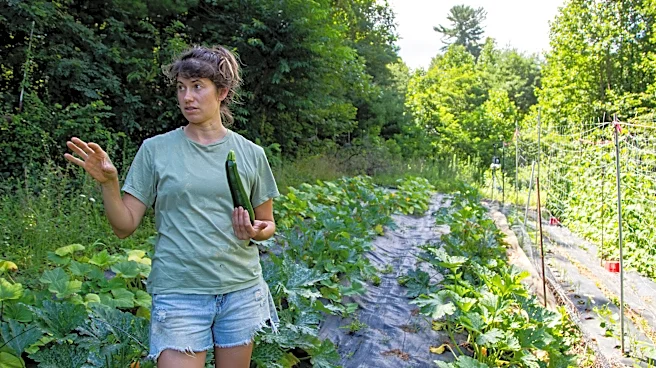






LEICESTER - Liz Elmore, farm manager of her family's Thatchmore Farm in Leicester, tried something new this summer: adding two rows of various beans to the crop at the 5-acre farm, which sits on an 11-acre property.
Thatchmore Farm, like many others in Leicester and the greater Western North Carolina, is a small, diverse farm that grows a wide selection of seasonal produce, including squash, tomatoes and cucumbers, instead of relying on a single crop for income.
Experimenting with growing different produce varieties ― called trialing ― can create more revenue-generating offerings for farmers market customers and create a financial safety net for the farm if some crops have a bad growing season.
“The more diverse a group of seeds is, the more resilient
farmers we can be,” Elmore said.

The diversified farming model can also give farmers more flexibility in what they can sell at their farms, farmers markets, farm stands, or through Community Supported Agriculture (CSA) subscription boxes if an unpredictable event, like flooding or extreme heat, damages portions of the crops.
If one crop doesn’t perform well or fails to grow, farms can pivot to other crops to supplement sales.
Elmore said that buying costly crop insurance wouldn't make sense, as the program is designed primarily to help larger commercial farms that grow large quantities of a single crop, a sentiment shared by others in the local agricultural community.
“We have smaller diversified farming here, and that’s different from the model that a lot of the programs are set up to focus on," said Buncombe County Commissioner Terri Wells. "On the state level, they tend to think of commodity farming ― larger farms focused on a single commodity."
Crop diversity offers safeguard for Leicester farmers
Wells oversees more rural communities in the county, including Leicester and Sandy Mush, where she resides on her family's farmland as a ninth-generation resident. She said advocacy at the state and federal levels is needed to ensure programs support local, diversified farms with direct sales.
The need for affordable insurance plans tailored to diversified farms became more evident during major weather events and other situations beyond farmers' control, such as Tropical Storm Helene, which can cause significant crop damage and destruction, leaving farms in debt and struggling to recover.
"It really did, early on, seem to shortchange our farms here because they were not getting the funding that they needed to help with recovery," Wells said.
After Gaining Ground Farm incurred an estimated $80,000 in crop losses when Tropical Depression Fred flooded its fields in 2021. Anne Grier, co-owner, said the Farm Service Agency provided disaster assistance funding to help them recover. Flood insurance wasn't an option for independent farmers, as costly programs are designed for commercial farms with larger monocrop plots.
“If you do get damage, it’s assessed at commercial value, not at organic, tiny farm selling direct prices. You would get $3 or $4 a pound for your garlic instead of $10,” Grier said.
Jason Roehrig is Farm Resilience Manager for ASAP Connections (the Appalachian Sustainable Agriculture Project), a regional organization that helps farms, farmers markets and consumers connect. Roehrig's role includes providing farmers with financial analysis to stabilize and grow their operations.
“Farmers have to do that same calculation ― what is the likelihood of me losing this percentage of my crop, and is the premium that I have to pay in order to protect myself from that loss worth it? So far, the farmers haven’t been calculating that the premium is worth it for those insurance products,” he said.
Roehrig said risk management lies in diversity, as it reduces the chance of losing entire productions. He said it's also an essential marketing tool, as farms have more to offer.
Grier and other local farmers aren't waiting for the system to change to protect their livelihood and the local food system.
"Diversity is our crop insurance," Grier said. "If one thing fails, something else is going to succeed, and we'll be alright."
A taste of Leicester farms
Leicester farmers determine what and how much they can grow, considering factors like acreage, the region's terrain, which can be hilly and forested, and climate, which can be just as unpredictable. Adapting and testing out what works for their unique situations and landscapes is part of their daily operations.
The Wild Embers Farm owners Ashley Goritz and Sean O’Neil said that they learned as they went and enjoyed the experimental, learning aspects of the process.
“We love growing food and working with nature and being able to sustain ourselves instead of relying on the grocery store industry,” Goritz said.
Since 2020, they've grown the 8-acre farm into a business that provides seasonal produce, including tomatoes, potatoes, peppers, and zucchini, and raises livestock, with more than 100 chickens roosting outside their Leicester farmhouse.
In the summer, Wild Embers Farm's pepper rows included a spicy purple pepper called Murasaki, a sweet Jimmy Nardello, a mild Pepperoncini, with much more hanging from the vines, like Siberian tomatoes. O'Neil said the selection benefits consumers by offering more options with higher quality and freshness than chain grocery stores.
"You may find those little unique items, but no one's really growing those heirloom varieties, so to really experience and get a different flavor, for us, that’s what it’s about. We want food to taste different in a good way," O'Neil said.
“You can go into any grocery store, and more or less they all have the same things," he said.
Leicester farmers are working to change consumers' perspective by cultivating unique varieties of familiar and lesser-known produce and offering a richer flavor.
The Utopian Seed Project, an agricultural nonprofit with farms in Leicester, helps farmers experiment with growing different varieties, testing their taste, how they grow, and their likelihood of becoming revenue-generating products for consumers, including those who buy directly from them at local farmers markets.
"We want food to taste good, and it should be good for you," said Terri Terrell, chef and culinary director at The Utopian Seed Project.
The organization is also part of the Leicester Food Coalition, a hyperlocal farming collective that includes independent operations in the Leicester, Sandy Mush, Alexander and Newfound rural communities.
Grocery stores often carry produce from large, monoculture farms outside the area, which, Terrell said, can be less flavorful and nutritious than produce from smaller, local, independent farms.
The Utopian Seed Project's seed trialing works with farmers, providing seeds, education and guidance on growing different types of produce and versions of the same item. Farmers provide feedback on what they’re likely to grow and see more of, as well as on progress and adaptability.
“When you’re able to have crops of different varieties, we’re also doing these trials for flavor," she said. "In our food system, things that are being delivered off these trucks to the restaurants ― no flavor exists."
The Utopian Seed Project's farms and greenhouses include okra, dry beans, greens, tomatoes, peppers, and more. The seed program encourages farmers to buy and save seeds and experiment with growing regional adaptations of the species. Home growers can also purchase seeds through Appalachian Seed Growers Seed Collective.
“We’re helping farmers feel a little more excited about being able to engage with the whole life cycle of the plant,” said Leeza Chen, co-farm manager.
The Utopian Seed Project's Trial to Table events
The Utopian Seed Project's Trial to Table is an educational and interactive tasting event series hosted throughout the year. Local chefs, cooks, and culinary creators prepare small bites for guests using farm trials and other local ingredients.
Attendees also have the chance to sample several varieties of featured produce and share feedback on what they like and would buy at a market.
Terrell said there's a story to tell about the ingredients before they get to the plate, and the project helps farmers be a part of the process earlier, by preserving, storing and growing seeds locally, instead of buying them from national conglomerate seed companies.
The chefs also share recipes so guests can recreate the dishes at home.
The next event is from 1-4 p.m. Nov. 7 at The Mule. Tickets cost $30-90.
"It’s super important that we have seed and food sovereignty and not being told what to do, but having choices ― not being reliant on our outside food system," Terrell said.
Tiana Kennell is the food and dining reporter for the Asheville Citizen Times, part of the USA TODAY Co., covering the food and beverage industry, including the James Beard Awards, Michelin Awards, restaurant openings, closings and other hospitality industry news and events. Tips, comments, questions? Email tkennell@citizentimes.com or follow @PrincessOfPage on Instagram. Sign up for AVL Bites and Brews, our weekly food and drink newsletter here.
This article originally appeared on Asheville Citizen Times: Leicester farms unearth flavor in food beyond the usual