







Fall has arrived in Western North Carolina, but peak dates for fall color throughout the region could still be weeks away.
Howard Neufeld, an Appalachian State University plant ecophysiology professor, explained that there are two main factors that cause leaves to change color: lower temperatures trigger trees to begin preparing for the winter, and shorter day lengths signal that cold will be coming soon, according to previous reports from the Citizen Times on fall color forecasting.
"It's best to say that trees look at both of those things, day length and temperature, with some emphasizing one more than the other," Neufeld told the Citizen Times in 2025.
Neufeld, who is known on social media as the "Fall Color Guy," also operates a website devoted
to Western N.C.'s fall colors. Here's what to know about this year's forecast based on weather, Neufeld's resources and more.
When do the leaves normally change colors in Asheville, NC?
The timing of peak "leaf season" varies based on a number of environmental factors.
Temperature and precipitation are two main ones - and due to the wide variations in elevation across the Western N.C. region, there tends to be an equally wide range of dates for peak color in the region every fall. This variety is one of the reasons why the North Carolina mountains are so popular among "leaf peepers," Neufeld stated.
"What I tell people is if you miss the colors at one elevation, just come next week and go a little lower down, and you'll see the colors," Neufeld told the Citizen Times. "North Carolina has the distinction of having the longest fall color season in the country, because it can start in late September at the highest peaks, and it'll go all the way to Thanksgiving down at the coast."
The Fall Color Guy website also offers an interactive map with colors that indicate estimates for peak fall color dates.
Will 2026 be a good year for fall color?
For much of Asheville, the map places 2026 peak fall color dates between Nov. 14-20, with times placed earlier as elevations rise. Some nearby areas could see peak dates closer to Oct. 31-Nov. 6, while highest nearby elevations in areas like the highest peaks of Mount Mitchell might see peak color dates as early as Oct. 3-9.
Why do the leaves change colors in the fall?
In biological terms, the Old Farmer's Almanac explains that chlorophyll, a chemical found in leaves, is responsible for absorbing sunlight. It also gives leaves their green color. When a combination of reduced light, lack of nutrients and less water triggers trees to start breaking down the chlorophyll, the green color fades.
The almanac adds that when the green chlorophyll has broken down, other chemicals present in leaves "reveal their bright faces;" Carotenoids cause yellow and orange colors, anthocyanins cause deep red and purplish colors and the presence of tannins creates brown and tan.
Which trees have the brightest fall colors?
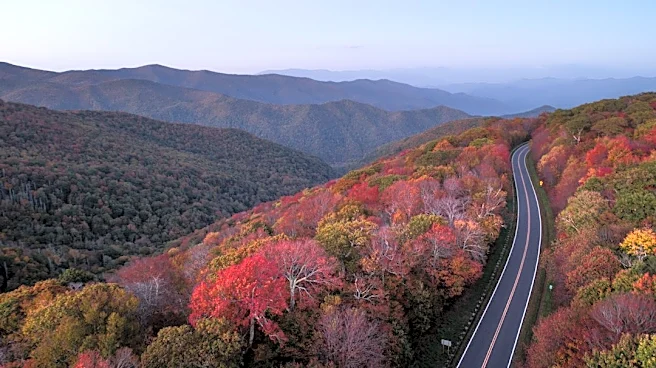
A wide range of fall colors can be spotted in Western N.C.
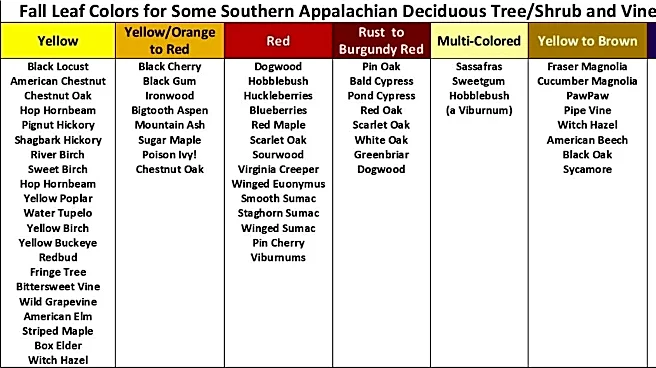
The table below, also Neufeld's creation, identifies some of the species most commonly associated with certain shades of fall foliage. The Fall Color Guy website notes, however, that "some trees may have leaves that range from yellow to orange to red and even deep purple, so we must be wary of characterizing the color of tree species too narrowly."

Iris Seaton is the trending news reporter for the Asheville Citizen Times, part of the USA TODAY Network. Reach her at iseaton@citizentimes.com.
This article originally appeared on Asheville Citizen Times: 'Leaf peeping' season is coming to Western NC. Track leaf changes here