



No matter who wins the midterm elections, the Buncombe County Board of Commissioners will get two fresh faces after November.
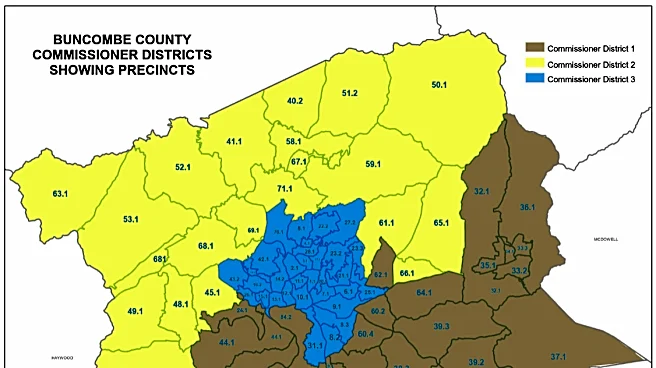
Due to political lines that shifted in 2023 — along with the decisions of incumbent Democrats Drew Ball and Martin Moore to seek other positions — voters in Districts 1 and 2 will both choose between candidates who have never before held elected office. (Democratic District 1 incumbent Al Whitesides is running unopposed in District 3, which covers most of the city of Asheville.)
In District 1, which stretches over most of Buncombe’s south and east, Democrat Anna Stearns faces Republican Rob Stetson. In District 2, covering the county’s north and west, Democrat Lonnie Israel squares off against Republican Greg Parks.
The
Citizen Times reached out to all four candidates to learn more about how they’d approach the county’s budget, cost of living, and interactions with other levels of government.

District 1
While Stearns has never been elected, the Black Mountain attorney has spent much of her life engaging with public policy. From her early years compiling meeting minutes for the town of Black Mountain, through a legislative assistantship with Democratic state Rep. Brian Turner and chief of staff position with Democratic N.C. Supreme Court Chief Justice Cheri Beasley, Stearns said she’s learned how different levels of government work and how they can best cooperate.

In contrast, Stetson is running from more of an outsider’s perspective. An insurance agent for the N.C. Farm Bureau, he said he’s previously applied to volunteer for Buncombe committees like the Board of Adjustment and Vance Monument Task Force but wasn’t accepted. He’s running to give back to a community he chose, having moved to the county from Austin, Texas, over two decades ago, and “change the way people view Republicans.”
Stetson did self-identify as a fiscal conservative, and he said his approach to managing the county’s budget would be similar to that of managing a household. Rather than raising property tax rates, he explained, he’d work to tighten spending and pause discretionary investments until the county’s economic growth could support them.
“You make adjustments to your budget to accomplish what your goals are. Maybe you eat out less,” Stetson said, by way of comparison. “We need to do a better job identifying areas where we can save and things that maybe we don’t tackle right now.”
While Stearns also said Buncombe could be more efficient — “I fundamentally believe we spend too much money on consultants,” she told the Citizen Times — she supports the tax increase needed to finance the $70 million in new bonds that voters could approve in November. She noted that the county’s previous bond package, passed in 2022, had leveraged seven times its value in other government and nonprofit support.
Stearns is particularly excited about the bonds’ potential to accelerate affordable housing through low-interest loans to developers. “It’s one of the places where county government can have a direct impact on the broader market, helping developers capital stack their funding sources,” she said. “We can get some of the more dense housing development projects off the ground and into construction.”

Her opponent, meanwhile, objects to subsidizing developers as government interference in the marketplace of supply and demand. Instead, Stetson said, Buncombe’s affordable housing policy should focus on direct rental assistance to lower-income residents who are employed but not earning a living wage.
District 2
Like Stearns, Israel is a Buncombe County native with strong ties to the region. Prior to his retirement, the Democrat spent nearly four decades operating Jesse Israel & Sons Nursery, while serving on boards for local organizations like the N.C. Arboretum and Upper Hominy Fire Department.
Israel highlighted his business background as an asset for helping him carefully steward taxpayer money. Commissioners, he added, “should promote transparency and accountability. They should focus on the essential services residents rely on every day, and encourage public input before making any major decisions.”

As a seventh-generation family farmer, continued Israel, he’s particularly interested in developing Buncombe County’s agriculture. By supporting the locally grown food supply and better markets for area farmers, he suggested, the county could help residents access higher-quality produce.
Growing the local farm economy would take partnerships with other government entities, Israel said, such as the Soil and Water Conservation District and the state Department of Agriculture and Consumer Services. He expressed needs for other intergovernmental collaboration as well, particularly with Buncombe’s municipalities, on matters like economic development and overcrowding at the county jail.
Parks, Israel’s Republican opponent, describes himself on his campaign website as “a proud Western North Carolina native, a devoted Christian, a husband and father, and a dedicated member of the Buncombe County community.” His stated priorities include “responsible growth, transparent government, and common-sense solutions to the challenges facing our county.”
Parks has previously sought office, having mounted unsuccessful campaigns for the Buncombe County Board of Education in 2022 and 2024. During his first campaign, as reported by Asheville Watchdog, Parks attracted controversy over his social media posts against “sexuality or gender ideology” in county schools.Asked how he would manage a county budget facing rising costs and limited revenue options, Parks said he opposes the proposed $70 million bond package and any spending that would require a higher property tax rate. Instead, he called for commissioners to cut spending and eliminate what he considers noncritical budget items.
“The residents of Buncombe County have already been hit with tax increases by the current Democrat-controlled board of commissioners,” Parks said. “This is not the time to ask them to take on further debt that will be paid with tax revenue.”
On affordability, Parks attributed rising prices largely to government intervention, spending and regulation. Rather than subsidies or price controls, he said the county should focus on increasing production and cutting “regulatory red tape” as a way to bring down the costs of necessities including food, housing and energy.

Parks also emphasized coordination when asked how he would work with federal, state and municipal governments on issues ranging from Tropical Storm Helene recovery to homelessness and transit. Aligning goals and maintaining open communication, he said, would help different levels of government remain focused on common objectives. Parks said he would also emphasize data-driven metrics, using shared and transparent measurements to track progress and accountability.
Daniel Walton is the City Government Watchdog Reporter for the Asheville Citizen Times. Email him at dwalton@gannett.com.
This article originally appeared on Asheville Citizen Times: Who's running for Buncombe County's Board of Commissioners in 2026?