






The Trump administration is moving forward with its plan to repeal a rule that protects 45 million acres of public lands from commercial logging and road construction.
The U.S. Department of Agriculture filed a proposal Aug. 18 to rescind the “roadless rule.” Enacted in 2001, the rule set aside over 60 million acres of forests and grasslands within national forests as “roadless areas,” the majority of the land in Western states, where it is some of the least-developed lands in the country.
The agency announced last August its intent to rescind the rule, calling it “an impediment to responsible forest management,” just two months after President Trump issued an emergency executive order urging public land management agencies to ramp up timber production.
“Active forest management is not an option. It’s essential,” said Forest Service Chief Tom Schultz, who operates under the USDA, in a statement on Aug. 18. “Acting now, thoughtfully and decisively, is the best way to restore the balance, reduce wildfire risk, and secure the long-term health of our forests and neighboring communities.”
But conservationists and some Arizona state officials say the move is a a veiled attempt at profiting off the country’s most pristine landscapes.
"We must not allow the federal government to strip Arizona's forests and wilderness of their protections,” said Arizona Attorney General Kris Mayes last September. “This is a public land grab by greedy corporate interests.”
Arizona has 1,174,000 acres of roadless areas, including parts of Prescott, Kaibab, Tonto, Coronado and Apache-Sitgreaves National Forests, according to the Environment Arizona Research and Policy Center.
'Roadless rule' helps protect habitat, conservationists say
The roadless rule was enacted under the Clinton administration after large-scale industrial logging destroyed habitat for wildlife and degraded watersheds to the detriment of downstream communities.
“Building roads into these last intact forests fragments them,” said Taylor McKinnon, the Southwest Director for the Center of Biological Diversity. It's kind of like a beautiful quilt, he said. The quilt as a whole is greater than if you were to cut it up into many smaller pieces. “The whole is greater than the sum of its parts.”
Roadless areas are an important refuge for imperiled wildlife like Mexican spotted owls and jaguars in Arizona, he said. “Building roads, opening them to various forms of development, would diminish that.”
The rule also helps protect the water resources that many Western states rely on, environmentalists say. Road construction can disturb natural hydrology, said Kate Groetzinger, the communications director for the Center for Western Priorities. In turn, it can increase sedimentation in streams and create poorer water quality.
“Our national forests are incredible water filters,” she said. The water that runs through forests ends up in reservoirs that supply drinking water to millions of people in cities like Phoenix.
Feds say rule will prevent wildfires
The Trump administration has pointed to the West’s increasing fire risk as evidence of forest mismanagement and suggested that logging could help prevent wildfires while boosting the economy. Over 28 million acres covered by the roadless rule are in areas of high or very high wildfire risk, according to the USDA.
“Our forests can’t afford another decade of inaction. Across the country, we’ve watched preventable conditions — overgrown stands, insect outbreaks and disease — turn healthy landscapes into tinderboxes,” said Agriculture Secretary Brooke Rollins. “For too long, outdated restrictions have kept tens of millions of forested acres off-limits to the very treatments that improve forest health and reduce wildfire risk to our communities.”
Conservationists and fire ecologists say the wildfire issue is more complicated than that.
Wildfires in the West have been growing larger and more severe over the last few decades. Climate change and a century of wildfire suppression have made forests drier and more crowded.
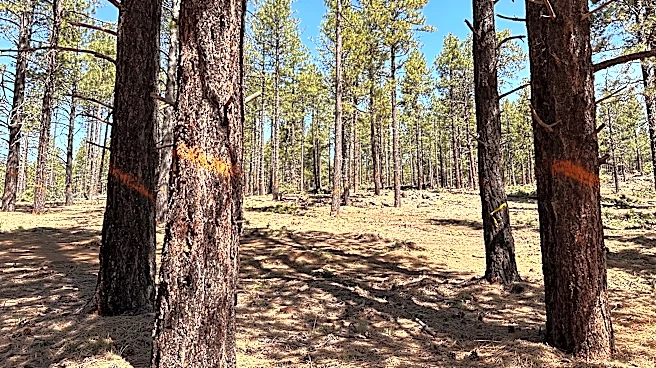
The roadless rule allows for fuels reduction and small tree thinning in places like Arizona’s ponderosa pine forests, McKinnon said.
The USDA’s claim that it has prevented efforts to reduce wildfire risk is undermined by the Forest Service’sown research, critics say.
“Its research demonstrates that treatments to reduce the risk of unnaturally intense fires actually occur more often in roadless areas than they do on other forested areas of the national forest system,” according to a statement from Trout Unlimited, a nonprofit conservation group.
Analysis by the group found that 85% of all wildfires are human-caused and 78% of human-caused fires in national forests start within half a mile of a road.
“More roads means more human-caused wildfires,” McKinnon said. Two of Arizona’s largest wildfires in the last decade — the Bush Fire and the Telegraph Fire — were both started by people. “ This isn't about managing fire or managing forests. It's about removing protections to open them up for industrial development.”
Rescinding the rule would remove protections for 45 million acres of land across the country, excluding Colorado and Idaho, which have their own laws protecting roadless areas.
Last year, U.S. Sen. Ruben Gallego, D-Ariz., co-sponsored a bill to enshrine the rule as federal law.
“For decades, the roadless rule has been protecting over 1 million acres of forest in Arizona — providing clean air and water, supporting areas of cultural and spiritual significance to many tribes, and bolstering our vital tourism economy,” said Gallego in a news release. “But unless we codify those protections into law, they will always be at risk.”
The USDA’s proposal will include a draft environmental impact statement to be released on Aug. 19. Public comments will be accepted until Sept. 21.
Sarah Henry covers environmental issues for The Arizona Republic and azcentral. Send tips or questions to sarah.henry@arizonarepublic.com.
Environmental coverage on azcentral.com and in The Arizona Republic is supported by a grant from the Nina Mason Pulliam Charitable Trust.
Follow The Republic environmental reporting team at environment.azcentral.com and @azcenvironment on Facebook and Instagram.
This article originally appeared on Arizona Republic: What Trump's plan to kill roadless rule means for Arizona's forests