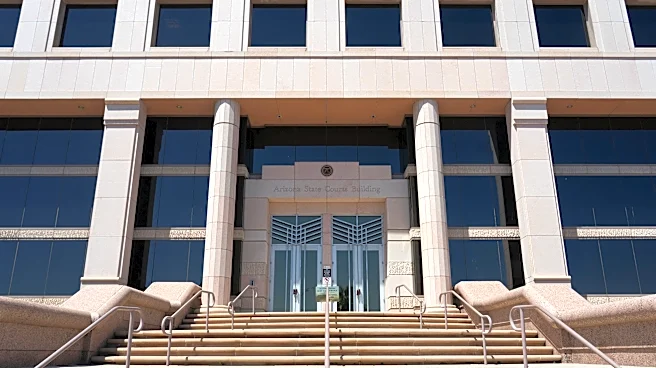






A Phoenix pastor who was secretly recorded by another pastor as he admitted to sexually abusing a girl can't block that recording from being used in his criminal case because it didn't amount to religious confession, the Arizona Supreme Court said.
The unanimous opinion issued Aug. 12 rejected Pastor Mario Rodriguez-Ramirez's argument that a recording of him should remain confidential because of Arizona's "clergy-penitent privilege." The privilege protects someone who confesses to clergy by allowing the confessor to refuse to disclose confidential information to law enforcement and the courts — and by preventing clergy from disclosing it, too.
The ruling clarifies what counts as a confession in a religious context when the person making the statement
wants to keep it from law enforcement.
The high court said Rodriguez-Ramirez couldn't use the clergy-penitent privilege because his conversation with the other pastor was largely about reputation management, not "absolution," and therefore wasn't actually a religious "confession."
The opinion, written by Justice James Beene, clarified how courts should assess privacy between religious leaders and confessors when confessors want to shield their disclosures from law enforcement or the courts.
"A communication does not cease to be a confession merely because it also includes discussion of non-spiritual matters. Similarly, a communication is not transformed into a confession merely because it contains admissions ofwrongdoing, spiritual discussion, or a prayer. Instead, a communication must be for the purpose of absolution," the opinion says.
In 2020, Rodriguez-Ramirez met with Jose Padron, his brother-in-law, who was also the co-pastor of a Phoenix church the two jointly led. They discussed accusations that had surfaced that Rodriguez-Ramirez sexually abused a 13-year-old girl. Padron recorded the encounter, and during the encounter, Rodriguez-Ramirez said he had secretly watched the girl shower, hugged and kissed her and acknowledged touching her inappropriately.
"I know it's not right," Rodriguez-Ramirez said at one point.
Courts make different rulings in case
Rodriguez-Ramirez argued that communication he had with Padron was shielded from becoming evidence in court because he sought spiritual guidance and believed the conversation was confidential.
A trial court rejected the claim, though, noting that the majority of the conversation was about protecting Rodriguez-Ramirez's reputation, succession plans for the church and "an exit strategy to avoid any legal repercussions." Because of that, the lower court determined that Padron wasn't acting in his capacity as a pastor, so the privilege didn't apply.
An appeals court reversed course, siding with Rodriguez-Ramirez. The court noted that because Padron responded to Rodriguez-Ramirez by "offering him spiritual guidance," he was therefore operating "in his professional character as clergy."
But the Arizona Supreme Court agreed with the trial court, finding that the communication wasn't a legally protected confession.
Earlier this month, the state's high court, in a separate case involving The Church of Jesus Christ of Latter-day Saints, said it was up to churches to define what counts as a confession, and that for a judge or jury to do so would violate the First Amendment's protections for religious exercise.
The justices wrote that the Rodriguez-Ramirez opinion wasn't inconsistent with the prior decision. That's because that case dealt with the church's obligation to disclose confessional communications under a separate law, and analyzing what was confidential under that law would have required analyzing church doctrine.
The First Amendment forbids a judge or jury from making theological determinations, the court said. The case dealt with whether LDS bishops were exempted from a duty-to-report child abuse law.
But in the case of clergy-penitent privilege, Beene wrote that the court's test of whether communication counted as confession focused on whether the confessor "sought spiritual absolution, consolation, or guidance."
"That question is factual — it asks what the communication was for, not whether it complied with the tenets of anyreligion — and it therefore does not implicate the constitutional concerns identified (in the LDS case)," the opinion said.
Beene said the court needed to be able to assess whether a confession could be legally shielded from becoming evidence because nondisclosure "impede(s) the truth-seeking function of the court."
Taylor Seely writes about First Amendment issues at The Arizona Republic / azcentral.com. Do you have a story about the government infringing on your First Amendment rights? Reach her at tseely@arizonarepublic.com or by phone at 480-476-6116.
Seely's role is funded through a collaboration between the Freedom Forum and Journalism Funding Partners. Funders do not provide editorial input.
This article originally appeared on Arizona Republic: Arizona pastor can't block secret recording about sex abuse, court says