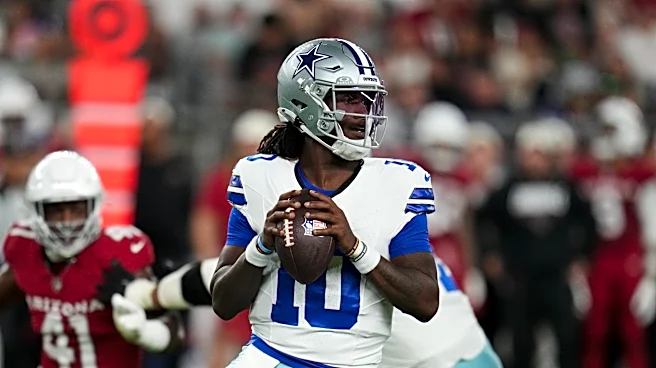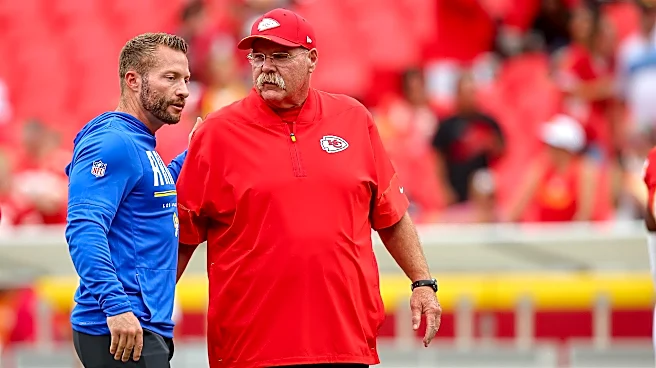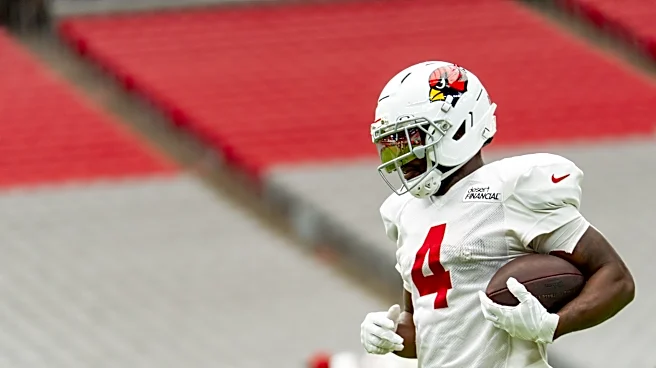

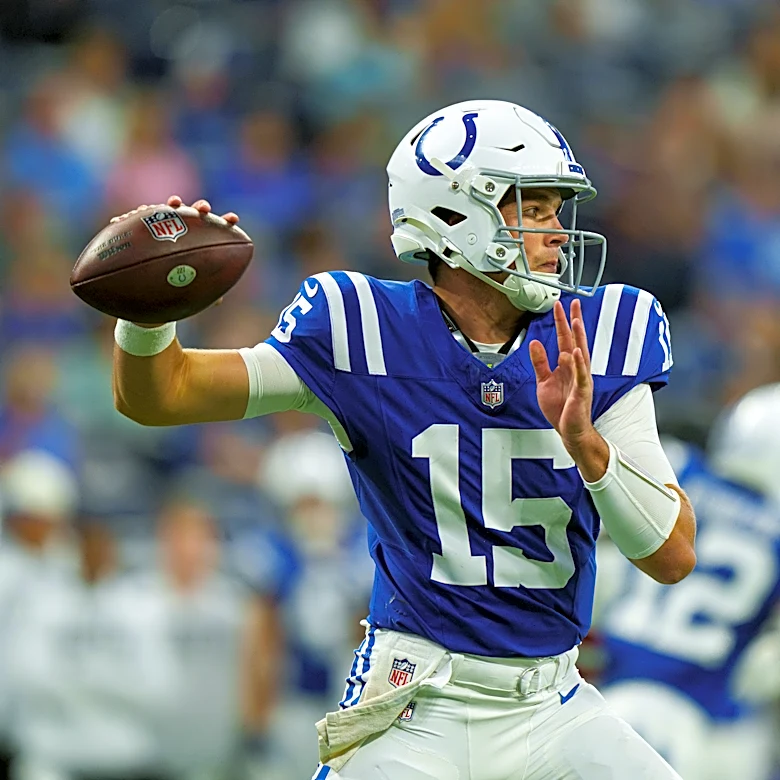

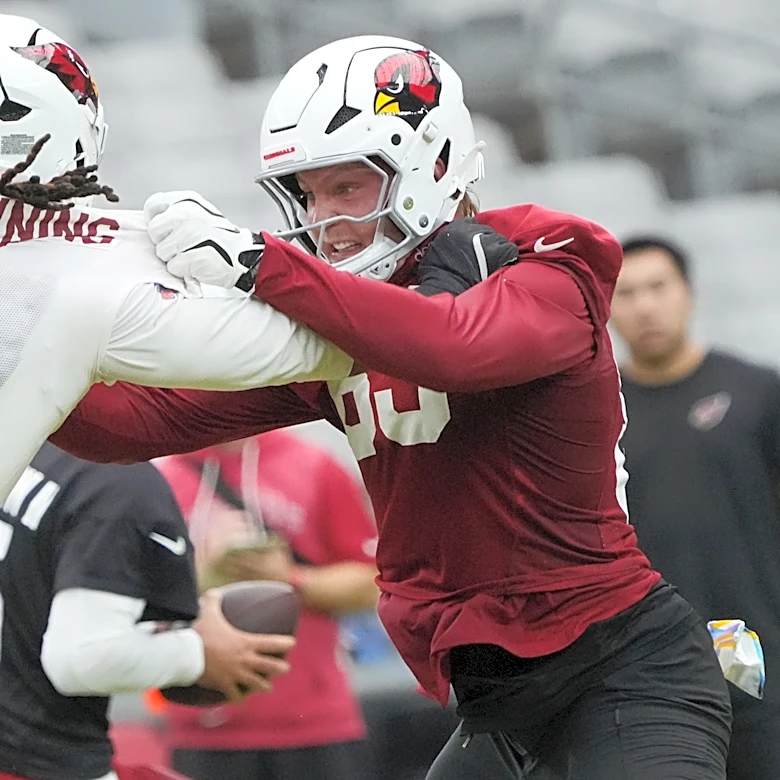
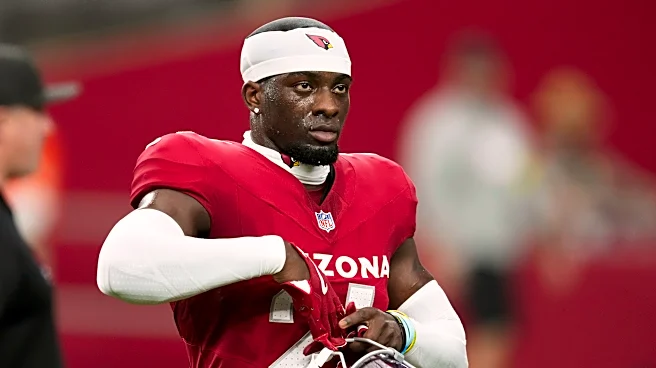
The Arizona Cardinals might not be a good team, or even a good offense, but they’re filled with players going high off the board in fantasy football drafts.
Per FantasyPros, their average draft positions in half PPR are as follows: Trey McBride 23rd, Jeremiyah Love 26th, Marvin Harrison Jr. 76th, Michael Wilson 85th. As a reminder, this is for a team with an over/under of 3.5 wins.
So, how to square those two realities? That’s what we’re here for. Here are five key fantasy football-related takeaways from Cardinals training camp, which included eight days of 11-on-11 practice open to media, as well as their first two preseason games.
Jeremiyah Love is RB1A — but it’s complicated
Early in training camp, the Cardinals’ running back room was more muddled than anyone expected. Day after day, Tyler
Allgeier was the first running back on the field with the starting offense, before Love would rotate in.
Then there was offensive coordinator Nathaniel Hackett’s quote after being asked about Love, when he said, “He’s definitely a rookie.” Hardly a glowing endorsement.
As camp progressed, though, Love began to take over, taking the first snaps with the starters. That was the case in the preseason game against the Raiders, too. Love got the start and played eight of 11 snaps before the rest of the starters were removed, compared to Allgeier’s three.
After that game, head coach Mike LaFleur explained how Love was “really hoppy” early in camp, dancing too much in the backfield. Over the past month, he’s earned the trust of his coaching staff by growing more decisive.
“You got to stay grounded and be able to hit (your gap),” LaFleur said. “And he’s only gotten better at that.”
Still, the carry count with the starting offense in training camp was as follows: 50 carries for Allgeier, 49 for Love. That almost certainly won’t be the case in the regular season, but it’s unnerving given Love’s price. This could be a 60/40 backfield, at least to start the season.
And that’s before accounting for James Conner (who has not yet worked in 11-on-11 drills) or Love’s current high-ankle sprain, which could imperil his availability for Week 1.

Love’s exciting receiving role
The workload is much less murky in the passing game, where the Cardinals have made it a clear priority to emphasize Love.
His 17 targets with the starters in training camp made up a 10.2% target share, despite splitting snaps with Allgeier. By contrast, Allgeier saw just seven targets.
The numbers also don’t tell the full story. While Allgeier’s targets all came on checkdowns, the Cardinals seem to have a package of plays that feature Love as the first read. They occasionally split him out as a receiver and often motion him around the formation to find favorable matchups.
Plus, his route tree is diverse, even featuring a go route one day late in camp. For the most part, though, the Cardinals use him within 10 yards of the line of scrimmage, in a variety of ways.
“He’s probably one of the best option (route) runners I’ve ever seen, from a running back or a receiver,” Wilson said.

Wide receiver room is murky
If you’re looking for clarity on the Cardinals WR1, the first four weeks of their summer have not offered much help.
Here’s how the numbers broke down during training camp:
- Marvin Harrison Jr.: 35 targets, 20 catches
- Michael Wilson: 28 targets, 20 catches
- Kendrick Bourne: 18 targets, 14 catches
Not only did neither Harrison nor Wilson emerge as a clear WR1, but Bourne has a larger role than expected as the starting slot receiver, siphoning off targets.
Some clarity, at least, has arrived on their roles. Harrison is the X receiver, meaning he’s most often split out wide. He’s also typically the lone receiver on the field in 13 personnel (one running back, three tight ends) looks, meaning he should lead the wide receiver room in snap share.
But Wilson has a more creative role. Last season, the Rams (with LaFleur as offensive coordinator) threw to a wide receiver in motion 133 times, compared to 18 times for the Cardinals under Drew Petzing. That is most often Wilson’s job in this offense, which should create some easy designed catches. He even got one of those against the Raiders, motioning across the line of scrimmage at the snap for a wide-open catch off a play-action boot.
None of that, though, helps identify who will lead the wide receiver room in the important stats: Receptions, yards and touchdowns.

Trey McBride remains elite
Against the Raiders, LaFleur rested two starters: Safety Budda Baker and McBride. It was a testament to what the past two seasons have shown: McBride is the Cardinals’ most important offensive player, and it’s not particularly close.
Remember those training camp stats above? Remember how closely the wide receivers were bunched?
Not McBride. He caught 33 balls on 43 targets, proving to be Jacoby Brissett’s preferred receiver day after day.
That’s little surprise, given that the star tight end finished last season with 1,239 yards and 11 touchdowns on 126 catches. But if anything, it seems like his role might even be expanded this season, rather than shrunk with a new playcaller in town.
“Here was your route tree since you've been here,” LaFleur said. “It’s like, what can we expand off it? ... I think he can have maybe a deeper intermediate route tree, because he does have the speed and the body lean and the savvy to get from point A to point B within the timing of plays.”
That’s scary in the best way.
Cardinals passing game looks better than expected, but is it?
One consistent theme throughout training camp: The Cardinals’ offense — especially in the passing game — outperformed its defense, day after day.
That became even more true once Brissett returned from his holdout. He had some growing pains as he acclimated to a new offense but mostly operated well, unlocking a downfield passing game that was quiet with Gardner Minshew behind center.
These things are difficult to parse in training camp: Is the offense good or is the defense just bad? The answer might be both. Against the Raiders, the starting offense marched down the field for a passing touchdown on its lone drive, while the starting defense was shredded apart by Kirk Cousins and Tre Tucker.
And it’s hard to ignore just how effective the passing game has been. Yes, it’s preseason, when defenses are showing only their most vanilla schemes. But through two games, the Cardinals’ three quarterbacks are 50-of-59 for 494 yards and five touchdowns.
“I think a lot of that is coaching,” Wilson said. “… It’s getting the right calls in, the way that Mike and the offensive staff are detailing things up in the pass game, getting guys open, getting guys advantageous 1-on-1s.”
If that’s the case, it may carry over to the regular season, even when the Cardinals face more talented defenses operating with their full playbooks.
This article originally appeared on Arizona Republic: 5 fantasy football takeaways from Arizona Cardinals training camp