


I know firsthand what it means to grow up in Arizona and wonder whether all your hard work will ever be seen. I also know what it means to fight for a policy that says your years in Arizona classrooms should count.
The Department of Justice wants Arizonans to believe Proposition 308 created a special benefit for Dreamers at the expense of American citizens. I know the law, I know the students who fought for it, and that is not what Arizona voters approved.
Before we debate the legality of Prop. 308, we must be honest about what Arizona voters actually enacted ― and what is at stake for Arizona students and the economic future of our state.
The DOJ argues that Prop. 308 gives undocumented students in-state tuition, denies the same benefit to some
U.S. citizens, unlawfully favors undocumented students and conflicts with federal law, particularly 8 U.S.C. § 1623.
But the DOJ is making an immigration-status argument about a law that uses educational criteria.
Prop. 308 establishes a straightforward standard: a student who attends an Arizona high school for at least two years and graduates from an Arizona high school or equivalent is eligible for in-state tuition. The law does not ask whether a student is a citizen, a Dreamer or undocumented. It asks whether they meet Arizona's educational criteria.
That distinction matters.
Prop. 308's eligibility trigger is not immigration status or even current Arizona residency. Arizona Attorney General Kris Mayes concluded that Prop. 308 is consistent with federal law because eligibility is based on educational criteria, not residence. A student can satisfy those educational criteria regardless of citizenship and without currently being an Arizona resident.
The DOJ's comparison between an out-of-state U.S. citizen and an undocumented student who meets Prop. 308's criteria is therefore flawed. They are not similarly situated under the law. One meets Arizona's educational standard; the other does not.
When the federal government repeatedly describes Arizona students as "illegal aliens" and tells the public they are being placed ahead of American citizens, it creates a picture that the text of Prop. 308 simply does not support. There is no "Dreamer preference" written into the law. There is an educational standard, and U.S. citizens can meet it, too.
The problem with the DOJ's framing is not limited to the law. Its presentation of the financial impact also deserves scrutiny.

According to AZCIR's reporting, the DOJ's $10.5 million figure treated 432 students whose participation in Prop. 308 occurred over multiple semesters from spring 2023 through fall 2025 as though they represented a single semester, then multiplied that figure by the tuition difference.
If we are going to have a serious conversation about the cost of Prop. 308, Arizona deserves serious numbers.
And we should ask a bigger question: What does Arizona gain when these students are able to reach their potential?
When Arizona educates students but makes higher education inaccessible, we are not simply asking students to bear a cost. We risk walking away from human capital Arizona has already spent years helping develop. We risk educating students here only to make it harder for them to build their futures here.
I am not making an abstract argument. I grew up in Arizona, attended Arizona schools, earned degrees from Arizona State University and Grand Canyon University and completed executive education at Harvard Kennedy School. I became a teacher, was recognized by Forbes as a 30 Under 30 social entrepreneur and helped lead the movement that passed Prop. 308.
My story is not unique. It is a reminder of what can happen when a young person is given the opportunity to turn an Arizona education into an Arizona future.
Whatever one's views on immigration policy, Arizona voters have already made a policy choice about higher education. The federal government should not misrepresent that choice in an effort to undo it.
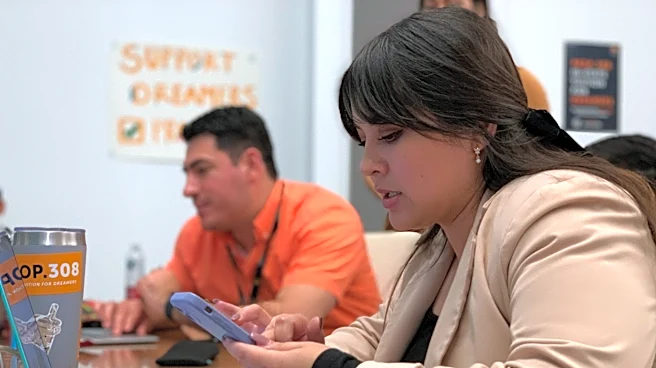
Prop. 308 was not handed down from Washington or quietly created by a bureaucracy. Young people organized for it. Students, Dreamers, educators, business and faith leaders testified, organized, knocked on doors, shared their stories and persuaded voters. Ultimately, Arizona voters said yes.
They made a clear choice: students who spend their formative years in Arizona schools and graduate here should have a pathway to higher education without an additional financial barrier based on immigration status.
The DOJ can disagree with that policy. It can ask Congress to change federal law. But it should not misrepresent what Arizona voters actually enacted.
When I think about Prop. 308, I do not see a special benefit for Dreamers. I see Arizona students who have spent years in our classrooms and now have the opportunity to become the college graduates, professionals and leaders Arizona needs.
Prop. 308 is more than an education policy. It is a smart workforce policy rooted in a simple premise: when we educate a child in Arizona, we are investing in Arizona's future.
Arizona voters chose to make that investment.
Reyna Montoya is founder, CEO and board member of Aliento, serving students, "Dreamers," and immigrant families in Arizona. Montoya is a regular contributor to The Republic Viewpoints section and serves on The Republic's Community Advisory Board.
This article originally appeared on Arizona Republic: Don't turn Arizona's tuition law into an immigration fight | Opinion