





The Arizona Supreme Court issued a ruling that could make it easier for members of the public to successfully sue government agencies that stonewall requests for public records, a decision that strengthens public transparency.
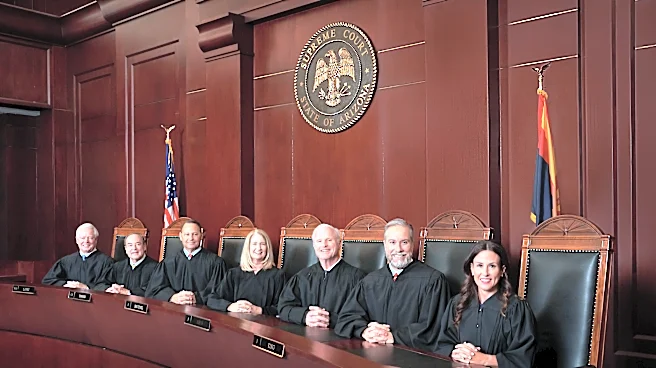
The court's seven justices released a unanimous opinion Sept. 18 favoring Matthew Abraham, a former University of Arizona professor who sued the college after it had rejected and delayed providing some records and substantially redacted others. Abraham had grown suspicious that the university was infusing "diversity, equity and inclusion" philosophies into hiring and requested hiring records.
He pointed to the Arizona Public Records Law, which requires public entities to maintain records related to their duties. The law
has a few exemptions but favors disclosure to the public.
Justice Clint Bolick, writing for the majority, said courts, not government agencies, must determine when public records can be legally withheld and redacted, and that a government agency that destroys a record can be held liable.
If a plaintiff sues over such a denial, the high court said attorneys' fees can be awarded not just if the plaintiff is successful and the agency provides records after litigation, but also if the plaintiff compelled the records by hiring an attorney and sending a demand letter. That means having to hire an attorney to force an agency to provide public records could later affect how much that person recoups in attorneys' fees.
Ignoring the fact that people sometimes have to hire an attorney just to access public records would allow "a public entity to stonewall a request until just before a lawsuit is filed without financial penalty," Bolick wrote.
The ruling could mean more scrutiny on government agencies' decisions to conceal public records by the courts. It could also make it easier for plaintiffs to recoup attorneys' fees.
But the high court said the law may still "lead to results at odds with — disclosure of public records" since some government agencies may not respond to records requests until someone hires a lawyer, which means people without financial resources could still be blocked from seeing records they're entitled to.
"But these concerns are for the Legislature to address, not the Court," the ruling read.
Former UA professor's court win comes after years of legal battling
Abraham, a former English professor at the Tucson university, put in requests for public records between November 2018 and September 2020 related to the university's hiring processes. Over time, he had grown suspicious that UA was implementing "DEI" principles in who was chosen for employment, running afoul of state law.
The request sought survey data used for the hiring and appointment of certain university positions, and records relating to the search and selection processes for these positions.
After the college only provided some records and redacted or withheld others, he hired an attorney who sent a demand letter in October 2020. The university then acknowledged that some of its decisions to withhold some records were "incorrect."
The school provided more, but not all, documents and told him an audio recording he requested no longer existed. The recording was of a meeting for the “Committee of Eleven,” which he said was responsible for “evaluating shared governance structures and practices” at UA. Abraham sent two more demand letters before the university wrote back defending its position.
After that, Abraham sued. The college provided 1,700 documents about two months later and asked the Pima County Superior Court judge to dismiss Abraham's lawsuit, largely because the records either were provided or didn't exist.
A Pima County Superior Court judge found the university "substantially abused its discretion" or "acted arbitrarily" with record denials and redactions before Abraham's demand letter. Even still, the court dismissed Abraham's claims, saying the university couldn't provide a record that no longer existed and that it had remedied its initial "impermissible actions” by "eventually" providing the records.
And since the university technically provided documents before a judge ordered officials to do so, the trial court denied Abraham's attorneys' fees. The appellate court likewise sided with the university.
Abraham told the Supreme Court the lower courts "tipped the scales against disclosure" by deferring to the university's judgment about what records needed confidentiality. He argued that upholding the lower courts' decisions would create "a dangerous incentive for public entities to destroy requested records."
Supreme Court's decision after Abraham petitions for recourse
The Supreme Court overturned the trial and appellate courts' decisions, saying "post-request destruction" of a record was the "ultimate denial" and an "obvious violation" of the public records law.
But since the lower courts refused to decide whether Abraham was formally "denied" records, the high court said he was unable to seek attorneys' fees.
The opinion also said the lower courts were wrong to defer to UA on what it had to or did not have to provide. The decision is a "question of law," Bolick wrote.
University of Arizona had justified withholding some documents under the public records law exemption that says records can be shielded if doing so is in "the best interest of the state."
The Arizona Court of Appeals had said trial courts needed to decide whether the university abused its discretion when withholding or redacting documents under the "best interest" exemption.
But the high court rejected that finding, noting that the abuse-of-discretion standard defers to government agencies' determinations.
Doing that, "especially over whether a nondisclosure or redaction serves the best interests of the state, ‘would defeat the strong presumption of transparency and public access embodied in our public records statutes,’” Bolick wrote, referring to arguments the Goldwater Institute made in a separate but related case.
The justices sent Abraham's case back to Superior Court. The trial court will need to decide whether the university was legally justified in concealing and redacting certain documents and whether Abraham qualifies for attorneys' fees.
Taylor Seely's role covering First Amendment issues at The Arizona Republic/azcentral.com is made possible by a collaboration among Freedom Forum, Journalism Funding Partners and the USA TODAY Network. Freedom Forum does not provide editorial input.
Do you have a story about the government infringing on your freedoms? Reach her at tseely@arizonarepublic.com or by phone at 480-476-6116. She can be reached on Instagram at @taylor.azc.
This article originally appeared on Arizona Republic: Arizona ruling could make it easier for public to sue the government