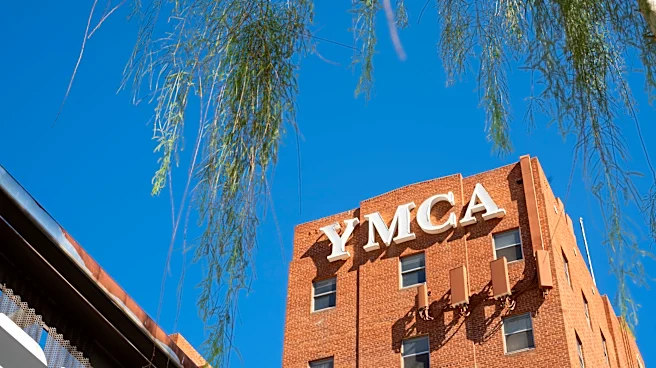






The YMCA in downtown Phoenix locked its doors permanently on Sept. 30.
The closing of the hulking eight-story building on Central Avenue between Fillmore and Van Buren streets forced hundreds of people who belonged to the Christian-influenced organization to search for a new place to live and exercise, including about 70 residents who lived in low- or no-cost studio apartments with communal bathrooms on the property.
The closing brought an end to the Y's presence in central Phoenix dating back to the 1890s, when the Young Men's Christian Organization was first housed at a different location.
The organization plans to demolish the 1954 brick structure, which had the city's first indoor swimming pool that closed in 2020, and replace the building
with a modern facility, said Kirsten Gray, a vice president of operations for the Valley of the Sun YMCA.
When they were informed that the downtown YMCA was closing, residents feared they would be unable to find comparable housing by the Oct. 1 eviction date and would end up homeless living on the streets.
But as of Sept. 30, all but eight of the downtown Y's 70 residents had already moved out of the building's apartments, which were intended to be transitional, after caseworkers helped them find housing at various locations, Gray said.
Of the eight, four had found housing and were preparing to leave, Gray said. Only four residents still hadn't found a place to live, Gray said. The four would be allowed to continue to live at the downtown Y until at least the end of the coming weekend to give them more time to find housing, Gray said.
"We have committed from the beginning that every resident will have a place to go," Gray said, noting that the Y provided residents with help finding places to live and move.
A group that advocates for low-income tenants, however, said many of the residents who had been living at the downtown YMCA, officially known as the Lincoln Family Downtown YMCA, were placed in shelters, motels or apartments they can't afford and are still at risk of ending up on the streets.
"Even though it's transitional housing, people have called this building home," said Max Quinn, an organizer with Valley Tenants Union, noting that some residents had lived at the downtown YMCA for as long as a decade. "They are being pushed out to different corners of the Valley with no guarantee and no assurance that they won't be evicted again. So the cycle of displacement continues and continues and continues."
About 20 to 30 supporters of the group protested the eviction of the downtown Y's residents on Sept. 29, the eve of the building's closing.
Zachary Jackson, 37, moved into one of the small apartments at the downtown YMCA six months ago after he lost his job at a car dealership. He said he could no longer afford to pay the $800-a-month rent for an apartment he was renting in north Phoenix.
Jackson, who said he served in the Army, lived at the downtown YMCA rent-free under a housing program for veterans.
As of Sept. 30, Jackson said he hadn't been able to find an apartment he could afford because he still hadn't been able to find a new job.
Residents were told they had to be out of the building by noon on Sept. 30, but he said he was told the deadline was extended until Friday.
Caseworkers had found a place for him to live at a sober living facility, but Jackson said he turned it down "because I'm not a drug addict, and I don't have a drinking problem."
Jackson spent Sept. 30 packing his belongings and was preparing to live in his car rather than on the streets, he said.
The Y had also offered to help pay his moving fees, but without a job, Jackson said he had no way to afford an apartment.
"Right now I don't have a way to prove that I'm actually working, so even if they do pay the moving fees, I won't have a way to carry it, so I'll just end up getting an eviction," Jackson said. He was standing on Central Avenue outside the downtown YMCA near a blue sign informing the public the building was slated for demolition.
Earlier in the day, workers from a tech salvage company hauled away computer equipment, while a handful of members squeezed in one last workout in the facility's nearly empty indoor exercise gym, where most of the machines sat idle.
Raul Delgado, a 67-year-old Phoenix resident, said he has come to the Y daily to exercise for the past seven or eight years after undergoing chemotherapy for cancer.
"It's a shame they are closing it," Delgado said. He said it would be a challenge to find another gym that was affordable and where he felt comfortable.
"The gyms around here, I believe they are for young people," Delgado said, taking a break on one of the machines. "This facility was a nice location for older people like me."
Delgado planned to check out the Legacy Foundation Chris-Town YMCA in north-central Phoenix the following day.
Halldor Hjalmarson, who is 87, was pedaling away on a stationary bike. He said he has heart problems and has been coming to the gym three times a week for the past 10 or 12 years to get exercise.
He was considering transferring his membership to the Chris-Town YMCA, which would add six miles round trip to his gym commute, or trying out a facility at the Banner Good Samaritan Medical Center.
"It's an end of an era," said Curt Behun, a 74-year-old retired electrical engineer who was sitting on an exercise bike next to Hjalmarson.
With the closing of the downtown YMCA, the city was losing not only a centrally located place to exercise but a piece of history, Behun said. His children, now adults, had grown up attending programs at the downtown Y.
"Some people like change, but I like history, so I'm always attached to the historical aspect of it," Behun said. "And you know, if something's been there for so many years and you know it, you have a bond with it. And if it gets torn down and you build something new, you (have) nothing."
Under some shade structures on the north side of the building, about 10 people stood in line waiting to receive food boxes handed out by the Y at 1 p.m. every Wednesday.
Some of the people in line were surprised to find out it was the last day they could receive food boxes at the downtown Y.
Maria Bustillos, 58, wasn't sure where she would go for food boxes in the future.
She had been going there off and on for the past two months on the bus to receive a food box after losing her job with a commercial cleaning company.
"I'm going through hard times right now," Bustillos said. "I just lost my apartment a couple weeks ago. So I've been staying at a hotel for the past couple weeks. And I lost my job. I was only working part-time, and part-time wasn't doing it to pay my rent. So things got hard and rough, and I had to move out."
Darlene Rios, a 63-year-old unemployed waitress, said finding another place that distributes food boxes would not be easy.
She said her refrigerator would be empty without the food she receives at the downtown YMCA. "It's very important," Rios said, holding a box of food she had received with some lettuce, cold cuts and a container of potato salad.
"It comes in handy. Look, I got a pizza. It's gonna put some meals on the table," Rios said.
Have a news tip? Contact The Arizona Republic and azcentral.com at newstips@arizonarepublic.com.
This article originally appeared on Arizona Republic: Downtown Phoenix YMCA slated for demolition after closure