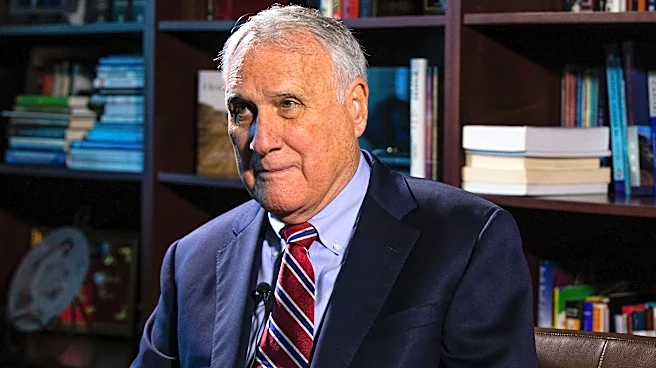






Former U.S. Sen. Jon Kyl, who died on Sept. 16, was one of Arizona's most influential water policy experts, a water law attorney who was also a principal figure in several tribal water settlements.
During his 26 years in Congress, including four terms in the House and three Senate terms, Kyl shepherded some of the largest Indian water rights settlements, including the pivotal Arizona Water Settlement Act in 2004, which at the time was the nation's largest-ever such deal.
That bill settled long-standing claims by the Gila River Indian Community and the Tohono O'odham Nation.
Gila River Gov. Stephen Roe Lewis issued a statement Sept. 17 honoring Kyl's legacy. "Sen. Kyl understood perhaps better than almost anyone in public life that Arizona's future
depends on water, and that Arizona's Tribal nations must have a meaningful voice in determining that future," Lewis said. He said Kyl was a statesman whose legacy will be felt in Arizona for generations.
"His knowledge of water law was extraordinary," he said, "but just as important was his willingness to bring people together, work through enormously complicated issues and remain at the table until solutions could be found."
Tom Buschatzke, director of the Arizona Department of Water Resources also lauded Kyl's tribal water expertise. "Among his many accomplishments, his determination to see complex Tribal water rights claims through to completion stands out," he said.
"One of the most technically and politically challenging of all Tribal water settlements, the Arizona Water Settlement Act of 2004, would not have been possible without Senator Kyl’s skillful leadership." Buschatzke said that the water settlement was the largest in Arizona history.
Kyl also pushed through water settlements for the White Mountain Apache Tribe and Zuni Pueblo.
Buschatzke also said that Kyl was heavily involved in the eventual enactment of the Arizona Groundwater Management Act in 1980 and helped create Buschatzke's own agency. In 1983, Kyl successfully represented the state before the U.S. Supreme Court in a case that confirmed the jurisdiction of the state courts for comprehensive water rights adjudications that include tribal and non-tribal water rights.
Kyl tried to make settlement 'as balanced and successful as possible'
But it was one settlement in particular that a tribal water policy expert said particularly showed Kyl's understanding of how Native peoples revere water in its sacred cultural aspect.
"The Pueblo of Zuni settlement was unique because it's one of the only settlements in the state that is really focused on protecting water resources," said Cora Tso, a senior research fellow at the Kyl Center for Water Policy at Arizona State University.
Rather than just providing water rights or infrastructure to turn "paper" water into "wet" water, the Zuni settlement focused on restoring and maintaining Kołuwala:wa, or the Zuni Heaven Reservation, a 12,482-acre lake, wetlands and riparian area in eastern Arizona where Zuni people have journeyed every four years for ceremonies for millennia. The site is about 60 miles west of Zuni's main tribal lands in western New Mexico.
"We don't often have statesmen that can do that work in a way that I think truly respects each party's interest in a way to make things as balanced and as successful as possible," Tso, a member of the Navajo Nation said.
"I think his role, not only nationally, but within our state shows me how important it is to stay in connection with community and striving to advocate for all different interests."
Kyl hoped that his final water bill, filed with the late Sen. John McCain to settle water claims by the Navajo and Hopi tribes, would be his capstone. But after federal enthusiasm for spending hundreds of millions of dollars on tribal water infrastructure dried up, the bill that had emerged after years of negotiation with tribes and other stakeholders in Northeastern Arizona was substantially different — and with a much smaller price tag.
When Kyl and McCain met with tribal leaders in Tuba City in April 2012 to outline what had changed in the bill, they were met by more by 300 protesters who denounced the agreements. Other tribal members thronged into chapter houses and meeting rooms to ask questions and proclaim their opposition. The bill ultimately failed to grab any traction.
Another 12 years would pass before a new settlement, this time between the Navajo Nation and the Hopi and San Southern Paiute tribes would be enacted. Legislation to ratify that settlement has languished in Congress.
'No smarter man on water issues'
Tso said she was further impressed by Kyl when he came to speak at a water law seminar at the Sandra Day O'Connor College of Law at Arizona State University.
"He made time to come and speak to our small group of 12 law students," Tso said. The students asked about the impact of the failure of the first Navajo-Hopi water right settlement agreement.
"I think Kyl being open to having a frank discussion about those issues and acknowledging the role of community and how important it was to respect that what the Navajo Nation council did was important," she said. "But also having the space to say, 'It was a failure, and it's hard to not have seen that through and get the bill through at the time that we needed it to' was really interesting."
McCain talked about Kyl in an interview on KFYI-AM in Phoenix: "There is no smarter man in America on water issues than Senator Jon Kyl, and that is the issue of the 21st century."
Lewis's father, water attorney Rod Lewis, was one of the chief architects of the 2004 settlement and worked alongside Kyl.
"Sen. Kyl devoted decades of his life to Arizona and approached public servicer with seriousness, intellect and a deep respect for the institutions he served," Stephen Roe Lewis said. "His service to Arizona will long be remembered."
Debra Krol reports on Indigenous communities at the confluence of climate, culture and commerce in Arizona and the Intermountain West. Reach Krol at debra.krol@azcentral.com. Follow her on X, formerly known as Twitter, @debkrol and on Bluesky at @debkrol.bsky.social.
This article originally appeared on Arizona Republic: Jon Kyl leaves legacy of tribal water settlements in the Southwest