








The Duppa Homestead has long been recognized as the oldest house in Phoenix, but historians say this isn't true, despite how often it is repeated.
Located off Sherman Street and Second Avenue just south of downtown Phoenix, the Duppa Homestead is known to be the home of Bryan Phillip Darrell Duppa, one of the founders of Phoenix, often credited with giving Phoenix its name.
The dilapidated adobe structure is often reported to have been built in 1871 during some of Duppa's early years while pioneering what is now one of the biggest cities in the country.
While it's true that Duppa once owned the land the Duppa Homestead sits on, historians claim this building's history has been deeply misunderstood.
Even The Arizona Republic questioned the historical
legitimacy of this building as early as 1960. So why do the rumors persist?
History of the Duppa Homestead
A quick Google search indicates that the Duppa Homestead is Phoenix's oldest house, with news articles, blog posts and videos saying so dating all the way back to 1871. Vincent Murray, a native Arizona architectural historian, said this is not true.
"It is not the oldest house in Phoenix, and it's also not a house," Murray said, baffled at how this rumor has maintained itself.
Murray claims that while it's true that Duppa owned the land, the structure was not his home, nor did Duppa even own the land when the structure was built.
Duppa was one of the first people to qualify for a land grant in the city, owning 160 acres in 1871. However, Duppa sold the land to James Miller in 1872, who later sold the land to John Britt Montgomery in 1880, who likely built the structure that is now known as the Duppa Homestead.
However, even Montgomery didn't utilize the building as a house. It is believed that the building served as a milk shed for Montgomery's farm and dairy operation.
Even looking at the structure of the Duppa Homestead, it doesn't look like a house. What appear to be windows sit at the top of the wall, out of eye-level view.
"I think that there was a dairy operation and that this was basically used for dairy storage, and that the openings in the upper part of the wall are to help dissipate heat," Murray said, "You probably put a big block of ice or something in there with your milk, and it will keep the stuff cool in there because it's made out of adobe."
Based on the deeds documented by the Maricopa County Recorder's Office, since Montgomery did not buy the land from Miller until 1880, it's unlikely that this house was built any earlier than then. However, Murray suggests the structure was even built later, around the early 1900s.
"I think it's built somewhere around the turn of the century, more likely around 1904, 1905. We don't have the Sanborn Maps going back that far because of its location of it being south of the train tracks," Murray said.
However, the Maricopa County Recorder's Office documented that Montgomery sold the land to Fredrick G. Fisher in 1902, making it hard to know exactly when the Duppa Homestead was built and by whom.
Still, the Duppa Homestead is decidedly not the oldest house in Phoenix.
'It's just a bad lie'

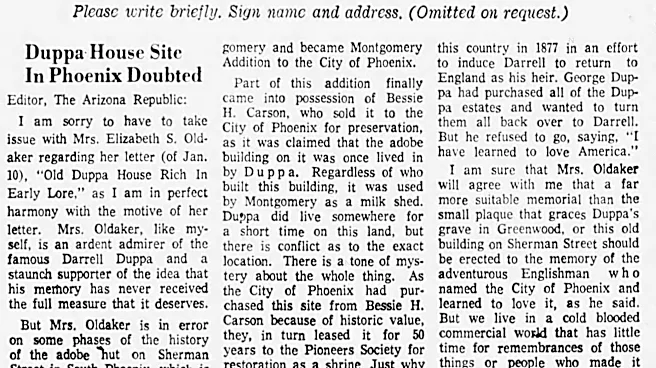
As early as 1960, The Republic began documenting Arizonans questions about the legitimacy of the Duppa Homestead tale, but how did this rumor even start?
Elizabeth Seargeant Oldaker, an Arizona historian whose mother co-founded the Arizona Museum, like many, believed that the Duppa Homestead was the home of Darrell Duppa. Oldaker worked to restore the building in the 1940s and 1950s so it could be opened as a historical site.
In a 1960 column of The Republic, titled "Old Duppa House Rich in Early Lore," Oldaker wrote, "To find a remnant of those pioneer days, one needs only to drive, or walk, south on First Ave. about seven blocks beyond our Maricopa County Building to Sherman St., turn right and there at 116 W. Sherman one sees a little adobe house which was once the home of Darrell Duppa."
Six days later, John Lindley Higham wrote in The Republic a rebuttal to Oldaker's claim: "Ms. Oldaker is in error of some phases of the history of the adobe hut on Sherman Street in South Phoenix, which is credited with having been the home at one time of Darrell of Dupa. I’m not convinced of this."
Oldaker claimed that her grandmother told her Duppa had lived in the adobe structure, and that he even left behind books.
In a 1996 edition of The Republic, Cindy Myers, then-executive director of the Phoenix Museum of History, said people once even believed the windowlike holes in the structure, which were likely used for ventilation, were gun ports for rifles.
"(Oldaker) said that her mother remembered when Darrell Dupa lived in that house and that's where he would shoot at Indians out of those holes. That has gotta be about the most absurd thing I've ever heard," Murray said.
While Oldaker's intention to preserve some of Phoenix's earliest history may have been pure, it has caused modern-day confusion about this building's real origin.
"People do that, they have a story that they got from somebody else, and it slowly gets changed a little bit by a little bit, and then the next thing you know it basically then becomes gospel," Murray said.
What is the oldest house in Phoenix?
It's more likely that the Jones-Montoya House, built in 1879, is the oldest house in the city.
The property was once home to Dr. Wilson Walker Jones, Alcaria Montoya and their seven children. Now the house is owned by the local nonprofit Chicanos Por La Causa, which has worked to restore the home while maintaining its historic architecture.
This article originally appeared on Arizona Republic: This isn't Phoenix's oldest house. So why does everyone think it is?