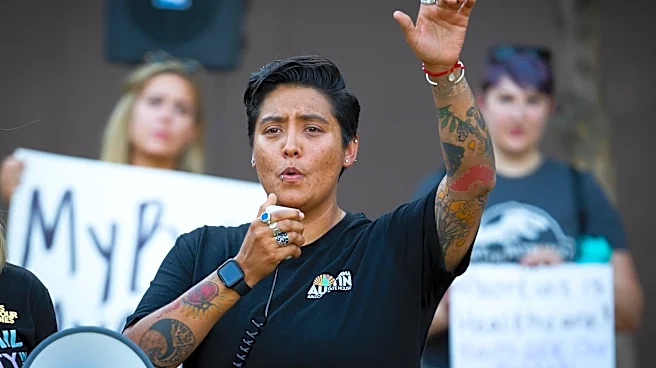



Several social media photos circulating over the long weekend appeared to show Democratic state Rep. Lorena Austin joining a campaign called “Demócratas por Biggs" supporting the Republican gubernatorial candidate.
But the images aren’t real, Austin said.
“100% not me,” the Mesa lawmaker said. “It was a generated deepfake of me that I did not consent to.”
The now-deleted photos showed a person who resembled Austin holding a campaign sign supporting Andy Biggs, who is challenging Democratic Gov. Katie Hobbs this November. One of the images showed Austin with five other people.
But in both images, several of Austin's tattoos were not pictured accurately. There is also no official campaign titled "Demócratas por Biggs" or "Democrats for Biggs."
The
images were shared on X by Matt Whitmire and Mary Ann Mendoza and were viewed roughly 25,000 times. Mendoza is a former Republican state House candidate who lost in 2024 and 2022. Both accounts have since deleted the images.
Mendoza and Whitmire are not working on the Biggs campaign, according to Biggs' spokesperson Drew Sexton. Sexton hedged when asked if the campaign would ask its supporters to take down the images.
"The campaign is responsible for what the campaign posts at the end of the day," he said. "That's what we're focused on, and we would encourage all of our supporters to follow our lead."
"We're not going to get into policing what people can and should, or shouldn't, say," he added.
The first image showing multiple people alongside a person who resembled Austin showed that it was digitally altered based on three out of four AI-detection systems used by The Arizona Republic. The second image was detected to include AI alteration in two of the systems used.
Austin, who is running for reelection in Legislative District 9, hasn’t used the social media platform for several years and wasn’t aware that images depicting them campaigning for Biggs were being shared until someone else raised the issue.
The lawmaker denounced conservative political advocacy group Turning Point Action over the posts. Mendoza includes her title as a "Chase the Vote Manager" for the group on her X account, and social media posts indicate Whitmire holds the same job.
“I was definitely shocked, but in a sense, I wasn't surprised,” Austin said, who believes the group played a role. “I think Turning Point is deceitful and dishonest, and this is on par for them.”
Andrew Kolvet, a spokesperson for Turning Point Action, did not respond to multiple requests for comment.
Mendoza said her post was a joke.
"An open borders radical like Lorena Austin would never stand with a patriot like Andy Biggs, the humorous intent is obvious to competent journalists," Mendoza wrote in a statement.
A man who answered at a phone number listed as belonging to Whitmire said Whitmire wasn't available, and then hung up. Multiple text messages to the number went unanswered.
Laws tackling AI deepfakes could be strengthened, Austin says
Hobbs signed two bills tackling artificial intelligence deepfakes in politics in 2024. Lawmakers united around both bills, which passed with sweeping bipartisan support.
The first statute bans deepfakes of politicians within 90 days of an election unless there is a clear disclosure “that conveys to a reasonable person that the media includes content generated by artificial intelligence.” The law doesn’t apply to satire and parodies. The second outlines legal action that can be taken against someone for sharing or creating AI-generated content without proper disclosures.
If a person fails to disclose the use of AI to create an impersonation, they may be fined $10 per day for the first 15 days and $25 per day after that, according to Arizona law.
Austin is interested in speaking with AI experts about what further legislation could strengthen the state's existing AI laws.
“I think we are going to start to see how this could negatively impact people,” Austin said. “We'll see what happens with next session, right? If we're able to revisit and perhaps come to a bipartisan effort.”
Over the last several years, federal and state-level politicians have started to incorporate more AI-generated images into their online toolbox. Many times, the images are altered photos and videos of themselves, such as a manufactured video of longtime Arizona Sen. John Kavanagh fighting "bathroom spirits" in response to resurfaced statements from his primary election opponent.
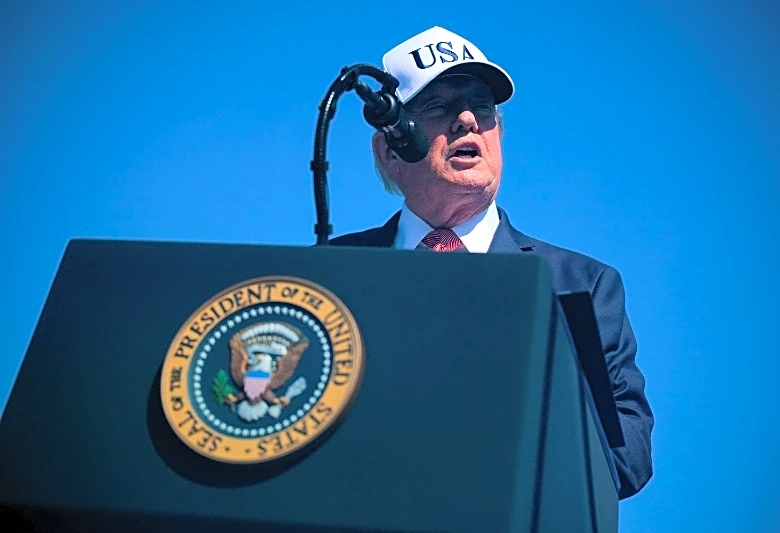
President Donald Trump has also published dozens of AI-generated photos and videos, including an April image that received backlash after several people said the Truth Social post attempted to portray Trump as a Christ-like figure.
Other instances have escalated further. Former congressional candidate Joseph Chaplik sued a conservative super PAC in July, claiming an attack ad that featured AI-generated images defamed him, according to the Phoenix New Times.
Reach reporter Helen Rummel at hrummel@azcentral.com. Follow her on X, formerly Twitter: @helenrummel.
Reach reporter Stacey Barchenger at stacey.barchenger@arizonarepublic.com or 480-416-5669.
This article originally appeared on Arizona Republic: Arizona Democratic lawmaker says pro-Andy Biggs images are deepfakes