
One of Arizona’s most famous endangered felines is on the move again.
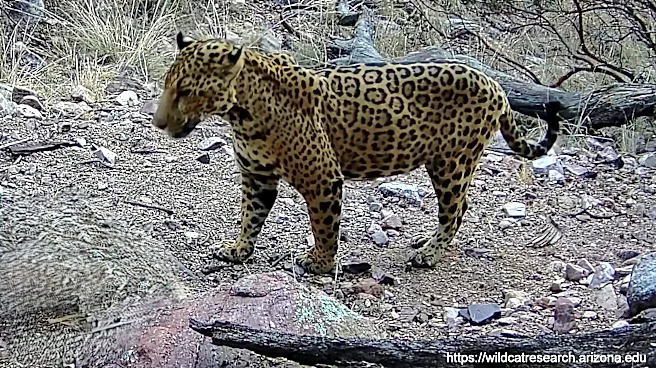
Trail camera footage captured the male jaguar, nicknamed Cinco, prowling along a grassy stream on Aug. 18.
Cinco is the fifth jaguar
to be documented in the state since 2011, when the University of Arizona’s Wild Cat Research and Conservation Center began monitoring them.
To encounter a jaguar in the wild is rare, especially in Arizona. Jaguar territory once stretched all the way to the Grand Canyon. These days not so much. Documenting jaguars on trail cameras in southern Arizona, the farthest northern reach of their present-day range, gives researchers studying their recovery new insights.
“Seeing Cinco again is exciting, but the science goes beyond another photograph,” said Susan Malusa, the director of the wild cat center, which uses genetics to understand species diversity and how the jaguars detected in Arizona fit into larger populations in Mexico. “Each new detection gives us another opportunity to add to that bigger picture.”
Cinco isn’t alone. The wild cat center has tracked four other jaguars with a network of 100 cameras in Arizona over the last 15 years. It’s collected more than 240 sightings.
Across the border in Mexico, another researcher has also documented five jaguars, at least one of which he suspects could be female — the first in 70 years to be spotted as far north as the U.S.- Mexico borderlands.
Jaguar detections aren’t anomalies, Malusa said. They show consistent use of the landscape and wildlife corridors along the border, and that's good news.
"Jaguars are an indicator species," she said. "If a jaguar can survive here, it means the entire system, prey, water, habitat, is functioning at a level that can support a top predator."
Here are the five jaguars spotted in Arizona's wildlands over the past 15 years:

No. 5: Cinco
Cinco is the most recently spotted jaguar on the U.S. side of the border.
Researchers at the wild cat center first got footage of him last November at a site they have been monitoring for years. As he moves across the region, Cinco is visiting places where UA researchers have documented other jaguars before him.
That means his movements aren’t random, the wildcat center said. They are strategic. He is making use of the same corridors and resources his predecessors did. Malusa calls that site fidelity — jaguars will return to places that reliably provide water, prey and shelter.
Using that research, they have even been able to predict where Cinco will appear next, Malusa said.
“The science is working,” she told The Arizona Republic in August. “We’re able to identify the habitat these jaguars need.”
Since last year, the center has documented Cinco nearly every month ― about 20 times. The big cat was also seen on video captured by the Center for Biological Diversity this spring and summer. On Sept. 4, the university released footage of him from this August, including a rare picture of the jaguar prowling around in the daylight.

No. 4: The southern Arizona jaguar
Jaguar #4 popped up on a camera in 2023 around the Coronado National Forest. Then he disappeared for nearly two years.
Researchers at the wild cat center weren't able to document him on camera again until the summer of 2025, when a camera trap turned up a shadowy picture of the jaguar, his eyes glinting in the camera’s light. Through June and July, cameras captured his movements seven times at six different locations. Those detections helped piece together information about how the animals were using the landscape, Malusa said.
This big cat hasn't been documented again since last summer.

No. 3: The Chiricahua jaguar
A decade ago, the Bureau of Land Management and the University’s Citizen Science Monitoring Team detected this male jaguar roaming in the Chiricahua Mountains, part of a patchwork region of isolated mountain ranges and grasslands that spans across the border called the Sky Islands.
From 2016 the team has documented the big cat through photos and videos about 50 times.

No. 2: The Huachuca jaguar
In 2016, U.S. Customs and Border Protection detected a male jaguar on one of the agency’s cameras. One year later, the university's citizen science team documented nine more sightings in the Huachuca Mountains.
A sample of the jaguar’s scat was collected and analyzed at the wild cat center’s lab. For researchers like Malusa, scat isn’t gross so much as it is a wealth of information.
The samples are an important part of studying the species’ genetics. They can reveal how diverse the population is and how jaguars are related. Over time, samples from different individuals can answer big questions about landscape connectivity and the future of conservation for jaguars.
In 2018, the Huachuca jaguar was found dead in Sonora, Mexico.

No. 1: El Jefe
With his pack of hunting dogs and his 10-year-old daughter, Donnie Fenn went out in search of mountain lions in November 2011.
The hounds did not come across any lions. But they did chase a jaguar — the first spotted in the state since 2009 — up a tree. Fenn had been hunting in Whetstone Mountains when the dogs caught the jaguar’s scent and took off after the big cat, which Fenn told the New York Times was twice the size of a mountain lion.
Researchers at the UA went on to document the jaguar over 125 times at 23 different sites. Pictures from trail cameras even show the cat traipsing through falling snow in the Santa Rita Mountains. Eventually, the jaguar crossed back over the border into Mexico, based on detections from 2022.
Sarah Henry covers environmental issues for The Arizona Republic and azcentral. Send tips or questions to sarah.henry@arizonarepublic.com.
Environmental coverage on azcentral.com and in The Arizona Republic is supported by a grant from the Nina Mason Pulliam Charitable Trust.
Follow The Republic environmental reporting team at environment.azcentral.com and @azcenvironment on Facebook and Instagram.
This article originally appeared on Arizona Republic: 'Cinco' is on the move again. Meet all 5 jaguars spotted in Arizona