


It was on Nov. 26, 1976, that the Sex Pistols uncorked the bottled lightning of a debut single that remains one of the most electrifying records in the history of rock ‘n’ roll, an anti-social anthem for the ages called “Anarchy in the U.K.”
The Pistols had already galvanized the U.K. punk scene by the time that single hit the streets. Joe Strummer of The Clash was singing rockabilly in an unassuming pub-rock combo called the 101ers when he shared a bill that April with the Pistols.
“I saw the future — with a snotty handkerchief — right in front of me,” he told Record Collector years later. “It was immediately clear. Pub rock was, ‘Hello, you bunch of drunks, I'm gonna play these boogies and I hope you like them.’ The Pistols came out that Tuesday
evening and their attitude was, ‘Here's our tunes, and we couldn't give a flying (expletive) whether you like them or not. In fact, we're gonna play them even if you (expletive) hate them."
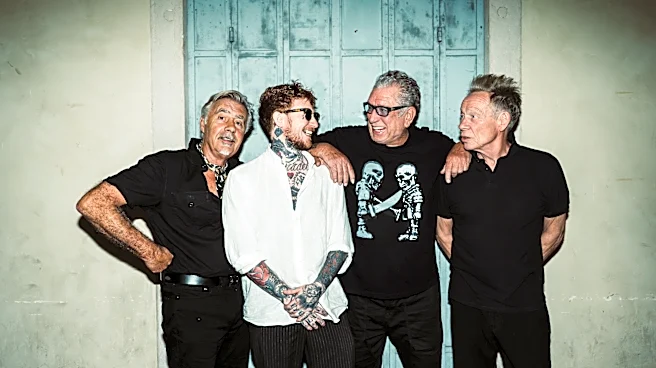
Fifty years later, guitarist Steve Jones of the Sex Pistols has yet to find it in his heart to give a flying (expletive) whether you like him or not as he makes his way to Arizona on a 50 Years of Punk Tour, which unites Jones and fellow founding members Glen Matlock and Paul Cook with Frank Carter of Gallows on vocals.
Johnny Rotten, who’d rather be referred to by his real name, John Lydon, has made it all too clear that he gets the feeling you'll be cheated.
In an interview last year with The I Paper, the Artist Formerly Known as Johnny Rotten said, “When I first heard that the Sex Pistols were touring this year without me, it pissed me off. It annoyed me. I just thought, 'They’re absolutely going to kill all that was good with the Pistols by eliminating the point and the purpose of it all.'”
Reminded that his former bandmate has been talking trash on the idea of the Pistols moving on without him, Jones says, “Yeah, well what's new? When does he never ever talk (expletive)?”
Here’s what else Jones had to say in an exclusive interview with The Arizona Republic.

Steve Jones says Frank Carter injected a lot of energy into the Pistols
How does it feel to be out there celebrating 50 years of punk?
It's great. We're having a blast. We really are. Frank Carter has injected a lot of energy to the band. He's a great front man. And we're really embracing the album, “Never Mind The Bollocks,” and a few others. We're like a well-oiled machine at this point. We've been playing a lot, and it's great. We're having a lot of fun and people seem to enjoy it.
They love it, all ages. They just sing along and I'm grateful that, at 71, I get to do this, and I think the combination with Frank, who's 41 or 42, with way more energy, and the three of us kind of just stoking the fire, it's awesome. It really is. I don't think we've really had one dud gig.
How did you find yourselves touring with him?
It might take up a lot of the interview, but basically a short version is that me and Paul were doing a thing with Billy Idol and Tony James from Generation X, this thing called Generation Sex, half Pistols songs, half Generation X songs. We played Glastonbury in ’23 and a bunch of other shows. That ended. And we thought that was that.
Then we thought, “Why don't we just do Pistols songs? And let's find someone else to sing.” Because Billy wanted to do his touring again. Glen’s son, Louis, knew Frank. And he said he thought it would be a good idea. Long story short, I came to England — I was in LA at the time — and we had a rehearsal. We're like, “OK, this sounds great.”
Then there was this club in Shepherd's Bush, where we're from — me and Paul — that was going out of business. It was called Bush Hall. I'm like, “This is the perfect opportunity. Let's book it for three nights and do three shows.” It held, I don't know, 200, 300 people. It sold out every night. And once we played in front of a live audience, we knew we had something.
After we did them three shows, we did a few more and a few more, a few more. We're like, “This is working. People love it. Let's do a tour.” That's how it happened. We didn't audition any other singers.

Why the Sex Pistols and Johnny Rotten don't just tour together
How did it get to the point where working with John was no longer an option?
Well, I think “Pistol,” the TV biopic Danny Boyle directed, John didn't want it to happen and he didn't want us to use the music, so we had to sue him. He lost the lawsuit and I think that didn't make him happy, understandably.
But on the other hand, I don't know why he did that because if it was Danny Boyle going to John and saying, “I want to do a biopic on one of your books,” I'm sure you would have done it. The fact that it was my book and not John is why I think he had the beef about it, you know? But we've done things before where we've kind of got back together again. So who knows?
Who knows?
It might not be the end.
Wow. I'm surprised to hear you say that.
Well, you never know. We haven't talked about it, and there is no talk about it. But next year is the 50th. There's so many bleeding anniversaries. I get lost. So it's a big one next year. If some big shot comes along and says, “I'll give you X amount of money,” who knows? You never know.
So you'd be open to it?
We haven't spoken about it so don't print that we're thinking about doing it.
Well, I assume you've seen the (expletive) he's talked in the press about you guys touring without him.
Yeah, well what's new? When does he never ever talk (expletive)? And you're gonna get your John Lydon hardcore fans who think what we're doing is a joke, but these are all (expletives) on the internet. People who have come to the show, they're at the show, they're not in a sub bedsit on their computer. They're enjoying the show. So we must be doing something right, you know what I mean?
That's the real world, where people actually show up, you perform for them. This is not some guy, “No Johnny, no Pistols.”
And if three of you are original members, it's not…
Well, that's what I mean. That's the funny thing these knuckleheads don't seem to get. It's ludicrous, but you know what? You don't have to (expletive) come either. No one's making you come. We don't care. We're playing to a lot of people. And that's it.
Steve Jones reflects on the recording of 'Anarchy in the U.K.'
We're coming up on the 50th anniversary of “Anarchy in the U.K.,” your first single. What do you recall of the making of that record?
Well, we initially had a different producer. He was our sound guy. Dave Goodman. We did demos with him, the “Spunk” album. We had a little four-track or eight-track that we did the demos with. We thought, “OK, well, now that we’ve got a record deal with EMI, we'll use him in a proper studio.” But that went south really quick. He got too out of control. He wasn't a pro. I mean, he was smoking so much weed, I couldn't even breathe. And it was a disaster.
So we got rid of him. Then we're like, “OK, we need to get a proper producer.” And Chris Thomas came up. We're like, “Great. We love rock music. Let's give him a go.” But I must say, when we were with Dave Goodman in the studio, we literally did “Anarchy” 50 times. And it sounded exactly the same every time. And this idiot was still, “No, you could get it. You're still not getting it.” That's when we had enough.
And then we went in with Chris Thomas. We cut it in the second take. He's like, “This is it. Got it.” And this is with Glen. Glen was still around in the band at this point. It's the only track that Glen played the bass on “Never Mind the Bollocks.” And then after that, he left and we got Sid. But it was great working with Chris Thomas and Bill Price. They were pros. They just knew how to deal with us, who really hadn't done a lot of recording.
That was probably my favorite time, putting guitar tracks on “Never Mind the Bollocks” and learning as I go because I hadn't been playing that long. A year at most. And it was great. It was so much fun.
And “Anarchy” was … I mean, when you heard the finished results, everyone thinks there's a thousand guitars. There are actually eight. But what a gem, lyrically and the power. I mean, we didn't even … you know, it's incredible that these young guys could knock that up. It was something else. And John, his lyrics. Unbelievable.
I've read quotes from members of The Clash about seeing those early Pistols gigs. And they speak about it as though they experienced a spiritual epiphany almost. What do you think it was about your group in that moment that you had that effect on people?
Well, it was new. And we were young. And we looked fresh. And we had decent songs. It was different, even though it was a 4/4 beat. It was just magic and we didn't even know it was magic. And a whole thing started. The Damned, The Clash. It was a movement that was started.
And there's always that (expletive) about who started it. Was it the New York thing, the Ramones and all this? To be honest with you — and I like the Ramones — but this was back when there was no computers or cell phones. I hadn't heard the Ramones ‘til I got hold of their first album, but we were already well on our way prior to that.
People want to twist it like, “Oh, it was because of the Ramones the Pistols happened.” It's not true. It's absolutely not true. If you go back to the timelines, you can see it. There's my two cents.
You’d been playing with Paul for a while by then, right? You were in The Strand.
Yeah, which was, you know, we didn't know what we were doing there either. We could barely play. But me and Paul were together and with Glen at some point. It was just a great time because you didn't know what was coming around the corner. That feeling of something was happening. I'm forever grateful that we came around at that period in time. It was time for a change. Things were stale.
The big bands were bloated and people were tired of it. And this new thing comes along, as it does, like in the ’50s. You had your Elvis, Jerry Lewis, Eddie Cochran. It was rock 'n' roll, the first stages, Before that, it was all big bands and jazz. Then came the Beatles. And it all changed again. This is the first time there was bands writing music and all the bands wanting to sound like the Beatles and the Stones and the Kinks and all the rest of it.
That kind of petered out. And then you had, in the early ’70s, glam. You had Spiders from Mars, Roxy Music, Mott the Hoople, them kind of bands. That was my era. I was 14, 15, 16. And I loved it. The Faces. It was another version and it moved on a bit, but it was still rock 'n' roll to me when it was raw. It was exciting, sexy. Then we came along. And there was another shift. So even though the word punk was thrown out there, to me it was just a continuation of rock ‘n’ roll.
“Never Mind the Bollocks” is a very rock ’n’ roll album.
It's pretty much the 4/4. We wasn't playing crazy fast, nothing faster that hadn't been done before. But that's what we liked. That's what me and Paul liked and also Glen. We all liked the same bands. The Faces, Roxy Music, all the bands I said. So that's what we wanted to do. And of course, we were just learning and John couldn't sing and I couldn't play guitar and it kind of gave it that sound.
We thought we was playing great, but it was because it was different. Technically, I'd literally been not playing that long at all.
I love the guitar on that album.
It gave to a lot of kids, “Oh, I could do this. What they're doing doesn't seem that difficult.” And that started that whole … all them bands that came afterwards.
This newsletter goes to 11. Sign up for weekly music news.
'It was like lightning in a bottle for a couple years'
The guitar style on those records is pretty iconic now, for you just learning how to play.
Well, I want to thank black beauties for that.
Do you recall a point at which you arrived at what we think of as the Sex Pistols sound, a point where it all came together and you were like, "Yeah, this is it"?
It literally did happen when the four of us started rehearsing. We just knew something was happening. We didn't know where it was gonna go. It was one of them things where it was like lightning in a bottle for a couple years. And then it ended, which wasn't a bad thing either, you know. It was a great time. We were all 19, 20, 21 years old. And it was just magic. It was just one of them things.
What do you think it was about England at the time that made it such fertile ground for that type of music?
Well, it was a (expletive) hole at the time. It was a lot of unrest there. Not that I cared. I was having a great time. But apparently there was a lot of unrest, and it's always miserable and cold. I have a theory. Do you get more creative if you're in a cold climate than if you're in Hawaii? That's my theory. I could be wrong.
The Sex Pistols featuring Frank Carter
When: 7:30 p.m. Saturday, Oct. 17.
Where: Marquee Theatre, 730 N. Mill Ave., Tempe.
Admission: $91.77 and up.
Details: 480-829-1300, luckymanonline.com.
Ed has covered pop music for The Republic since 2007, reviewing festivals and concerts, interviewing legends, covering the local scene and more. He did the same in Pittsburgh for more than a decade. Follow him on X and Instagram @edmasley and on Facebook as Ed Masley. Email him at ed.masley@arizonarepublic.com.
This article originally appeared on Arizona Republic: No Johnny Rotten, no Sex Pistols? Why the band couldn't care less