







Leaders of Phoenix's Traffic Management System haven't been tracking the progress of a city-wide network upgrade of its glitchy traffic-signal technology, The Arizona Republic has learned.
That means officials charged with upgrading signals at Phoenix's 1,300 intersections can't currently confirm the equipment they are installing is working.
But the city may soon track how the upgrade is going, said Matt Wilson, the city's assistant street transportation director.
"We're currently working on organizing a reporting system that clearly tracks the completion rate of this project," Wilson said.
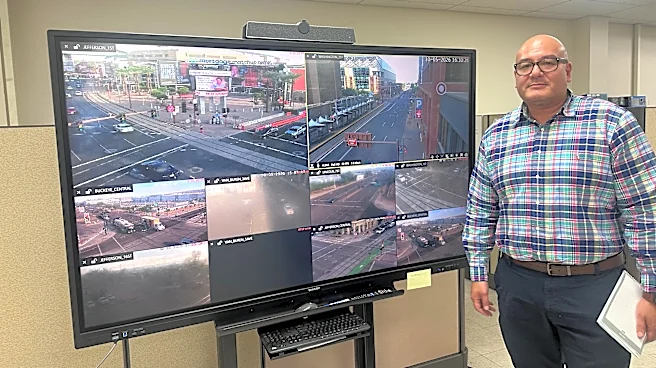
During the upgrade process, which has been ongoing for nearly two years, the city doesn't currently have a monitoring station with multiple video screens showing
live feeds from city intersections ― standard equipment for the state, large counties and several other Arizona cities.
Even if it did, as The Republic previously reported, the upgrade has shut down hundreds of intersection cameras that monitor traffic, and most of the network is offline on a daily basis.
The problems make the traffic system less efficient, meaning slower responses when signals have problems like timing malfunctions that make vehicles wait needlessly at red lights.
City officials maintain the glitches don't affect traffic safety, though a member of a city traffic safety board wants that checked out.
Wilson mentioned the new tracking plan after The Republic asked whether recent upgrades at some intersections were actually working. He said officials have been working on the plan to report that for about a month.
Officials only recently found out how many traffic-monitoring video cameras are installed at its intersections.
Simon Ramos, the city's senior traffic engineer who's in charge of the upgrade project, said at a city meeting in April the city had "roughly 350" closed-circuit cameras at intersections throughout the city. But when The Republic inquired about the upgrade problems on Oct. 5, Ramos said the city had 587 of the traffic-monitoring cameras, about 450 of which were not sending images that day.
Asked about the discrepancy, John Trierweiler, spokesperson for Phoenix's Transportation department, said in a text message the extra 237 cameras "were installed and/or discovered since Simon gave that presentation in April." The city's inventory of cameras was always known, Trierweiler added.
Wilson said only some of the newly found cameras had been recently installed. Most were found in the "discovery process" that took place during the design of the new network or found at intersections by workers, he said, without explaining what that meant.
Many of the newly discovered cameras are among those that routinely don't provide images.
Ramos didn't respond to a request for comment.

Contractor says Phoenix traffic camera work should be done faster
Each of the city's 1,359 signalized intersections, including 118 HAWK pedestrian signals, can be connected to a central system using fiber optics cable or older wi-fi transmissions. But the older equipment needs modernizing in order to support newer software and the bandwidth for more devices, including cameras.
Ramos told The Republic the city's transportation department began the upgrade project to add new software and physical equipment to traffic signals at hundreds of intersections after a network crash in early 2024.
Bruce Littleton, a former traffic engineering supervisor who led the city Traffic Management Center until March 2024, said the problem resulted from the addition over time of more cameras and other advanced equipment at intersections.
The city's intersection network, connected by fiberoptic cables and less-efficient wi-fi radio signals, eventually couldn't handle the load, Littleton said.

Yet the camera and connectivity problems have apparently persisted for two years or more. During that time, city workers haven't been able to monitor traffic thoroughly or make remote fixes as usual. They've been relying more heavily during the upgrade on complaint calls from citizens and driving to intersections to make manual fixes like resetting internal clocks that control signal timing.
The Traffic Management Center and its six employees were moved out of City Hall in mid-2024 to the Signal Shop, a city facility at 22nd and Jefferson streets. The center's "wall" of traffic-monitoring video screens that city officials and visitors had seen for years at City Hall has not been replaced.
With many or most of Phoenix's closed-circuit cameras at intersections dark, city staff can't see traffic problems as rapidly. Combined with the lack of data coming from intersections without network communication, staff members have to drive out to intersections to know what's happening there and fix problems that could be handled remotely with a working network.
Because they can't respond to problems as quickly as they otherwise might, motorists collectively spend more time in traffic that could be reduced, or stuck at a red light when no other vehicles are around.
Officials shared a rendering of the new Traffic Management Center expected to be built in a space at the Signal Shop by late 2027, when the Ramos said he expected his staff to finish the network upgrade.

Ramos previously told The Republic he sought approval for the upgrade in early 2025, and that work on the upgrade required cameras and intersections to temporarily go offline.
Records show the company the city hired to design the new network, the Mesa-based Enterprise Networks Solutions, presented a plan to Ramos in October 2024 to do the design for about $300,000. The design would require about 30 to 40 weeks' worth of work, according to the scope of work presented by the company's president and owner, Larry Potthoff.
Jeffrey Pourier, a former sales engineer for the company, led the design project from roughly December 2024 to August of this year. Ramos is now having the Traffic Management Center team build the network Pourier and his team designed.
Pourier previously told The Republic he believed completing the network upgrade with city staff would take two or three more years.
"It would certainly get done faster with professionals," he said.
Potthoff, whose company has nearly completed the design project, said he believed the upgrade would likely be fully built out in a year or two depending on the resources the city puts on it.
Potthoff emphasized, as city officials have noted, that the lack of camera images and network connectivity problems does not mean traffic signals are displaying green lights that should be red, but that the nuanced effects do lead to more delays for motorists.
"Let's get it done quicker," he said. "That way − less pollution, less gas usage, less time on the road, more efficiency. So I say let's move faster than slower."
Vision Zero board to explore Phoenix signal upgrade process
Whether problems or delays in the upgrade process cause more collisions isn't clear. A 2024 study of Australia roadways concluded that reducing traffic congestion "may enhance road safety." Other studies haven't found any significant connection between traffic jams and safety.
Nevertheless, advanced technology at intersections is considered key to the city's plans of making streets safer.
"In many parts of the city, we are no longer able to build our way out of congested streets but must rather turn to smart technology to optimize traffic flow and improve safety for vehicles, pedestrians and bicyclists," city officials said in a May 2026 report to the Transportation, Infrastructure, and Planning subcommittee.
Upgrading intersection technology is also a goal of the city's ambitious Vision Zero program, which the city council adopted in 2022.
Phoenix has some of the highest death rates in the country for pedestrians and victims of red-light runners.
Vision Zero, which aims to eliminate all traffic deaths and injuries in Phoenix by 2050, has a $10 million annual budget and an advisory board. State and regional authorities are helping fund new traffic infrastructure in Phoenix and other cities, including upgrades to intersections.
In the advisory board's Oct. 14 meeting, board member Joe Yuhas, a political consultant, told fellow board members and city staff he wanted to see more details regarding camera and connectivity problems that The Republic had detailed in an Oct. 7 article.
One of the questions he'd like answered is when will the upgrade be complete. And he wants to know if the Traffic Management Center being unable to see what's happening or receive data from signals at most of the city's signalized intersections affects the safety of motorists.
Yuhas said he was "alarmed" by city officials' response in the Oct. 7 Republic story that the lack of camera images or network connectivity wasn't a safety issue. That stance minimizes the role advanced technology is expected to play in keeping citizens safer on the streets, he said.
"I really feel that there's multiple ways in which we're going to achieve Vision Zero by 2050, and one of them is technology," Yuhas said. ""So if our technology is failing in some fashion, you know, I'm concerned."
Discussion of the Traffic Management Center upgrade will be on the agenda for the Dec. 9 board meeting, he said.
After publication of the Oct. 7 article, The Republic also received an email from the Canada-based Miovision, a company that provides vehicle-detection technology and other equipment for intersections. The company said it has some of its equipment installed in Chandler and Phoenix.
Sofia Ashley, Miovision's public relations representative, said in the email company representatives would talk about how connected intersections reduce congestion, how Chandler is "worlds apart" from Phoenix in intersection connectivity and "how Phoenix's Vision Zero goal becomes nearly impossible to measure without a connected traffic system."
But when The Republic accepted the invitation, Ashley said an interview would no longer be possible.
"We thought we were good to go, but when Miovision mentioned their intent to talk with you to some of their municipal clients, they asked Miovision to pass right now," Ashley said.
Reach the reporter at rstern@arizonarepublic.com or 480-276-3237. Follow him on X @raystern
This article originally appeared on Arizona Republic: Phoenix 'discovers' hundreds more faulty traffic cameras | Exclusive