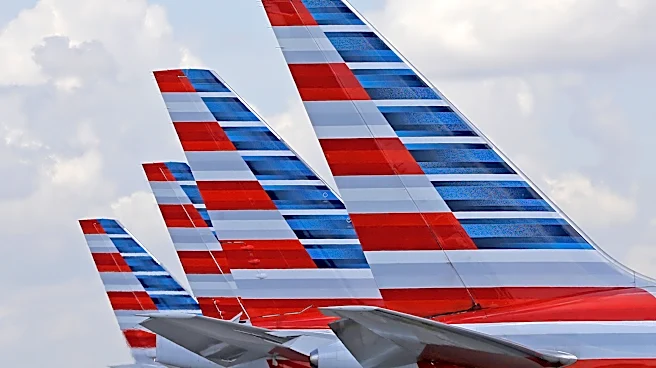




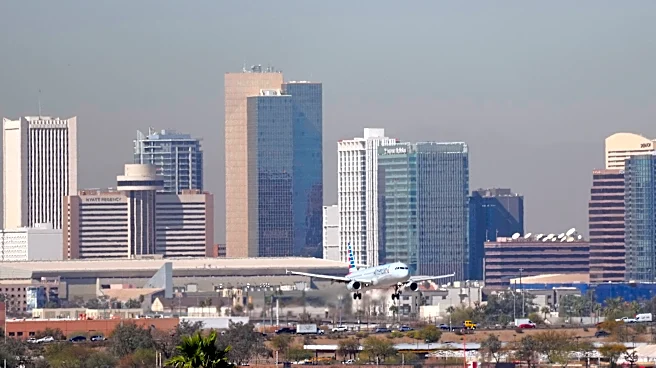

Two passenger jets with the same call sign crossed paths over Phoenix, creating the possibility that one crew could mistake the other plane’s instructions for its own.
Both aircraft were flying as American Airlines Flight 2482 early Aug. 14. One was descending toward Phoenix Sky Harbor International Airport from Chicago. The other was climbing away on a flight to Chicago.
On the recording, one crew alerted the air traffic controller to the duplicate call sign after another voice appeared to answer a clearance.
The controller began calling one “American 2482 on the arrival” and the other “American 2482 on the departure,” according to air traffic control audio.
The Federal Aviation Administration said the planes remained the required distance apart
throughout the encounter. American Airlines said both flights continued safely.
Cary Grant, an aviation professor and retired airline captain who reviewed publicly available flight tracks and the controller audio, reached a similar conclusion.
“This was not a close call,” Grant said. But that didn't mean the encounter wasn't unusual.
Expert weighs in
Grant is a professor of aeronautical science at Embry-Riddle Aeronautical University in Prescott.
He spent 20 years in the Air Force and retired as a lieutenant colonel. He then flew for United Airlines for 23 years, retiring as an Airbus captain.
Having two active flights with the same call sign is not necessarily unusual, Grant said. A delayed flight can remain in the system long enough to overlap with a later flight assigned the same number.
Airlines or air traffic controllers can distinguish the flights by adding a suffix such as “Bravo” to one call sign, he said.
Grant encountered modified call signs during his own airline career; however, he had never encountered two same-number flights operating near each other.
“What was uncommon in this was that they were in the same airspace talking to the same controller at the same time,” Grant said.
How identical call signs create confusion
Federal aviation guidance warns that identical or similar call signs can lead pilots to follow instructions intended for another aircraft.
Grant said that was the risk in Phoenix, as both crews were monitoring the same radio frequency and listening for “American 2482.”
A pilot who heard the call sign and an altitude of 9,000 feet could act without realizing the instruction was intended for the other flight, Grant said.
“If you’re not listening to the whole thing, you hear 9,000 and the call sign and you say, ‘Oh, that was for us,’” Grant said.
In a worst-case scenario, both aircraft could have headed toward the same altitude as their routes crossed.
Grant said the danger came from the possibility of a mistaken instruction, not from the aircraft already being dangerously close.
How the controller responded
The controller assigned the departing flight an altitude of 9,000 feet and the arriving flight an altitude of 10,000 feet. By doing so, the controller removed the ambiguity by identifying the aircraft as the arrival and the departure each time he spoke to them.
“I thought it was handled very well,” Grant said.
He said the publicly available flight tracks appeared to show several thousand feet of vertical separation when the duplicate call signs were identified. His assessment relied on estimated altitudes rather than official FAA findings.
The FAA has not disclosed the aircraft’s closest distance or provided a detailed chronology of the encounter.
Other safeguards existed
Grant said additional safety systems could have warned controllers and pilots if the aircraft had continued to converge.
Air traffic controllers use conflict alerts that warn when aircraft are approaching each other, he said.
The aircraft also carry Traffic Collision Avoidance Systems. The system can warn pilots of nearby traffic and, if needed, direct one plane to climb while directing the other to descend.
Airline pilots encounter such scenarios during recurring training and must follow a system’s directions, Grant said.
Why duplication was not caught remains unclear
American Airlines has not publicly explained why the two flights retained identical call signs as they entered the same airspace.
The controller said on the recording that he would file a mandatory occurrence report.
Grant said such a report can prompt an internal review of an aviation event and the procedures surrounding it. The review could examine whether the airline should have modified one flight’s call sign or whether air traffic control systems should have identified the duplication sooner, he said.
Arizona Republic reporter Perry Vandell contributed to this article.
Have a news tip? Contact The Arizona Republic and azcentral.com at newstips@arizonarepublic.com.
Rey Covarrubias Jr. is a reporter for The Arizona Republic and azcentral.com. Email him at: rcovarrubias@azcentral.com, and connect with him on Instagram, Threads, Bluesky and X (formerly Twitter) at @ReyCJrAZ.
This article originally appeared on Arizona Republic: Expert explains what kept 2 AA jets apart above Phoenix