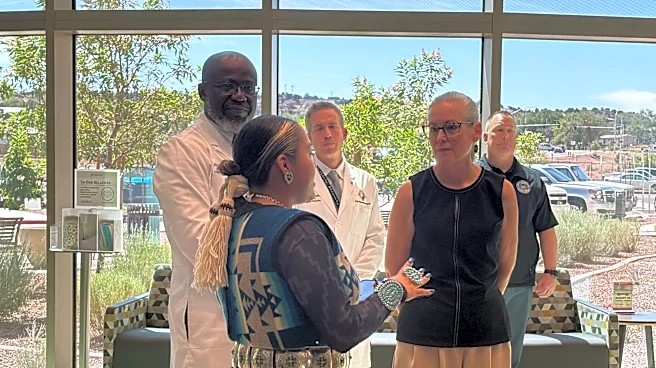



GANADO — As Gov. Katie Hobbs toured the new six-chair dialysis center under construction at Sage Memorial Hospital on the Navajo Nation, she emphasized the ongoing challenges of accessing health care in rural communities.
Hobbs, the first Arizona governor to visit all 22 federally recognized tribes in the state, underscored the critical need for health care facilities like Sage Memorial Hospital — continuing to expand its services as it celebrates its 96th anniversary — to serve rural and tribal communities.
"I know how many challenges we have in rural and tribal health care access," Hobbs told The Republic. "So many people have to travel hours and hours to get the care they need. This hospital is so critical to addressing that access."
Sage Memorial
Hospital marked its anniversary with a community event on Aug. 26, attended by Hobbs. The celebration came nearly two years after the hospital opened its new $177 million state-of-the-art facility, located not far from the original hospital built in 1930.
That first facility brought modern amenities to the community, including a surgical unit and X-ray department, and established the first nursing school for Native Americans, which trained women from more than 20 tribes and earned accreditation from the state of Arizona.
The anniversary celebration also gave hospital leadership an opportunity to give Hobbs a tour of the new facility, including the six-chair dialysis center under construction. Hobbs helped secure a $3 million investment in the state's fiscal year 2026 budget to support the dialysis center’s construction. The visit marked Hobbs’ seventh trip to the Navajo Nation since taking office in 2024.
"We worked to identify what the need was and were able secure it in the budget," said Hobbs. "I'm proud of the work we have done to build partnership all across the state. We have expanded the scope of the work the Governor's Office of Tribal Relations does by 600% and we will continue to build those partnerships."
Advocating for a community need
Sage Memorial Hospital serves an area with approximately 11,000 people across eight Navajo communities, including Ganado, Steamboat, Klagetoh, Wide Ruins, Greasewood Springs, Cornfields, Kinlichee and Nazlini. Many Navajo patients must travel long distances for dialysis, putting significant burdens on patients and families.
The nearest dialysis center is about over 30 miles from Ganado in Tse Bonito, New Mexico, while the next option in the area is in Chinle, another 30 to 40 miles away. While those distances may not seem significant, the journey can be a major challenge for patients due to little or no public transportation, rising gas costs or lack of a reliable vehicle. For those requiring regular dialysis treatments, the repeated travel can create an added financial and logistical burden.
"We did the calculations and we saw there's a need. Our dialysis center is not going to be huge and that will not be enough, so we're already thinking about planning to do a mobile dialysis in Greasewood because there's such a need," said Melinda White, chief executive officer of the Navajo Health Foundation–Sage Memorial Hospital. "Our whole purpose is patients first. Sage Memorial Hospital looks at health care as 'how do we make it accessible? How do we make it equitable?'"
White explained that during construction of the new hospital, leaders faced difficult decisions about whether to scale back services to manage the project’s costs. The hospital was required to pay $7 million for two stoplights, adding a significant financial burden to the project and ultimately forcing the hospital to put completion of the dialysis center on hold.

Seeking to recover some of those costs, White said the hospital began educating state officials and advocating for funding through the Arizona Department of Transportation. That attempt wasn't successful, but through more advocating, hospital leaders were able to get $3 million for the dialysis center through a grant that originated from Senate Bill 1575, sponsored by Senator Theresa Hatathlie and approved by the Arizona State Senate in early 2025. This bill targeted health care needs in rural Native communities, particularly for diabetes care.
Historically, almost no Navajo suffered from diabetes. But because of scarcity of wholesome groceries within the Navajo Nation, one in three Navajo are now diabetic or pre-diabetic. In some regions, health care workers report diagnosing diabetes in every other patient, according to the Community Outreach and Patient Empowerment.
Dr. Kenneth Anaeme, chief medical officer at Sage Memorial Hospital, emphasized the need for improved local dialysis care. Apache County currently has 324 active end-stage renal disease patients, while Navajo County accounts for 400, bringing the total to 724 individuals who could greatly benefit from enhanced access to treatment.
"Here we call the people who come to our health care, relatives," said Delores Noble, chairwoman of the SMH board. "They are not patients, they are relatives."
Tribal hospital going strong after nearly a century in operation
Jim Kristofic, author of "Medicine Women: The Story of the First Native American Nursing School," which chronicles the history of Sage Memorial Hospital’s pioneering nursing program, also spoke at the celebration, sharing the hospital’s rich history and its lasting impact on the community.

The School of Nursing would operate for 20 years at Sage Memorial Hospital, until June of 1951. It graduated more than 130 nurses from more than 50 tribes. In 2008, the Department of Interior recognized the school and Ganado Mission as a National Historic Site, according to Kristofic, who also grew up in Ganado.
Sage Memorial Hospital traces its roots to 1911, when a small clinic operated from the back room of the stone church at Ganado Mission, treating trachoma, a bacterial eye infection that could cause blindness.
In 1928, Dr. Clarence Salsbury began construction of a new hospital with Navajo crews before funding was even secured. The Russell Sage Foundation provided much of the construction funding, leading to the hospital taking the name Sage Memorial Hospital.
Kristofic emphasizes the significant role Navajo workers played throughout the construction of the hospital, from its early stages, and again when it was being rebuilt. A new Sage Memorial Hospital building was dedicated in 1963.
"When you hear him talk about the area and the buildings, you have a little bit more investment into the place, especially for the people who aren't from here," Christian Bigwater, chief patient experience officer, said of Kristofic. "There is a lot of innovation that has been apart of the community. At one point, we used to get places like Mayo (Clinic) and Cleveland (Clinic) come here because it was the central location where medical experts could gather. We want to bring it back to that point."
Hobbs toured the new hospital for the first time, taking in the 140,296-square-foot facility, more than double the capacity of its predecessor. As Bigwater, who is also an artist, walked ahead of the tour, he pointed out the artwork displayed throughout the hospital’s bright, welcoming halls. He explained that the hospital was given a budget to purchase artwork from local artists, as well as Navajo and other Native artists from other tribes. He said there are two or three pieces from Non-Native artists as well.
"We want you to feel welcome," said Bigwater. "We want you to feel like this is your home."

Traditional healing and Western medicine are intertwined
Through Kristofic’s research and writing on Sage Memorial Hospital, it becomes clear that Western medicine and traditional Navajo healing have long been intertwined at Sage Memorial, working together to provide essential care to the Navajo community.
During the 1918 flu epidemic, doctors traveled miles—sometimes as far as Chinle—to treat patients. Drs. Alice and Gary Burke later helped build the adobe hospital at Ganado Mission and traveled more than 5,000 miles in their first year treating patients.
"During those travels, they treated a hataałii (medicine man), who took their medicine in front of 20 people and encouraged them to visit the doctors," according to Kristofic. "From then on, people visited the adobe hospital every day. They trusted the doctors to perform surgeries on their relatives."
But that trust was nearly shaken after Salsbury, a surgeon with 20 years of experience, replaced the Burkes in 1927. During his first surgery at the hospital, a young local girl died from an embolism, threatening the hard-earned trust the community had placed in the doctors. Her relatives decided they would run him out of Ganado or, perhaps, kill him. But a local hataałii named Hastiin Łichíí Deez’áhí (Red Point) intervened and asked the relatives to forgive Salsbury, according to Kristofic.
“Sometimes I have used all my skills as a medicine man, and yet the sick one dies,” he said. “But I keep on trying, because I want to save lives. So it is with the bilagáana medicine man.”
During her tour, Hobbs was able to visit the traditional hogan on its campus, which is used to support culturally integrated behavioral health and healing services. Also, next to it set up for the event was a teepee, an aspect of wellness that is part of the hospital's Office of Indigenous Medicine.
"We have our own traditions and own culture, our own ways of healing and wellness, that's what we are trying to incorporate into the hospital as part of our model," said Bigwater. "As part of the healing process."
Isaiah Tsosie, a traditional practitioner assistant, and Richard Laughter, the hospital’s director of behavioral health and the only Navajo psychiatrist practicing on the Navajo Nation, sat inside the teepee as a fire burned at its center. The fire was available for those who wanted to be smudged by Tsosie and burn cedar as part of traditional practices.
With three traditional practitioners in the program, Tsosie said the clinical side refers patients to them, and this program is essential to help bring back balance and harmony to patients. They also hold sweat lodges for patients, as well as traditional prayers.
"People come to mental health for various reasons," said Laughter, who was a pivotal person to establish the Office of Indigenous Medicine. "We are trying to regain a balance and the way we are going to do it is to utilize our mind. What psychiatry and mental health has to offer is we have medication to help, counseling to help, but now we the Office of Indigenous Medicine, for those who believe in that way, that they can be able to come and do the cultural aspect, too."
Arlyssa D. Becenti covers Indigenous affairs for The Arizona Republic and azcentral.com. Send ideas and tips to arlyssa.becenti@arizonarepublic.com.
This article originally appeared on Arizona Republic: Dialysis center fills health care gap on Navajo Nation, Hobbs says