






An Arizona federal judge was photographed on the balcony of a swanky Montenegro residence belonging to a convicted international fraudster, fueling speculation about his efforts to secure a pardon from President Donald Trump.
U.S. District Judge Susan Brnovich, the widow of former Arizona Attorney General Mark Brnovich, denied helping George Cottrell, a politically connected British socialite who was convicted in Arizona nearly a decade ago for a money-laundering scam.
Brnovich, in a statement to The Arizona Republic, said it was "emotionally devastating" that a family trip to a country near and dear to her husband was being used to further a scandal in the British press.
"This was one of my late husband’s favorite places on Earth, and it’s where
his father’s family is from. Just being there made us each feel closer to him," Brnovich told The Republic. "Naturally, it has been emotionally devastating to see our trip mischaracterized by British tabloids and used by those who seek to score political points here at home or abroad."
Montenegro is a small country on the Balkan Peninsula, sandwiched between Albania and Bosnia and Herzegovina on the Adriatic coast.
Brnovich said Cottrell, who is a family friend, invited them to see the view from his balcony while they were visiting. She said Cottrell did not pay for their trip and they did not stay with him.
"We paid our own way and had separate accommodations," she said. "Lastly, I have nothing whatsoever to do with any effort of Mr. Cottrell’s to seek clemency, and we did not discuss it.”
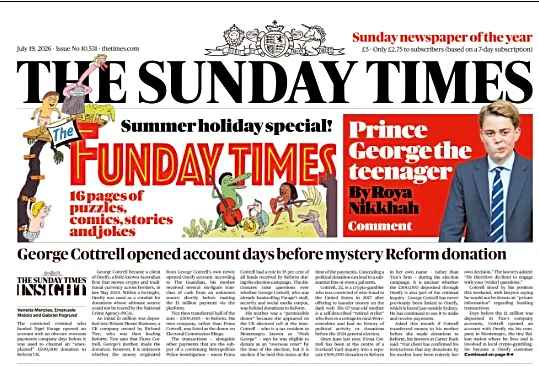
The picture of Brnovich on Cottrell's balcony in a red Wisconsin T-shirt captured by the Sunday Times set off rampant rumors in the British press about her influence in the Trump administration. News reports attempted to tie her visit to her husband's past consulting work for Cottrell, who wants a presidential pardon.
An investigation by The Times connected Cottrell, who is known as "Posh George," to a murky crypto gambling operation in the UK. It found he privately bankrolled Nigel Farage, a right-wing populist member of Parliament and longtime political party leader. He resigned days after the story broke.
Farrage, an ally of Trump, failed to disclose a web of "gifts and payments from Cottrell that helped pave Farage’s path to Westminster," the seat of British government, according to the Times. That included paying for Farage’s staff and security, lavish hotel stays, transportation and the use of a five-story house near Buckingham Palace — all of which appear to violate rules requiring members of Parliament to report benefits that could pose conflicts of interest.
Susan Brnovich would not address her husband's work for Cottrell. She said through a spokesp[erson that she was not privy to details and that attorney-client privilege prevented him from speaking with her about it.
Federal records show Cottrell gave Mark Brnovich at least $5,000 for unspecified “legal advice” in 2025, the Times reported.

Mark Brnovich served as Arizona attorney general from 2015 to 2023. He died of a heart attack in January at age 59.
Cottrell made no secret of his friendship with the former prosecutor. He dedicated a book that he coauthored to Brnovich.
Its title: How to Launder Money: A Guide for Law Enforcement, Prosecutors and Policymakers.
From aristocrat to cryptocrook to federal inmate
Cottrell is is an aristocrat whose family line includes a baron and slight brushes with royalty.
He's the 32-year-old son of a former model who once dated Charles III, the king of the United Kingdom. Cottrell is heir to a family soap fortune. He also did eight months in U.S. federal prison in 2017.
IRS agents nabbed Cottrell on his way back to London in 2016 after he attended the Republican National Convention in Cleveland with Farage. The then 22-year-old populist party adviser was held in Phoenix on money laundering, mail and wire fraud and blackmail charges related to extorting money from drug dealers.
He was the front man for a 2014 scheme that started when someone identified only as "the Banker" advertised money-laundering services on a black-market website through a dark-web network called the Onion Router, according to federal authorities.
Undercover agents posing as drug dealers contacted the Banker about laundering $50,000 to $150,000 a month in drug money. The Banker directed agents to an associate named Bill, later identified as Cottrell. Court records show he exchanged instant messages from London to agents in Phoenix through an encrypted platform called Cryptocat.
Cottrell explained in his plea agreement "various ways criminal proceeds could be laundered," including how to transfer large amounts of cash out of the United States to avoid reporting requirements and disguising proceeds from criminal activity as legitimate business income for tax purposes.
Cottrell told agents he could launder the money with complete anonymity using offshore accounts and in 2014 agreed to meet agents in Las Vegas, according to the indictment. In June 2014, Cottrell told undercover agents to send $20,000 to an associate in Colorado, who would move the money into Cottrell's bank accounts before transferring it back to them, according to the indictment.
About a week later, Cottrell threatened to report the money laundering and drug trafficking to authorities unless the agents agreed to pay him 130 bitcoin, at the time worth $80,000.
Cottrell initially was charged with 21 felonies and faced up to 20 years in federal prison.In exchange for his guilty plea, federal prosecutors agreed to drop all but one count of wire fraud.
Neither Brnovich was connected to Cottrell's money-laundering prosecution
The president has total control over pardons under the U.S. Constitution. As a federal judge, Susan Brnovich has no legal say in who Trump decides to grant clemency.
A separate division of the Department of Justice called the Office of the Pardon Attorney helps to process thousands of clemency applications each year by investigating cases and making recommendations.
Trump has a record of offering pardons to his political allies and donors. On his first day in office in his second term, Trump wiped the slate clean for more than 1,500 supporters who stormed the U.S. Capitol to try to halt certification of election results on Jan. 6, 2021.
Susan Brnovich recently dealt a blow to the Trump administration's attempt to gain control of voter rolls in at least 30 states before the 2026 midterm election. She dismissed a Department of Justice lawsuit with prejudice in April, saying it lacked the authority to seize Arizona's voter registration list.
Brnovich declined to address questions about potential conflict of interest — or the appearance of a conflict — posed by a sitting judge socializing with a convicted criminal, let alone one her late husband appeared to be helping.
Neither she nor Mark Brnovich had any part in the case against Cottrell, which was prosecuted in federal court by the Arizona U.S. Attorney's Office. The case was overseen by Judge Diane Humetewa.
Cottrell was out of prison by the time Trump appointed Brnovich to the federal bench in October 2018. Before that, she served as a Maricopa County Superior Court judge for nine years.
Mark Brnovich, a longtime Republican, was appointed to lead the Arizona Department of Gaming in 2009 and stayed until 2013 when he resigned to run for attorney general in the 2014 election.
Brnovich launched a campaign for U.S. Senate in 2021 while still serving as attorney general. But he ran afoul of Trump after refusing to support claims that Arizona's 2020 election was rigged in favor of Joe Biden. Trump publicly lambasted Brnovich for his refusal to overturn election results and never endorsed him. Brnovich lost in the Republican primary.
But Brnovich didn't reject Trump. Out of office, he embraced MAGA and began making frequent trips to Montenegro, where he might have crossed paths with Cottrell, according to the Times.
Cottrell had moved to the country while it was going through a digital currency boom. Brnovich was soon getting face time with Farage, who featured the former Arizona attorney general on his GB News show four times in 2024, the Times reported.
It was a two-way street. Brnovich gave public shout-outs to Farage, calling him Britain's next prime minister, the Times said. Brnovich also socialized with Farage at an elite private club in Mayfair where Cottrell did business, The Times said.
Trump in 2025 appeared to forgive Brnovich, nominating him as the U.S. ambassador to Serbia, which shares a border with Montegnegro. Trump gave him a full-throttled online endorsement in March.
"As the son of refugees who fled communism, Mark will be a strong advocate for Freedom, and always put AMERICA FIRST. Congratulations Mark!" Trump said in a Truth Social post.
An undated picture published by the Times showed Brnovich sitting with Montenegro's prime minister, Milojko Spajic, at a seaside eatry near Cottrell's home with its balcony view. They were all smiles.
Whatever future Brnovich envisioned at the time ended abruptly. In October, the White House withdrew Brnovich's nomination.
Trump offered no explanation.
Robert Anglen is an investigative reporter for The Republic. Reach him at robert.anglen@arizonarepublic.com. Follow him on X @robertanglen.
This article originally appeared on Arizona Republic: Arizona federal judge denies helping British fraudster seek a pardon