



Christopher Shayne is a hard-rocking singer-guitarist from Phoenix whose music is a gritty blend of Outlaw Country, Southern rock, Americana and blues-rock.
Given that influence, getting in the studio with the legendary musician Shooter Jennings to record an album was “one of those dreams come true,” he says.
The son of Outlaw Country legends Waylon Jennings and Jessi Colter has produced an album titled “High Noon” for the Phoenix rocker, who says he was on tour in Europe when he got the news that Jennings had agreed to do the record.
As Shayne recalls, “Our manager drops by, and he’s like, ‘Hey, we're gonna work on a new album as soon as you get back. We’ve got a little bit of time to write, but we're gonna go in with Shooter.’”
Shayne had opened
for Jennings at a Scottsdale nightclub in 2017, but that’s not why this project came together, Jennings said.
“I mean, his name set off a bell for me, but it wasn't until I got with him that he reminded me of that,” Jennings says. “I don’t remember if I saw the show or not. I probably didn't, knowing me on the road. I very rarely went in. I was like a hermit on the bus.”
How Shooter Jennings found himself producing Christopher Shayne
It was Jonathan “J.B.” Brightman, a former Buckcherry bassist who’s been friends with Jennings for 20-odd years, who set the wheels in motion.
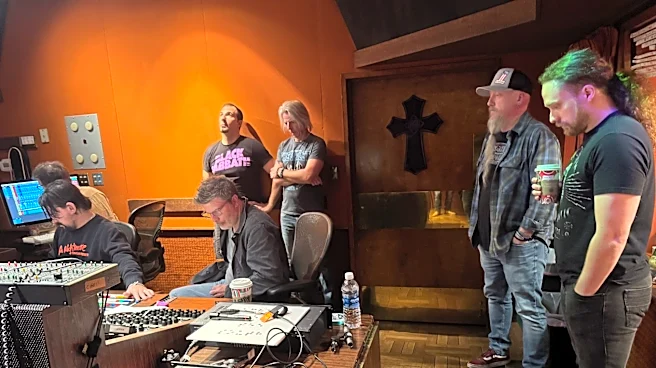
Jennings had moved into Studio 3 at Sunset Sound in Hollywood and was looking for projects to record.
“J.B. and I were hanging out,” Jennings recalls. “And he was like, ‘Hey, there's this band I know about that you’d do well to work with. I think you can help them get a good sound.’ Which anything J.B. says I'm down with.”
It wasn’t the first time he’d heard Brightman mention Shayne.
“He went into detail about his voice, how cool he was and how his manager was his friend,” Jennings says. “So essentially, he set us up and I met him and they were just the nicest guys. But that's how it happened. It was just a friend who had been watching Christopher and thought he had a lot of talent.”
Shayne's guitarist turned up with one of Waylon Jennings' old amps
Jennings watched some videos of Shayne and was impressed with what he saw, but he also had some definite ideas to help him lean into his strengths.
“My whole thing was they're a real rock band,” Jennings says. “But a lot of stuff that happened in the early 2000s changed the sonics of rock music in a way. A lot of bands feel they have to play in the modern world or they'll become a throwback. And I felt like reversing the years on the gear would kind of de-modernize some of the elements modern rock has.”
It didn’t hurt that Shayne’s guitarist showed up at the studio with vintage gear that was even better than what Jennings had on hand.
“The guitar player had these amps of my dad's that were sold in this estate sale we did years ago,” Jennings says. “And it sounded amazing. But I understood exactly where they were going and it was really cool because they kind of let us do it the way we do it. And we got to do some really cool stuff that I felt was Bowie-esque in the way we were treating his voice and other things.”
This newsletter goes to 11. Sign up for weekly music news.
'We walk in and there's Prince's piano sitting in the corner'
The album was recorded in two sessions with Jennings at Sunset Sound, which is also where Prince recorded several of his most iconic records.
“It was literally Prince's old studio,” Shayne says. “We’re already embracing the history and understanding the kind of gravitas that this studio holds. And we walk in and there's Prince's piano sitting in the corner. We're like, ‘OK, well, I don't know what song needs it, but we're gonna throw that on something.’”
They ended up finding a place to tuck in some piano. As Shayne says, they went into that recording session thinking “we have to incorporate the nature of where we are into this thing, whatever that is.”
Jennings proved to be the perfect fit Shayne naturally assumed he’d be.
“Shooter just kind of understood what we were,” Shayne says. “And we gelled really well because he’s both rock and country. Obviously country just because of who he is. But he's done a Marilyn Manson record and a few others. So when we showed up with our mixture of rock and country and a little bit of a Southern sound in there, he knew exactly what we were aiming for.”
Shooter Jennings: 'They were just really on fire'
Shayne arrived at Sunset Sound with more material than they could possibly have used.
“This is something I do on every record, is I sit there and I overwrite,” he says. “I think we showed up to the studio with 30 songs in tow. We didn't know which ones we were gonna do, so we just rehearsed all 30 knowing it was gonna get cut down. I think we cut it down to about 10 by the time we got done sorting through it all on that first day. But we overwrote, over-rehearsed, made sure we showed up ready to go.”
From there, the recording just flowed naturally.
“They’re a really great band,” Jennings says. “And they were tight as (expletive). Like, every take was great. They had it down. So it went very fast.”
By the time they returned a year later, Jennings says, “They were just really on fire. It was inspiring to see that they had grown so much. I've loved watching the trajectory of this band.”
'I would just pinch myself every single day we got to work with him'
It was Jennings’ idea for Shayne and his bandmates to record together live instead of tracking individual parts.
“A lot of these new recordings are like bricklaying,” Jennings says. “They do the drums and they get the drums all edited and perfect. Then, they do the guitar, and they build it that way. That kind of gives it this, like, perfect thing. And to me, the essence of rock 'n' roll and what it is, is the band plays and you capture it. They're playing live. I don't like to do it any other way, really.”
As Shayne recalls their first day in the studio, “We walk in and he goes, ‘All right, everybody go set up. We're gonna just play this record.’”
Working with Jennings was a thrill for Shayne, who says, “I would just pinch myself every single day we got to work with him.”
Jennings says he loves what they managed to capture on “High Noon.”
“It’s like a diary of exactly where they were,” he says. “I felt like he was learning how to use different sides of his voice. There's a guy I love named Dax Riggs, the singer in Acidbath. And I felt like Christopher can hit this low range similar to him in a way that I found really cool. I dig the record, and I'm happy for him, man.”

The Jennings family has strong ties to Phoenix; Jessi Colter still lives here
Working with a band from Phoenix was a cool experience for Jennings, whose family has strong ties to Arizona.
Waylon Jennings developed the sound that made him famous working seven nights a week with the Waylors at a place called JD’s in the Tempe river bottom. He was living in Chandler when he died and was laid to rest in Mesa. Jessi Colter was born in Phoenix and lives there now.
“When I moved to LA, they moved back to Arizona," Jennings says. "It was always my dad's favorite place, the place I think he felt the most at peace. I love Arizona, man. My children love Arizona. We travel there all the time to spend time with my mom. I've always loved it. Ever since I was a little kid. We used to come out there in the winters and I would climb Camelback Mountain back when I had a minidisc player.”
Jennings feels a kinship “with people from Arizona, from the West and for sure with Christopher,” he says. “I mean, he's the nicest guy. Christopher could not be a nicer guy and he couldn't be somebody you want to succeed because of how he is. He's just someone you like, but the Arizona thing definitely comes through, too. I definitely feel a kinship to people from Arizona. My dad's buried in Arizona, you know?”
The album's lead single was a cover of Tesla's 'Modern Day Cowboy'
The “High Noon” album is set to be released sometime in 2027, but three singles have already been released – “Modern Day Cowboy” in 2025, and “High Noon” and “Coming Around,” which won Best Music Video at the Mesa International Film Festival, in 2026.
“Modern Day Cowboy” is a Tesla cover.
“What's funny is we recorded that last,” Shayne says. “That was a late addition just because we were sitting there thinking, 'You know what? Let's do something a little darker, a little bit heavier, just to hold on to our history.'”
The cowboy vibe was a natural fit for Shayne.
“I mean, I'm born and raised in Arizona, right?” he says. “So it's kind of ingrained in me, this kind of Wild West thing. And it occurred to me prior to this record that I haven't really seen an artist own that part of the West in a non-kitschy kind of way, something that is just more genuine. So I really wanted to play with some Western motifs.”
Shayne's new single, 'Arizona,' is about how 'this is where my heart is'
His latest single, “Arizona,” isn’t on the album. He’s taken a break from rolling out the “High Noon" music to release a song co-written and produced by Brian Howes, whose credits range from Nickelback and Hinder to a Boys Like Girls track that features Taylor Swift on vocals.
He and Howes spent a week in the studio working on the song.
“I really wanted to tell this story of how I've been all over the world, I've gotten to do a lot of crazy things with music, but nothing feels like coming home to Arizona,” he says. “It’s about leaving and trying to find yourself. And then, you come right back to Arizona knowing, ‘This is where my heart is.’”
He liked the song too much to sit on it until he’d made it through the “High Noon” album cycle.
“We were like, ‘You know what? Let's push this out there because it just feels like the right time to do this — to celebrate Arizona,’” Shayne says. “And you look at the way that music is now, it used to be we were an album market and that has pretty much fallen away with Spotify and everything. Music is a singles game again, like it was in the ’60s.”
Why Christopher Shayne started calling his music Wild West rock
As he continues to release new music, Shayne has taken to referring to his sound as Wild West rock.
“My entire career, I have been told to pick a road,” he says. “I started playing music with this kind of deep blues influence, then fell in love with ZZ Top. But being so close to LA, we also get some of that in there. So I never had an opportunity to really establish what it is I do. People have tried to call it Southern rock. People have tried to call it Outlaw Country and all these other things. I never felt like I quite fit in with any one of those things.”
Wild West rock is a label he arrived at to explain where he was from while touring Europe after initially introducing himself onstage as Christopher Shayne from Arizona.
“I remember talking to some fans after a show,” he says. “They go, ‘I've only ever been to New York. I don't know where Arizona is in relation to New York.’ I said, ‘Well, we actually just did that drive. It's 36 hours.’ They go, “We don't have 36 hours of roads in the UK.” The next night, I go, ‘Hey, we're Christopher Shayne. We're from the Wild West.’ And immediately the crowd responded and knew exactly what we were.’”
So he started applying the term to their sound.
“And it immediately became clear to me, if we define what our own sound is, if we give it a moniker, it will help carry that forward instead of people constantly trying to box us into, ‘Well, you guys are rock or you guys are this or you guys are that,” he says. “It's like, ‘No, it's Wild West.’ It takes influences from Southern rock, from Texas blues, from California. We wanted to really hammer home the idea that it's gonna be different when you walk in the door.”
Ed has covered pop music for The Republic since 2007, reviewing festivals and concerts, interviewing legends, covering the local scene and more. He did the same in Pittsburgh for more than a decade. Follow him on X and Instagram @edmasley and on Facebook as Ed Masley. Email him at ed.masley@arizonarepublic.com.
This article originally appeared on Arizona Republic: How Shooter Jennings helped a Phoenix rocker find his Wild West sound