





In Arizona, some side quests get a little out of hand. For Ernest “Ernie” Adams, it all started with an old refrigerator. Well, actually, nine of them.
Adams had always dreamed of owning an antique car but couldn't afford one. In 1965, he remembered a refrigerator he'd seen as a teenager in the weeds back home in Nebraska. To him, its curves looked like the body of a tiny touring car. So he did what any determined tinkerer might: He cut up nine refrigerators and turned them into a miniature 1928 Chevrolet.
What Adams didn't know when he first fired up that little car was that he wasn't just building a toy, he was inventing a movement that would captivate thousands of other tinkerers and auto fans.
There was no elaborate manufacturing operation
behind the first car. There wasn't a sophisticated collection of machines or a team of engineers. There was a teenager figuring things out one piece at a time.
“That’s where I learned to start building a little bit at a time,” he said.
That approach stayed with Adams throughout his career. Rather than waiting for the perfect equipment, he learned to make what he needed.
“I make everything to the size that I want,” he said.
The birth of the dwarf car
For about a decade, he and several other builders produced various dwarf race cars. The vehicles were miniature versions of the types of cars that once dominated American racing.
But there was a problem; they needed a name for the creations.
“We didn’t know what to call it,” Adams said.
His neighbor, Tommy Vanderpool, suggested calling it a "dwarf." Adams looked it up in the dictionary and found that "dwarf" means an object smaller than average size.

The name stuck, and the dwarf race car class eventually spread far beyond Adams' Arizona workshop. Today, the cars race on dirt quarter-mile tracks around the country and have made their way into other countries.
The class of cars also became part of the story behind another form of miniature racing: Legends cars. Dwarf race cars have steel bodies and traditionally do not have fenders. Legends cars use fiberglass bodies with fenders over a dwarf-style chassis.
The origins of the Legends class eventually became the subject of a disagreement over who should receive credit for its creation.
According to Kevin Adams, Ernie's son, correspondence helped settle the history, with the Charlotte Motor Speedway eventually acknowledging Ernie Adams' role in creating the dwarf cars.
Then came another unusual moment in the life of a man who had begun building cars from refrigerators. Adams wanted to answer another question.
Could he make one street legal?

From the racetrack to the road
After spending 10 years building dwarf race cars, Adams decided to try something different. He wanted to build a miniature car that could cruise public roads.
He began his first street-legal build in the late 1980s. In 1990, he figured out how to make another set of bead roller dies for his homemade bead roller, allowing him to fabricate the components he needed.
The first street-legal dwarf cruiser was a 1939 Chevrolet. Adams finished it in 1991 and licensed it in 1992. Then he drove it to Des Moines, Iowa, and back.
The cars that followed became known as dwarf cruisers. Unlike the dwarf race cars, they weren't built for competition.
“They’re for cruising,” said Kevin Adams, and they are built with an unusual level of attention to detail.

Small doesn't mean simple
Look closely at one of the cars and the scale becomes apparent. The steering wheel is smaller. The seats are smaller. The dashboard is smaller. But everything is equally proportioned.
“They are identical replicas inside and out of what the real full-size car is,” Kevin Adams said. “They are simply dwarfed.”
That distinction is what makes the cars so unusually unique.
“You didn’t just scale the fenders or the body and have a big seat in the middle,” Kevin Adams said. “Everything inside and out is just spot on to what the real car is inside and out.”

He estimates approximately 3,000 working hours go into a dwarf cruiser. That works out to roughly three to five years for one car.
And yet Ernie Adams describes the process almost casually.
“There was no challenge to any of it,” said Ernie with a confidence that comes from decades of doing the work.
The workshop where everyone gathered
For Kevin, some of his earliest memories of his father are tied to the workshop.
“When I was growing up, Dad was always in the shop out back. If anybody wanted to find him, they didn’t knock on the door. They went out to the shop,” Kevin said.
Neighbors would stop by to watch Ernie work. People would sit and talk. Ernie would take a break and have coffee with them.
“There was always somebody back there,” Kevin said. “It was a good place to socialize.”

Kevin and his brother grew up surrounded by the cars, the tools and the people who came to see what their father was building. Eventually, they became part of the work themselves.
“We were all out there in the shop building race cars,” Kevin said.
For the Adams family, the cars were never simply machines. They were part of daily life.
When the collection became a museum
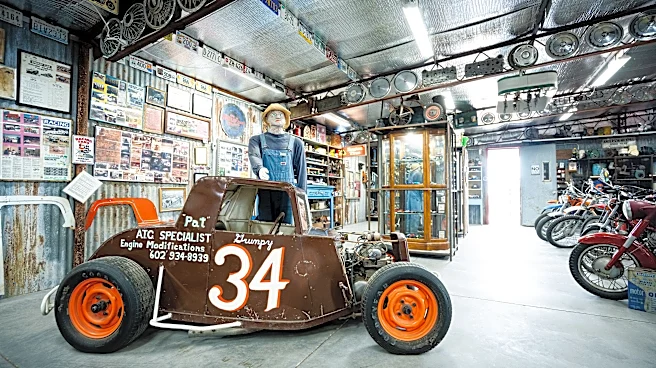
Tucked along a dusty stretch of Arizona highway, the Dwarf Car Museum in Maricopa looks less like a traditional museum and more like someone's wonderfully eccentric garage, which, in many ways, is exactly what it is.
"I started this museum,” Ernie added. “I built the cars in here all free-handed.”
The museum itself wasn't necessarily the original destination. The collection simply became large enough that visitors started calling it a museum.
“We got enough of them that people said it was like a museum,” Ernie said.

The Dwarf Car Museum was legally registered in 2009, though the collection had been open to visitors before then. Now it serves as a home for the cars Ernie spent decades creating.
The collection spans automobiles from 1932 through 1954, modeled after full-sized vehicles of the same era, giving visitors miniature snapshots of different eras of American automotive design. Ernie's favorite is reportedly a 1934 Ford sedan, a two-door model.
“There’s a handful of them that really stand out, and for different reasons,” Kevin said.
The cars aren't the only reason the museum feels different from a conventional automotive collection. The experience begins before visitors even enter the building.
“The whole driveway is lined with antiques and rusted equipment,” Kevin said.
Visitors tend to slow down as they approach.
“You see people going real slow coming in the drive because they’re looking at everything right away before they even come in the building.”
There are also Burma-Shave-style signs along the drive, a nod to an era when motorists traveling America's highways encountered sequential roadside signs that delivered jokes, warnings and slogans one piece at a time.

For the Adams family, the signs help establish the atmosphere. Then comes the building, which is an old steel structure dressed up like a vintage gas station. Inside, the dwarf cars share space with old toys, antiques and pieces of Americana.
It is not a museum where every object has been separated behind glass with several feet of space around it. There is a lot to look at.
One visitor found a description that stuck with the family.
“Organized chaos.” Kevin laughed at the phrase. “I love that,” he said.
The cars remain, even after the builder stops
Ernie doesn't build cars anymore. At 86, he has retired from the work that occupied so much of his life.
“I’m too old now,” he said. But he hasn't completely stepped away.

“I just watch the people come in and look at them.” That may be the most fitting role for him now. For decades, people watched Ernie build.
Neighbors watched from the workshop. Family members watched as he shaped steel. Racers watched as the dwarf cars evolved. Visitors watched as the collection grew.
Now Ernie watches visitors discover the finished work.
Kevin and his wife, Ginger Adams, help carry the museum forward, handling the practical details that come with maintaining a one-of-a-kind collection.
There are bigger car museums. Some have more vehicles, more staff and more polished exhibits.
But the Dwarf Car Museum offers something those places can't easily replicate: the story of one man's lifelong obsession, preserved in metal.
And inside an old steel building in Arizona, they have become something more than vehicles. They are history, shrunk down, built by hand and still telling the story of the man who imagined them.
Dwarf Car Museum
Address: 52954 W. Halfmoon Road, Maricopa.
Hours: 9 a.m.-1 p.m., Monday- Sunday.
Details: 520-424-3158. dwarfcarmuseum.com
Got a story you want to share? Reach out at Tiffany.Acosta@gannett.com. Follow @tiffsario on Instagram.
Looking for the best things to do in Arizona? Sign up for our newsletter.
This article originally appeared on Arizona Republic: How an Arizona man turned 9 refrigerators into a car movement