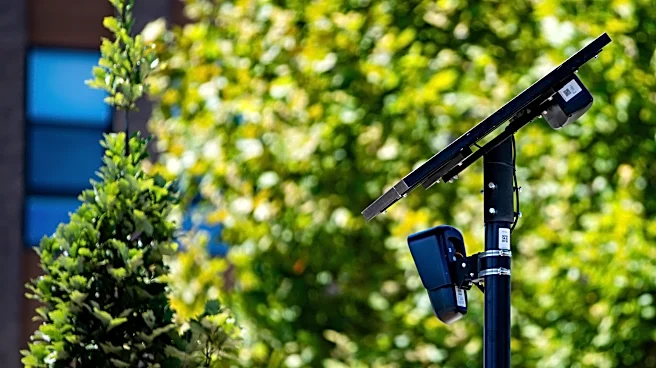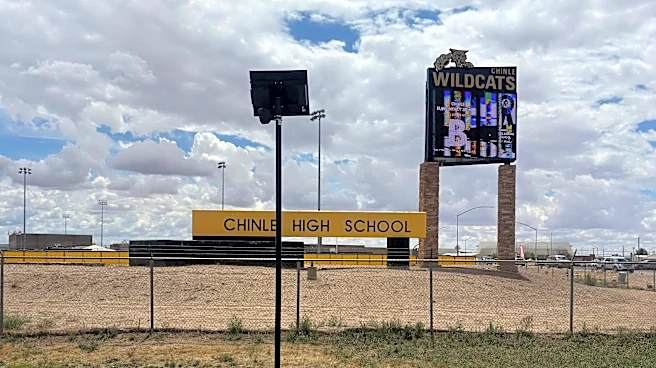





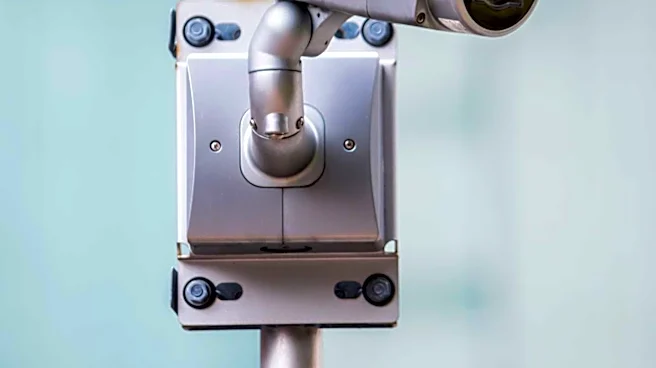


CHINLE — A Flock camera stands outside Chinle High School in the middle of the busy intersection in the large chapter on the Navajo Nation, and some community members are convinced that it's there to catch speeding drivers.
But these aren't speeding cameras. Instead, they read a vehicle's license plate.
Shell Higdon was at the Chinle Chapter House during the Central Navajo Nation Agency Fair on the weekend of Aug. 14, where she expressed her support for the cameras installed near the Chinle High School sign along U.S. Highway 191. Her reasoning echoed that of several other community members: She believed the cameras are a positive addition to the community because they will help catch speeding drivers.
"Honestly, as soon as I saw it I though 'finally,'"
said Higdon. "The way people drive around here is crazy. People zoom right by. On Route 7, the speed limit is 35 and people still go 65, 75."
But Flock cameras do not have speed-detection capabilities. Higdon’s belief, shared by other community members, highlights a broader lack of information—or the spread of misinformation—about the cameras on the Navajo Nation.
The misunderstanding raises questions about whether the public has been adequately informed about what these cameras actually do, critics say, what information they collect, and how that information is being used, especially after public backlash in cities in metro Phoenix over police officer misuse in recent weeks.
Elected officials, law enforcement remain silent
Flock cameras capture images of passing vehicles and upload information such as license plate numbers, vehicle make, model and color to a searchable database. Law enforcement officials can access this information to assist with criminal investigations and locate suspects. Despite their use in monitoring vehicles, Flock Safety cameras do not have speed-detection capabilities.
In an email to The Republic, Chinle Unified School District Superintendent Quincy Natay said the school "did not receive prior notification prior to installation from any of our stakeholders. My position is that if it will improve response/reaction time for Murdered Missing Indigenous Relatives or emergency situations then it should benefit the community."
The Republic reached out to Chinle Council Delegates Shawna Ann Claw, Eugenia Charles-Newton, Speaker Crystalyne Curley, the acting director of the Navajo Department of Public Safety, the director of the Navajo Criminal Investigators and the chapter house manager seeking comments and answers about the Flock cameras.
None responded. Staff at the Apache County District I office in Chinle also weren't knowledgable about the cameras.
But as reported in The Republic in July, the Council's Law and Order committee and its chair, Charles-Newton, held at least two public meetings with Flock representatives in 2025 about their partnership with the camera company.
In one of these meetings, Michael Henderson, the former director of Division of Public Safety, said the program would start with 417 devices across the Navajo Nation. During the January 2025 meeting, start-up costs for the Navajo Nation to purchase Flock devices were estimated at $1.8 million, with a recurring cost of about $1.5 million.
Charles-Newton indicated that the the Budget and Finance Committee had supported the proposal and that funding would be considered for inclusion in the Fiscal Year 2026 budget.
Misinformation about Flock cameras
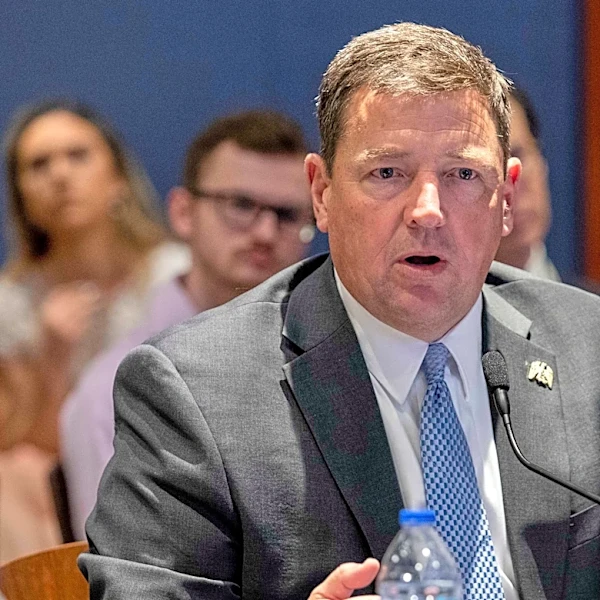
Carl Slater, a Council delegate and vice chair of the Budget and Finance Committee, represents the communities of Tsaile/Wheatfields, Lukachukai, Round Rock, Tséch'izhí and Rock Point in Apache County. With a Flock camera installed in the Tsaile community, Slater said he has not been able to obtain much information about its cost or information in general.
"I haven't been able to get a lot of information on this," Slater told The Republic. "So when it comes to the ongoing subscription fees... it's a $1.5 million fee per year, which seems outrageously high. We need to figure out what the return on our investment is going to be."
Slater said there has been misinformation surrounding the cameras and emphasized that he is not “categorically opposed” to their use. However, he said Flock cameras represent an expansion of the surveillance state, making it important for the Navajo Nation to carefully consider how it moves forward.
He suggested limiting data retention to a narrow window—such as seven or 30 days—and restricting the cameras’ use to specific public-safety purposes, including emergency response and locating missing people.
He also noted that constituents have reached out to him about the cameras, and he regularly discusses public safety concerns with community members. Based on those conversations, he said public safety remains a top concern for his constituents, and they want Navajo Nation to take meaningful steps to address these issues.
"We have funding for 300 officers and we have 120 right now...the biggest issue is getting people through the academy and its not necessarily the physical stuff, its things more academically related," said Slater. "There needs to be an all-above approach to public safety, but it can't be at the expense of our citizens' civil liberties. I hope that we don't use it as a crutch to eliminate the real police work that also needs to take place."
Will cameras fall under new AI policies?
A concern for Slater is the data should not be accessible in a way that allows an officer to misuse it—for example, checking on an ex-girlfriend’s new partner or using the information for personal reasons.
"So I do have some apprehensions, and that as a nation, just because we’re being confronted with new innovations doesn't mean we should turn a blind eye," said Slater. "We have to learn how to put these things in our terms."
The Naabik'iyati' Committee recently approved a position statement and established the Navajo Nation Artificial Intelligence Policy Working Group to protect Diné traditions and culture while strengthening data sovereignty.
Slater said he hopes the AI governance and policy team, through this new AI legislation, can help inform and put pressure on the police department and public safety agencies to strengthen their internal policies and controls to "make sure that there's appropriate management and elected leadership and citizen oversight of how these tools are being used."
With Navajo Nation leadership and public safety officials largely silent on concerns surrounding the cameras, aside from a press release issued by Flock confirming their partnership with Navajo Public Safety, Slater said the public disclosure and information process has been inadequate.
“I haven’t been involved in any decision-making related to it, but I do support testing the technology with appropriate safeguards,” Slater said. "The PD and public safety have a public information officer, there's no reason why there can't be an education system."
Arlyssa D. Becenti covers Indigenous affairs for The Arizona Republic and azcentral.com. Send ideas and tips to arlyssa.becenti@arizonarepublic.com.
This article originally appeared on Arizona Republic: Flock cameras on Navajo Nation pop up without public explanation