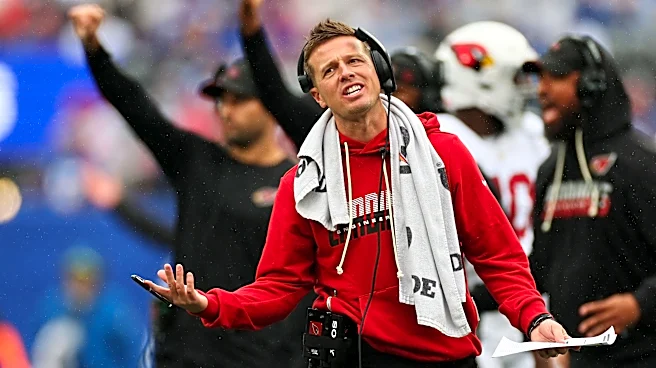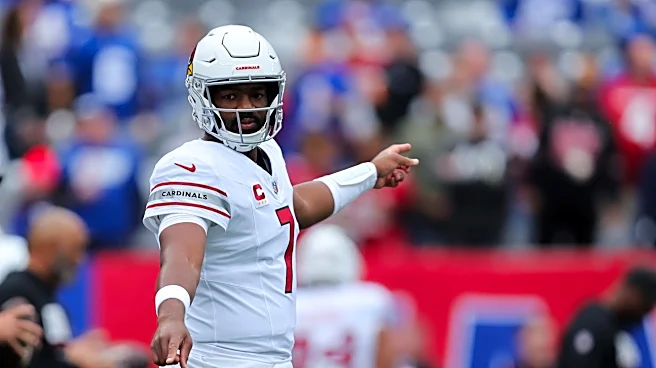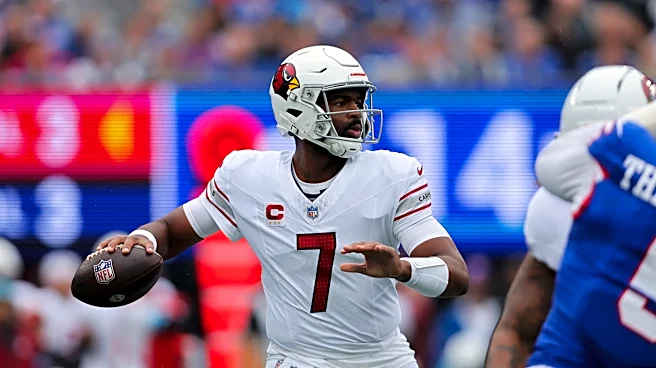


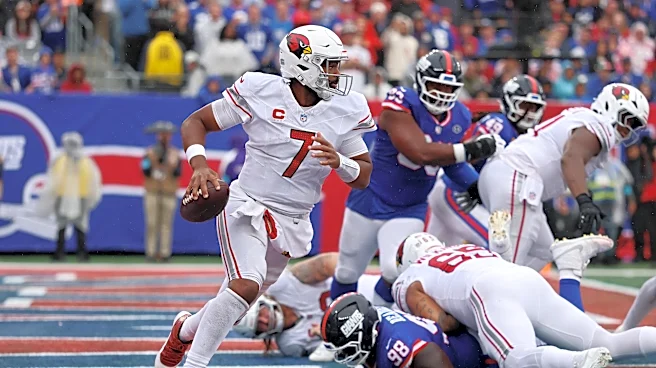
In the immediate aftermath of the Arizona Cardinals’ Week 4 loss to the New York Giants, head coach Mike LaFleur dismissed the notion of benching Jacoby Brissett with one word: “No.”
The following afternoon, when asked again about Brissett, he was only slightly more forthcoming.
“We were 12 feet away from scoring 30,” LaFleur said.
In some corners, this has earned significant vitriol sent LaFleur’s direction. Brissett ranks last among starting quarterbacks in yards per attempt (5.4) and has quarterbacked the Cardinals to a 2-14 record since he took over for Kyler Murray. In what is almost certainly a lost season, calls have grown for the Cardinals to turn to third-round rookie Carson Beck.
The reality, though, is that Brissett is likely the Cardinals’
best option — for now.
Brissett is not the type of player who will single-handedly drag his team to victory. Among 29 quarterbacks who have played 50% of their team’s snaps, Brissett ranks 24th in average depth of target and dead last in average time to throw. As a result, the Cardinals have produced the fewest explosive pass plays in the league.
When blitzed, he ranks 26th in expected points added (EPA) per dropback, because those plays often require a quarterback who can be creative. That’s not Brissett. He won’t conjure brilliant plays out of nothing, like Murray once did.
But within the rhythm of the offense, Brissett can effectively keep the operation on track. When he’s not blitzed, he ranks 14th among those same 29 quarterbacks in EPA per dropback. Overall, he ranks 20th.
— Theo Mackie film (@theomackie_film) October 6, 2026
This play against the Giants, on a third-and-10 in the first quarter, felt instructive for what Brissett is — and what he isn’t.
The Cardinals had a seam route and a slot fade called against man coverage with a single deep safety. That’s an ideal play call for the coverage because the safety can’t cover both vertical routes.
But when Trey McBride got bumped off his route, Brissett began to feel the pressure from New York’s six-man rush. Rather than spotting Kendrick Bourne wide open for a potential massive play, Brissett immediately worked to Michael Wilson on a stop route, delivering a nice, on-time pass to move the sticks.
An elite quarterback here would recognize the safety shading toward McBride and progress to Bourne, or extend the play with his legs.
A bad quarterback, meanwhile, might panic and succumb to a sack. Or he might simply miss Wilson by not throwing that pass with the correct timing.
Brissett falls somewhere in the middle. He missed the explosive, but he still got the first down.
— Theo Mackie film (@theomackie_film) October 6, 2026
Unfortunately, that doesn’t always work out so well for the Cardinals. Here, on another third down, Brissett saw McBride covered again and immediately worked to his checkdown. Had he instead recognized the Giants’ delayed blitz, he would have looked for Bourne, who was coming open over the middle for a potential first down.
These are Brissett’s limitations. But on the other side of the field in Week 4, the Cardinals saw what truly bad quarterback play looks like, from Jameis Winston (who ranks 27th of those 29 quarterbacks in EPA per dropback).
— Theo Mackie film (@theomackie_film) October 6, 2026
Each of Winston’s two interceptions would have been Brissett’s worst play of the season. On the first, he locked into a wide receiver who was completely covered, despite being in a clean pocket. On the second, he pulled his throw so badly that it was initially difficult to tell which wide receiver he was even targeting.
By contrast, two of Brissett’s interceptions came on tipped passes. The third was on fourth-and-4 as time expired, when there was no difference between an incompletion and an interception. These were not self-inflicted daggers, like those regularly produced by the league’s worst quarterbacks.
The easy retort, of course, is that the Giants are 3-1 and just beat the Cardinals, who are now 1-3.
But the reasons for that 1-3 record are myriad.
The Cardinals' defense is the biggest culprit, ranking 27th in EPA per play. They’re allowing an atrocious 9.1 yards per pass attempt, the worst mark in the league. Their Week 4 performance, with consistent coverage busts and no solution for Malik Nabers, was representative.
The offensive supporting cast has also not been as strong as hoped.
The offensive line has continued its struggles from last season. The pass protection numbers are largely solid, but that’s impacted by Brissett getting the ball out quickly. The tape tells a more concerning story. And in the run game, they rank 29th in yards before contact per attempt. Defenses rarely have to respect the Cardinals’ rushing threat.
And in Week 4, the Giants cooked up a new game plan to attack the Cardinals' weaknesses, playing man coverage on 48.7% of snaps.
While McBride has incredible feel for empty space in zone coverage, he’s not quite as dominant when matched against cornerbacks and safeties in man coverage. Wilson is solid against man coverage, but defenses can focus their attention on him because of Harrison’s struggles.
This season, Harrison has won just 7.4% of his routes against man coverage, per Fantasy Points Data. That ranks dead last among 51 wide receivers with at least 20 routes run against man.
After Week 4, Marv now has a 7.4% win rate against man coverage (per @FantasyPtsData). That's the worst among 51 WRs with at least 20 routes vs. man.
— Theo Mackie (@theo_mackie) October 6, 2026
The Giants exploited that, playing man nearly half the time. Here's every route Marv ran against those looks: pic.twitter.com/LW4qj02yMg
Plus, the Cardinals’ offensive line struggled to handle the Giants’ blitz-heavy game plan.
“The stats say it, the analytics say it, the tape says it, our eyes all said it, so we got to be better,” LaFleur said. “It starts with me in terms of the schematics, giving them a better advantage, giving them, like I said, better clarity.”
And when pressure arrived, Brissett lacked the mobility and creativity to find solutions. He’s not the type of quarterback who can overcome the issues around him, and never has been. If he were, he would be making four times as much money.
Yet still, the Cardinals offense remains respectable. Through four weeks, that unit ranks 17th in points per game and 21st in EPA per play.
Even in a losing season, that competence matters. The Cardinals need to learn which building blocks are in place. They need to learn whether LaFleur has the goods as an offensive playcaller. They need to know whether to exercise Harrison’s fifth-year option this offseason, and whether to extend several key offensive linemen.
Those answers are easier to find when the quarterback play is passable.
Gardner Minshew, their current backup, did not show in training camp that he is better than Brissett. His struggles in recent seasons are also a tick below what Brissett has provided this year.
Then there’s the Beck question. The Cardinals are careening toward a top-five pick, where they will likely have their opportunity to select the quarterback of the future. At some point, they do need to test whether Beck is the answer, in case his play pushes them away from drafting a quarterback.
But there are 13 games left in the season, and there’s balance here. The Cardinals need to give Beck enough time to know what he’s capable of. They also need to provide the rest of the offense with a passable foundation for as long as possible.
Yes, Beck was excellent in the Hall of Fame Game, but that was against a backup defense showing only its most basic looks.
“It's the first preseason game,” Beck acknowledged in a conversation with The Republic last month. “Everything's pretty simple, dialed down.”
The rest of training camp, against the Cardinals’ own backup defense, was a mixed bag. At times, he delivered impressive throws into tight windows. At other times, he struggled with the speed of the game, turning the ball over with regularity.
Plus, he then missed the final three weeks of training camp with a ribs injury. And since the season started, he’s been working with the scout team, splitting those reps with Minshew.
Quarterback development can be a long process, and it’s still early for Beck. There’s a reason he remains the emergency third quarterback and not the backup. Rushing that process would risk damaging his development.
Eventually, the equation will likely change. If the Cardinals are 2-8 in mid-November, they’ll owe it to themselves to find out what Beck can provide. But for now, Brissett offers a level of competence that keeps their operation on track.
This article originally appeared on Arizona Republic: Why Arizona Cardinals have not benched Jacoby Brissett for Carson Beck