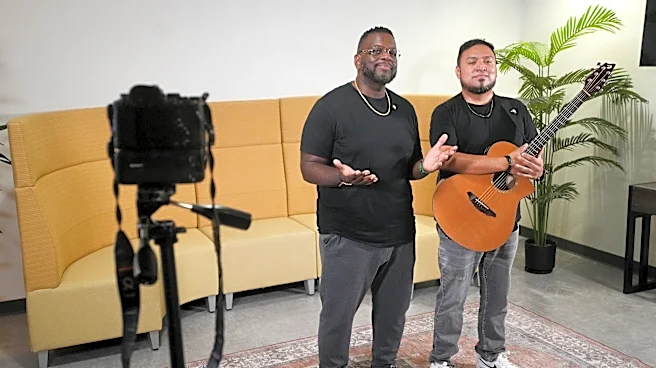

Raheem Jarbo stopped by The Arizona Republic for a USA TODAY Network Acoustic concert in a year of truly monumental anniversaries for one of Arizona’s most beloved hip-hop artists.
It was in 2006 that the Grammy-nominated rapper began his recording career with “The Call” and left his home in Philadelphia to take a teaching job in Phoenix.
He was Random then, a hip-hop alter ego he abandoned eight years later to adopt a videogame reference first used as the title of his second album, 2007's "Mega Ran."
“I don't even know if I recognize that guy sometimes,” Jarbo says of the voice you hear on that first Random album, released in February 2006.
“I listen to that album and I love it. But there are some rhyme styles, some couplets, some choices I made
creatively where I'm just like, ‘What was I thinking?’ In a great way, where I'm just like, ‘Whoa! Way to go, 20-years-ago me!’”
He hadn’t experienced much at that point, Jarbo says. “But I was reading. I was researching. If I didn't know something, I was learning about it.”
That first album also finds him rapping more about the things he doesn’t like than anything he’s done since then.
“I'm talking about things I don't like,” Jarbo says.
“Oh, I don't like the government. Oh, I don't like the way people of color are being treated. Oh, I don't like the way women are being treated. I don't like the struggles independent artists have to go through. I still don't enjoy those things. I didn't turn my head up and say, ‘I'm OK with that now.’ I just said, ‘My art should be a little more positive.’”
Mega Ran moved to Phoenix after one too many Philly winters
It wasn’t long after releasing that first album that Jarbo decided he was done with winter as he’d come to understand the meaning of the word in Philadelphia.
“I feel like it was a lot of small factors that led to it,” Jarbo says.
“But it was April and we had a really bad snowstorm. I'm like, ‘What is going on here? This is too much.'"
He was living in a rowhouse at the time with curbside parking.
"If a car rode down the street, it would push the snow into your parked vehicle, and you'd have a small mountain of snow you had to dig through before you could even pull out of your parking spot," he says. "And if it was below freezing, your locks would freeze. You'd have to start the car and then wait 15 minutes while the car warmed up before you could drive.’”
Every winter, he says, you’d read about fights breaking out over people parking in spaces someone else had shoveled out.
“That kind of bitterness the cold created was something I just didn't like and I could see it happening in myself,” he says. “Another cold day was the straw that broke the camel's back for me where I said, ‘I’ve got to get out of here. This place is changing me for the worse.'”
He was teaching in Philly at the time, and in the course of seeking teaching opportunities in warmer climates, from Miami to Las Vegas, he landed a job in Phoenix on the strength of a phone interview. And having interviewed him on the phone, I get it.
“So I drove my brand new Kia all the way across the country with my best friend right on time to start the school year as a public school special ed teacher on the west side of Phoenix," Jarbo says.
This newsletter goes to 11. Sign up for weekly music news.
How Raheem Jarbo developed his Mega Ran persona in Phoenix
It was after moving here that he developed the more positive approach to rapping that’s become his calling card by leaning into his nostalgia for the things that made him happy as a kid.
“The only thing that kind of got me back to a happy place was thinking about when I used to sit in front of my Nintendo after a Blockbuster night where we rented two really good games and me and my friends played Street Fighter and Sonic the Hedgehog all night,” he says. "Those things made me happy. So that's what I started to write about. And later on, I started finding other things that made me happy."
He has nothing but respect for those who do reflect the darkness of our times in music, citing Immortal Technique as a personal favorite. “But I thought, ‘I'm gonna try to be a little bit of a light in a dark place,'” he says.
The move to Phoenix definitely helped in that regard.
As Jarbo says, “I'd been insulated by the tall buildings of Philadelphia, and that was literally all I'd seen my entire life. Arizona was so picturesque. It's pretty enough to make you want to take up photography when you start seeing the sunsets. I think it put my mind at ease. I was so used to cold, windy weather, everyone bundled up and in a hurry. I felt people moving at a different pace in Arizona.”
He felt freer to explore his own identity in Phoenix.
“I didn't feel like I had to squeeze into any sort of sound to be heard or understood," he says. "It gave me a little more freedom to write songs I may have never written in Philadelphia, songs about being a nerd, enjoying video games or comic books. That just wasn’t a vibe or concept that I felt would work in Philadelphia. Maybe it would have, but I didn't have the guts to do it."
He hit the ground running in Phoenix, making contacts on the scene by reaching out to the Top 50 Arizona rappers on Reverb Nation.
“And one of them told me about the Hidden House,” he says.

A bar on Seventh Avenue and Osborn Road in Phoenix, The Hidden House “was very much my Cheers of the Southwest, where you go in and everybody knows your name, the bartender, the DJs, the performers,” Jarbo says.
“It's just nothing but love when you get in there. It was a welcome stage to cut my teeth and learn a little more about the scene. No one cared about my previous release. They didn't care who I'd worked with in Philadelphia. It was a fresh start. I appreciated that.
He also got in on the Blunt Club scene.
“And then from there, it just kept going up and up,” he says.
How Raheem Jarbo found his nerdy voice on 'Mega Ran'
In 2007, he released an album titled “Mega Ran.”
“The concept is that I was in a dream that I was in a video game I used to play when I was 12 years old,” he says.
"But also I was sampling video games and using the sounds, those bleeps and bloops. Much like my heroes did with jazz, funk and soul records, I did with video games because that was the music I grew up with. Now they call it 'nerdcore' and it’s gone to some really cool heights. There's YouTubers with millions of subscribers rapping about their favorite anime. I love the fact that we're in a space now where people can just literally do whatever they want.”
He faced some backlash at the time.
“People were like, ‘Hip-hop sounds like this; we can't do that,’” Jarbo says. “But it kind of cracked through. It hit a very unique niche of people, and I'm really glad it did. So that was all I needed. And I just kept going.”
That first Mega Ran album landed him a gig at San Diego Comic-Con performing in a boxing ring.
“They asked me to come and do some appearances for them and sign some things,” he says. “They’re like, ‘This album's kind of going viral.’ I was like ‘It is?!’ And they're like, ‘Yeah, we love this. We've never heard anything like this. So they really appreciated the creative risks I was taking, which was really cool. It allowed my music to get into new places.”
Nearly 20 years later, he's still taking those creative risks. In 2026, he earned a Grammy nomination, Jarbo's first, for "Buddy's Magic Tree House," the second children's album he's released since 2023. He and his wife were fostering a child they’ve since adopted, a boy named Zion, when Jarbo found himself imagining the sort of children’s record he might like to make.
"As a father, I want to make music my kid listens to," he says. "I want to make music that makes me smile because I think I'm a better person, a better husband, a better dad if I'm in a good mood and a good space. So I want to make music that puts me in a good space."
Ed has covered pop music for The Republic since 2007, reviewing festivals and concerts, interviewing legends, covering the local scene and more. He did the same in Pittsburgh for more than a decade. Follow him on X and Instagram @edmasley and on Facebook as Ed Masley. Email him at ed.masley@arizonarepublic.com.
This article originally appeared on Arizona Republic: How Mega Ran found his authentic voice after ditching snow for Phoenix