






The bolo tie has made its way into modern fashion; however, it was never a fad for the Southwest, even claiming its distinction as Arizona's official neckwear.
However, Arizona isn't the only Southwest state to claim the bolo as its official tie; Texas and New Mexico have also claimed it as their own. Still, Arizona Gov. Jack Williams was the first, signing legislation in 1971 making the bolo tie Arizona's official neckwear.
Now, the bolo tie is worn far beyond the Southwest, making it a fashion statement embraced globally.
While many believe Wickenburg resident Victor Cedarstaff invented the bolo tie, historians believe the bolo tie may predate Cedarstaff, showing up earlier in Southwest American history and in other unexpected parts of the world.
Regardless, the silver and turquoise details often found on bolo ties, alongside the tie's historical relationship to cowboy culture, can easily be tied to Arizona.
Who created the bolo tie?

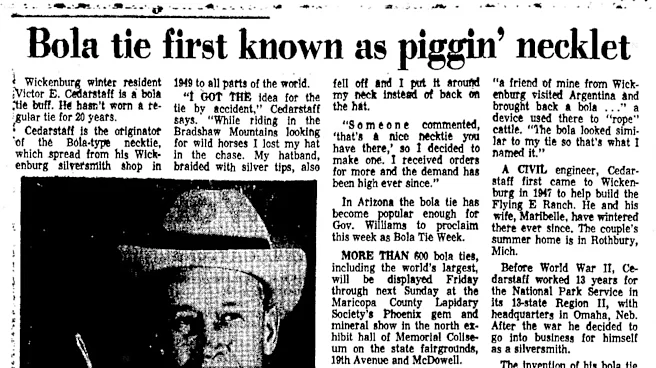
Victor Cedarstaff is often credited as the creator of the bolo tie in 1949, according to a 1969 article in The Arizona Republic. Cedarstaff later patented his idea in 1954, and the patent was granted in 1959.
How Cedarstaff supposedly came to his invention is quite interesting. While riding a horse, the band on Cedarstaff's hat had fallen off. In order not to lose it, he put the band around his neck. While keeping it around his neck, Cedarstaff began to get compliments on the fashionable necktie and decided to make more since he was a silversmith. There, the popularity grew.
Originally, the bolo tie was named the bola tie, which some historians still prefer. Cedarstaff even toyed with naming the neckwear a "piggin' necklet." Shockingly, this name did not catch on.
Cedarstaff said the name "bola tie" came from a bola, a device used to rope animals, which his friend had brought back from a trip to Argentina.
"The bola looked similar to my tie, so that's what I named it," Cedarstaff said in a 1969 article from The Arizona Republic.
History of the bolo tie

Although Cedarstaff was the first to patent the famous neckwear, historians find it hard to believe the bolo tie was the first of its kind.
"We talked to some early traders who bought and sold Native American art, and they indicated that these very small kind of trapezoid shaped bolo ties were being made in the 1940s by Native Americans. So it was our position that actually predated Victor Cederstaff," said Diana Pardue, chief curator of the Heard Museum and one of the authors of "Native American Bolo Ties: Vintage and Contemporary Artistry".
In a 1987 article for the New York Times, Albuquerque jewelry salesman Manny Goodman recalls seeing Native Americans wearing bandanas clasped with silver conches as early as the 1930s.
Even before the 1930s, examples of scarf slides and string ties from Indigenous communities in the Southwest and across the Great Plains from the late 1800s look strikingly similar to Cedarstaff's design. Even necklaces from the Victorian era show similarities to the bolo tie.
Are bolo ties in style?
Although the creator of the bolo tie is heavily debated, the piece's influence cannot be denied. The bolo tie has broken out of its traditional Western roots, making a name for itself in pop culture and fashion for decades.
Influential musicians like Bob Dylan, Bruce Springsteen and even Beyoncé have been seen sporting a bolo tie. Characters in cult classic movies like "Pulp Fiction," "Pretty in Pink" and "Blue Velvet" can also be spotted wearing the iconic piece.
It's safe to say Arizona started a trend as the first state to claim the bolo tie as its official neckwear. Arizona's recognition of the bolo legitimized the piece as more than a nontraditional tie. It allowed people to showcase a cultural emblem of Native American history.
(This story was updated to add a video.)
This article originally appeared on Arizona Republic: Who created this Western fashion? Historians challenge Arizona legend