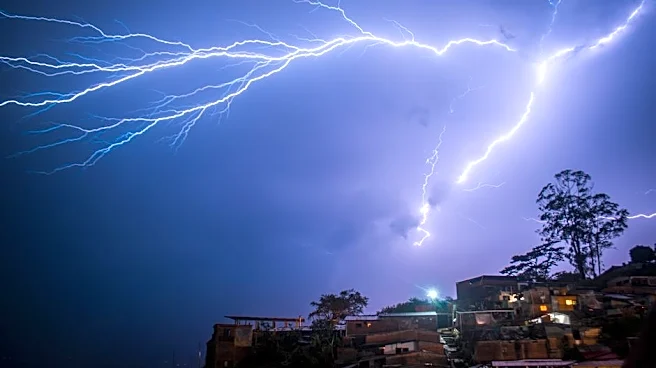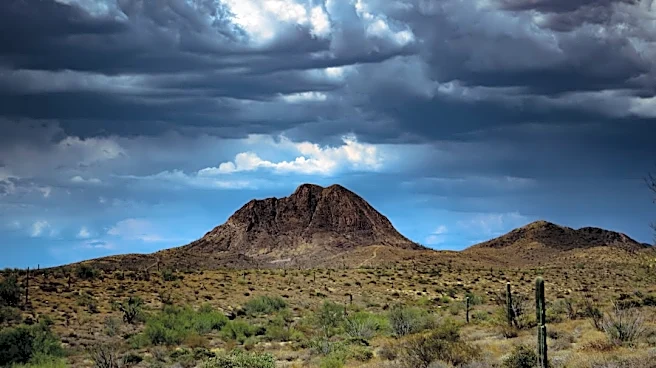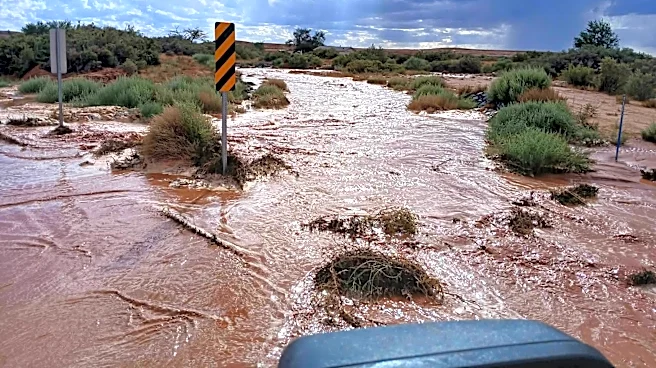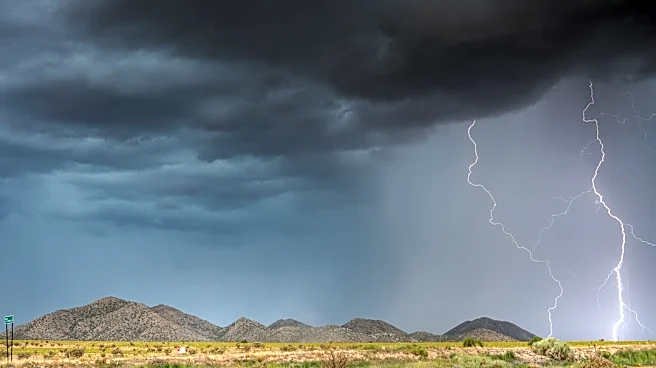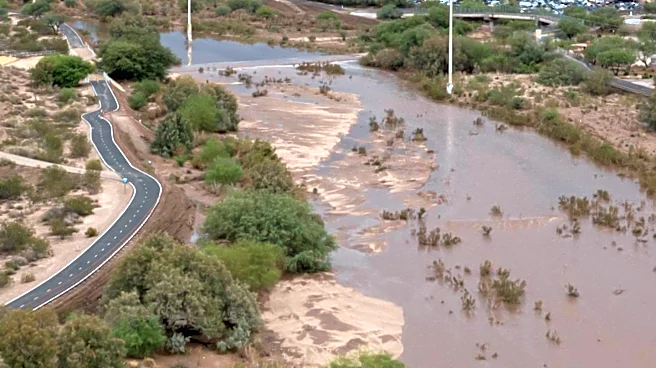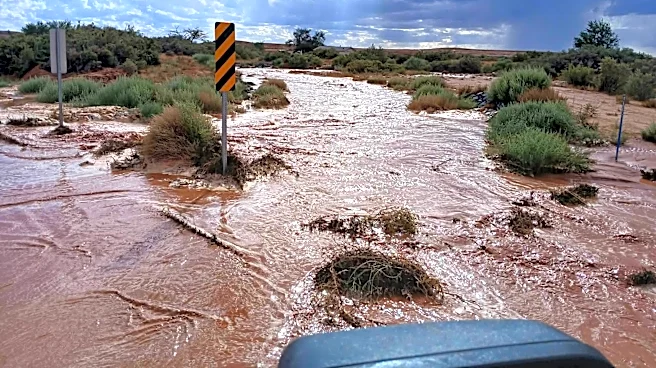


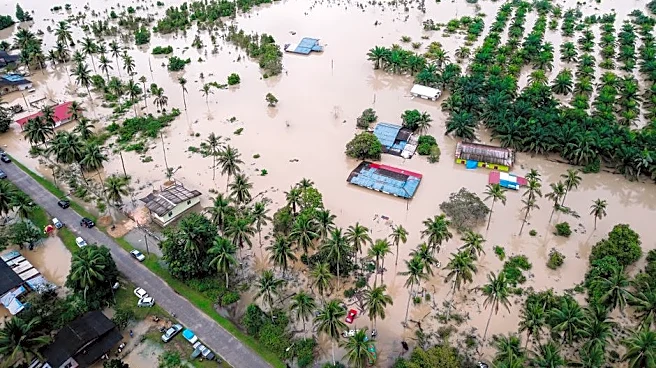
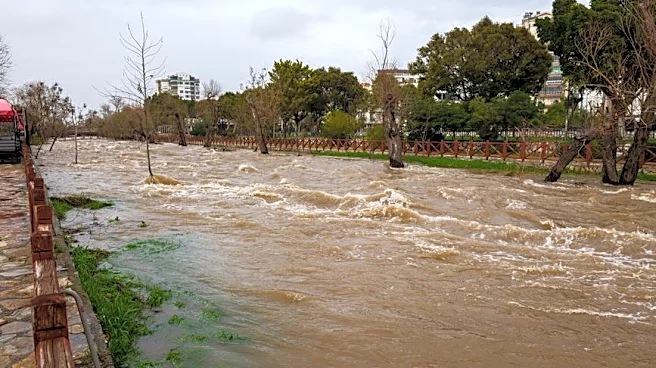
Flooding across the Navajo Nation has caused widespread damage, including significant impacts to roads in the communities of Chinle and Dennehotso, and triggered evacuations along the San Juan River.
Harsh impacts remain in Chinle at milepost 451–458 on U.S. Highway 191, where water diverted across washes into residential areas caused home flooding, road washouts and emergency medical evacuations. U.S. 160 near Dennehotso remains closed and traffic is being re-routed around Rough Rock, according to the Navajo Nation Department of Emergency Management.
Roads through Dennehotso also serve as a transportation route for uranium hauled by Energy Fuels Inc. Uranium hauling was temporarily halted Sept. 17–18 due to damage to U.S. 160 caused by heavy
rainfall.
Stephen Etsitty, director of the Navajo Environmental Protection Agency, said that, according to the Arizona Department of Transportation, a large section of U.S. 160 is closed between Kayenta and Mexican Water, Arizona. Severe damage has been reported near mileposts 419–420.

"We are awaiting more information from ADOT on their responses to the damage/repair work needed to fix the highway and to re-open U.S. 160 for all traffic, including uranium ore transport," said Etsitty in an email to The Arizona Republic about when uranium hauling will resume.
There are no other alternatives for Energy Fuels to move ore from its uranium mine near the Grand Canyon to its mill near Blanding, Utah. The 2025 agreement between the Navajo Nation and EFRI does not provide for the designation of alternative transportation routing, either on a temporary basis or for any permanent changes to the approved transport route, said Etsitty.
Residents seek temporary housing after evacuations
Recent flooding has also caused critical emergency situations in Chinle, Dennehotso and Navajo Mountain in Arizona and in the New Mexico communities of Newcomb, Sheep Springs, White Rock, Sanostee, Birdsprings, and Tohatchi, N.M.
"Our communities are dealing with their roads washed out," said Council Delegate Shaandiin Parrish, who represents Chilchinbeto, Dennehotso and Kayenta. "Many families have their homes flooded and need that emergency attention. I know in Dennehotso there's major flooding where four people had to be rescued from rushing water. There's continued damage to our Arizona highways as well."
One individual involved in a flash-flood incident was rescued and is alive, according to Navajo Nation Department of Emergency Management situation report, but the agency did not report the location.
Sheltering and temporary housing assistance also remain active. The Navajo Housing Authority identified seven homes for displaced families. Three of those homes have been cleaned and are ready for occupancy, while the remaining displaced families have been placed in hotels, with the housing authority covering the costs. Community Services Block Grant funding is also being used to support short-term needs.
Canyon de Chelly National Monument announced a temporary closure of the park due to high water flows within the canyon. Because of elevated canyon water levels, all access to the canyon is temporarily closed.
"A lot of people are affected by it, especially the elders that live near the wash," said Viola Klain, a tour guide with Beauty Way Jeep Tours at Canyon de Chelly of the torrential downpour.
Klain said the Apache County Road Department has been busy responding to the flooding and trying to keep the roads accessible. She noted local schools have also been impacted, with some cancelling schools because many of the students live in rural areas where the roads are flooded.
She said there is extensive road damage, and not just in the local areas around Chinle and Many Farms—the damage is widespread, and many routes have been affected. She noted there were reports of sinkholes, which addd to the concerns about the condition and safety of the roads. Also, buses have to survive and endure the muddy conditions of the rural dirt roads that turn into heavy, thick mud once wet weather hits.
"I don't know if there's if there's money to fix these roads, but a lot of communities have been hit hard," said Klain. "A lot of these roads need some fixing, some TLC. That's the main concern. It would be nice to have gravel roads in some areas."

Canyon de Chelly closure hurts tour businesses
Klain’s employer, Leander Staley, owner of Beauty Way Jeep Tours, said that while he is grateful for the recent moisture, the weather has affected his Jeep tour business. With the National Park Service closing the park, the company is unable to obtain permits to take visitors on tours and had to notify customers of cancellations.
Staley said business was already slow this season as inflation and rising travel costs have discouraged some visitors from traveling to Canyon de Chelly and booking tours. He said other businesses that rely on tourism in the area are also feeling the strain.
"The water is defintely a blessing," said Staley, whose father started the business 30 years ago.
Staley said his great-grandparents and grandparents were among the last generations of his family to live at the bottom of the canyon, in the South Branch near a site called Sliding House Ruins. He remembers a time when the monsoon season looked and behaved much differently than it does today.
He said as a child, he remembers experiencing floods during the monsoon season. His grandparents would prepare for the flooding by opening the irrigation canal so they could divert water onto the corn field.
"The major issue that we're having is, Park Service in the 1960s started planting Russian Olives and Tamarisk," said Staley. "They're invasive, they took over the canyon floor. So those trees, they created this channel and it's eroded about 30 feet from where we once used to rely on gravity to irrigate our field."
Now Staley said they have to purchase water pumps to move the water approximately 30 feet uphill to irrigate their cornfield. In the past, when there was less vegetation, the water could spread out across the canyon floor, much like water coming from a garden hose without a nozzle. It moved more slowly and was less destructive, resulting in less erosion.
Living in the canyon has made him highly aware of his surroundings and the environment, particularly during monsoon season. He said they remain cautious and watchful for thunderstorms, but the danger can be even greater when microbursts occur, which he says have become more prevalent.
"That sudden dump of water collects quickly," said Staley.
Emergency declaration unlocks funding
Water levels can rise quickly and conditions can change with little warning, which is why residents and visitors in the Shiprock area were warned Sept. 18 of potential rising water and flooding along the San Juan River. Anyone near the river was warned to use extreme caution and remain alert, according to Navajo Division of Transportation.
As a precautionary measure, the Navajo Police Department was reportedly conducting a temporary evacuation of residents living along the San Juan River to the San Juan Chapter House.
The Navajo Nation Commission on Emergency Management unanimously approved an amended Declaration of Emergency on Sept. 17 in response to severe monsoon storms, flash flooding and damage to road infrastructure across the Navajo Nation.
The amended declaration provides for affected chapters to access emergency funds and directs the Navajo Department of Transportation to coordinate with the Federal Highway Administration to seek assistance through applicable emergency relief programs. It also authorizes organizations to conduct damage assessments and seek federal assistance, and allows available resources to be used to mitigate risks to public health, safety and community infrastructure, including emergency procurement.
The emergency declaration due to severe monsoon storms will remain in effect until the monsoon season has ended or the declaration is terminated.
Arlyssa D. Becenti covers Indigenous affairs for The Arizona Republic and azcentral.com. Send ideas and tips to arlyssa.becenti@arizonarepublic.com. Follow her on Bluesky at @abecenti.bsky.social.
This article originally appeared on Arizona Republic: Flash floods force evacuations, damage roads across the Navajo Nation