




A small, plastic bottle of water arrived at the Phoenix Mayor's desk in 1985. Terry Goddard, who sat in that chair at the time, said he will never forget the slogan on the side: "Our lifeline is online." It was a souvenir of the first delivery of Colorado River water through the Central Arizona Project Canal.
In the four decades since, Arizona has relied on water from the $4 billion project, diverted from the river and transported 336 miles to Phoenix and Tucson. And once that massive infrastructure was in place, Arizona officials made sure the state would not lose a drop of the water it could take from river.
"We put it underground, we provided a cushion," said Goddard, now the president of the CAP board.
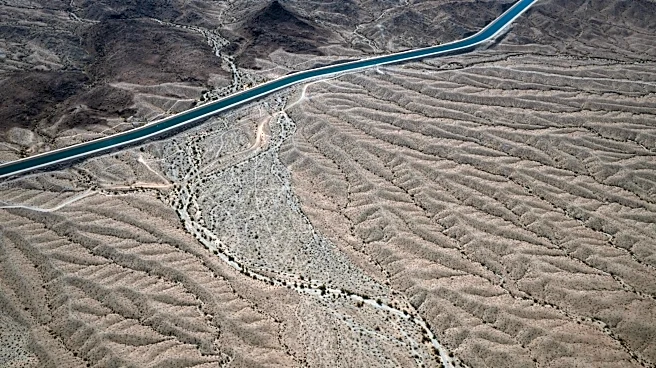
Along flattened stretches of desert, by
dry river beds and sandy basins, water from the great canal was left to flood and seep into the aquifer. This intentional recharge built up underground water savings in different parts of central and southern Arizona for the day its users would need it.
That day is now close: Three decades of drought have choked the flow of water from the Colorado River, and Arizona cities are preparing to tap into the water savings to fill in gaps created by federally ordered cuts to the state's supply.
But withdrawing water isn't as easy as putting in. Water is sometimes banked far from where it's needed, and to recover it, cities need permits, wells, water lines and treatment plants — or partnerships with those who have those things. Most began recovery plans years ago. Some won't have to tap into their savings just yet.
There are also limits to what they can recover. Water banking is a system, used around the world with some variations, to manage water resources long-term. In Arizona, it operates under state oversight.
Some savings accounts belong to the Arizona Water Banking Authority, created by state lawmakers in 1996, and some belong to dozens of entities — from cities to water investors — who earn long-term storage credits by recharging river water underground for future use, and who sell, lease or buy credits from other parties with rights to water.
For most of its three decades in existence, Arizona water banking consisted mostly of deposits and trading, rather than withdrawals, but that' shifting. The last year Arizona had a surplus of river water to bank was 2019.
Most cities won't have to dig into their own savings account just yet, as the banking authority will provide enough credits to offset 2027 cuts. A compass for how fast and how much they can draw from the state's water savings after that, is still missing.
A new era for water banking
Arizona once enjoyed a surplus of Colorado River water. Legally, the state could take 2.8 million acre-feet of water from the river, based on agreements that overallocated the river a century ago. But until the 1990s, the state had no way to transport it to its urban centers.
Building the Central Arizona Project, a 336-mile canal, a system of dams and pumps that lift water a total of 3,000 feet, was a feat of enormous proportions, a technical, political and financial dream that became reality after 40 years of debate within the state, in the courtrooms and in the halls of Congress.
When the CAP Canal finally flowed with river water, it took nearly another decade before Arizona devised a system to bank excess water. For decades, California took the surplus for its own farms, and continued to do so until Arizona lawmakers created the Arizona Water Banking Authority in 1996 to make sure the state would keep the river water it was entitled to.
"We were a little bit overconfident and a little bit self-satisfied to see the CAP from 1985 reliably producing 1.6 million acre-feet, more than we could use," said Goddard, who followed the making of the CAP, from legislation to completion. He listened to his father — then-Gov. Sam Goddard — testify in Washington, joined Arizona lawmakers behind closed doors, and wrote his dissertation on the CAP project before he ran for mayor.
Having excess water to bank, Goddard said, "made us feel more comfortable than we should have been, given the erratic nature of the Colorado River." In retrospect, state leaders failed to seek and pick up the next big water infrastructure project, for example seeking new sources like desalinated seawater.
From the canal, some Colorado River water was sent to water treatment plants, bound for city taps. Some went to farms and other users. And some was recharged into central Arizona's aquifers via injection wells or recharge basins, either to be pumped out that same year or decades later in times of need.
For every acre-foot of water a given entity recharged and left in the aquifer for a year or more, the water bank issued a long-term storage credit that can be claimed later.
Ever since, different parties have banked, traded and purchased credits for this banked water.
"We've stored for the future," said Rebecca Bernat, director of Arizona's water bank, which owns credits and can also distribute them to secure the Colorado River water entitlements for tribes, as well as municipal and industrial water users.
When the CAP started delivering water, reservoirs were full. By 2027, the canal will run with about 50% of the state's original entitlement.
A three decades-long megadrought has forced voluntary and mandatory cuts to Colorado River water allocations over the past years. The cuts signal a new era of limits. The feds could maintain or deepen those cuts in 2028 and beyond.
Arizona's water saving accounts, on the other hand, have barely been used. So far, only 5% of all credits have been recovered from central Arizona's aquifers.
Shortage plans look different for every city. Not all Valley residents get Colorado River water in their tap — some are served water pumped from a local aquifer, from the Salt and Verde rivers, or a mix. Many cities also hold secure water leases from tribes, with higher priority CAP water, or allocations large enough that they won't have to tap into banked water just yet.
Peoria, for example, has banked water near the city's service area and also south by Tucson's Avra Valley. About 88% of the water they deliver to customer taps in a year comes from the CAP Canal, but the 2027 cuts won't push the city to dig into water savings just yet. It will also get credits transferred from the water bank for the cuts in 2027.
Additionally, the city purchased 173,672 acre feet of water credits from a company that banked CAP water in the Harquahala Valley about three decades ago. Peoria's purchase came with some wells and canals, but the city still has to go through permitting and constructions steps before that water can reach their customers, said Melinda Whittington, Peoria's water resources advisor. So far, it's not needed.
"Our plan is to sort of sip from those credits," Whittington said.
The hardest part comes after credits are transferred. Cities and other account holders need to conduct hydrological studies and apply for a recovery well permit with the Arizona Department of Water Resources so they can pump banked water. They can also pay CAP to recover and deliver the water. Then they need to find a way to treat it to potable standards and get it to customers' taps.
Whether they use the water now or in years to come, cities are ramping up their plans to tap into these savings. Over 60% of all recovery well permits have been issued just in the past four years, according to agency records obtained by The Arizona Republic.
For one year, the water bank will distribute to cities and other entities enough long-term storage credits to make up for water lost through the Bureau of Reclamation cuts. For 2028 and beyond, the water bank has no policy on credit distribution. That policy will be determined sometime in 2027, Bernat said.
How long will the savings last?
The Arizona water bank has the mission of helping ensure long-term management of the state's water resources. It's not administered or overseen by Arizona's water agency but works closely with some of the agency's divisions.
The water banking system is meant to act as a savings account, providing a bridge to cities and other entities in times of emergency until they find new supplies. Using an analogy of personal finances: The savings account is meant to stretch resources until there is a new source of income; drying out the savings before could be dangerous.
Many agencies are involved. The Arizona Department of Water Resources oversees permits for water storage and recovery, and approves long-term storage accounts for cities, tribes and other entities banking water, including the water bank itself.
The water bank authority has multiple savings accounts to shield tribes, municipalities and industries in times of shortage, and over the past three decades has paid to have excess CAP water stored. The last year it had a surplus of CAP water to store was 2019.
The Central Arizona Water Conservation District is the recovery agent for the water bank. When the bank distributes credits, cities could recover them directly or pay CAWCD, currently at a cost of $400 per acre-foot of water recovered, although that might change.
While the accounts are not held by the water bank itself, the state authority determines how many credits it distributes, from its own accounts, to municipal and industrial CAP users in times of stress. This is known as firming, securing water in times of shortage through the distribution of long-term storage credits.
Municipal and industrial water users also have their own accounts and can draw from them without the water bank permission if they get the necessary permits from the state water agency. The same goes for mining companies and others who have stored water underground.
Currently, there are nearly 15 million acre-feet of water in these long-term storage accounts, banked mostly in aquifers beneath Pinal, Pima and Maricopa counties.
How long cities' water servings will last, depends on many things. For one, it will depend on "the extent and length of any shortages, and how many credits are available," explained Sharon Megdal, director of the University of Arizona Water Resources Research Center, who has been following water banking since its inception.
Phoenix, for example, had a balance of 673,461 acre-feet of water in its long-term storage account with ADWR by 2024, agency records show. That is nearly six times the amount of CAP water the city delivers to taps in a year. Because Phoenix will experience some cuts but not a total loss of CAP water in 2027, water savings could last decades. The city will also get credits from the water bank.
Phoenix also has rights to pump some groundwater, and is investing with other cities in advanced water purification technology to reuse existing water sources, and to expand reservoirs on the Verde River. All of them are part of the city's long-term water planning to face CAP shortage.
For 2027, the water bank will be the one filling that CAP water gap for cities, with credits from its own accounts. Cities will still have to figure out how they recover that water, from permits to pumping to treatment to tap water deliveries.
Who does water banking?
City utilities, private utilities, mining companies, golf courses, farms, water bottling companies, investors and other businesses have long-term storage accounts with ADWR. So does the Arizona Water Bank Authority, which purchases and trades credits too.
The water bank holds 11 long-term storage accounts with ADWR, and each meets unique obligations. Some of those accounts, and the water credit balance in them, is used to secure Colorado River water for the Gila River Indian Community, the White Mountain Apache Tribe and the Hualapai Tribe in times of shortage or disruption. Other accounts are there to secure water for CAP municipal and industrial users, like Phoenix.
The water bank also has an arrangement with Nevada. Arizona stores available river water in its aquifers, Nevada receives the credits, and when it needs to recover the banked water, the state pulls it from Lake Mead. A similar agreement is in place with the Mohave County Water Authority.
In total, there are 229 accounts in Arizona, according to public records from the state water agency.
Water banking also creates a market for water. In Arizona, banked water creates long-term storage credits that can be bought and sold. For example, a farm land owner in Maricopa County can forgo groundwater pumping in exchange for Colorado River water from a city, which in turn gains a credit to the groundwater that wasn't used.
Cities can also accrue credits by banking highly treated wastewater in the aquifer, but this only represents a fraction of all water banking in the state.
How is Colorado River water stored below ground?
After traveling down the CAP Canal, Colorado River water is diverted to huge, dug-out shallow ponds where it filters underground. From above, they resemble artificial lakes or reservoirs, but they are located at sites where water can reach the aquifer the fastest. Streambeds or areas with sandier soil are ideal.
To bank water underground, cities and other entities must get sites approved by ADWR first. The sites are called underground storage facilities. Cities will often hire a hydrological firm to obtain the permit. Among other criteria, the application package must prove the recharge potential of the project and its area of hydrological impact — how far the recharged water travels — with direct measurements and mathematical models, explained Ryan Mitchell, chief hydrogeologist with ADWR. The permits also establish a limit for how much water can be stored.
Water can move 10 to 30 feet per day through sand and gravel, but barely one foot per day through clay, he said.
"You wanna do it in an area that has the best chance of recharging the aquifer."
CAP has its own storage facilities, and so do some towns, cities and Salt River Project. There are 104 of these recharge sites.

There are also injection wells for recharge and groundwater saving facilities. The latter consists of an exchange with farms: A city or company trades part of its Colorado River water for irrigation, and gets credits for the groundwater that the farm did not pump. Irrigation districts and farms also need a permit for this exchange, and they don't lose their right to pump groundwater in the future.
Because water banking is meant to stretch and preserve water supplies, and because this water is stored in the aquifer, each account and saving facility is sorted by groundwater-regulated Active Management Areas or AMAs. Phoenix has an account for storage credits within the Phoenix AMA; Coolidge has its account within the Pinal AMA. Water can also be banked and traded outside these areas, but it's minimal.
This recharge creates different pots of water, throughout central and southern Arizona. One of the largest storage sites is Avra Valley, west of the Tucson Mountains, where many entities have banked water.
Legally, when cities and water providers tap into the "savings account" they would recover stored Colorado River water. Technically, they would be pumping a blend of water sources, as the CAP water mixed with the regional aquifers when it was injected through wells deep below ground or dumped into sandy basins.
Recovering stored water
Recovery is probably the biggest challenge for cities who depend on CAP water and are now facing deeper cuts.
Water must be pumped, or recovered, from the same AMA or basin where water was stored — large areas, with several aquifers, often covering more than one county. While it is prefered that entities recover water on the same location where they recharged CAP water and got credits — what Mitchell called the "hydrologic area of impact" — they can recover water from other places.
This nuance can create a "hydrologic disconnect," said Megdal, the UA research center director. Recovering water from a place other than where it was stored can create an uneven drawdown on the aquifers. It's an issue that has been recognized for a long time, she said, but it's been hard to get all parties to agree and change the rules.
Stored water cannot be pumped using any well; it has to be a permitted recovery well. Not all cities have recovery wells and the network of canals, pipes and treatment plants to send that water to customers. Or they might have them where they don't need them the most.
Salt River Project, one of the biggest public utilities in Arizona providing water and electricity to millions, operates two large underground storage facilities in central Arizona. One of them, below the Granite Reef Dam on the Salt River, will be key for many cities to access banked water.
In a partnership with the Salt River Pima-Maricopa Indian Community and the Maricopa County Department of Transportation, SRP recently completed a decade-long project with five high production wells and three miles of pipeline to pump water stored in the Granite Reef Underground Storage Project into the Arizona Canal, which takes that water to city's treatment plants.
Cities with credits for stored water but no well recovery permits or other infrastructure to recover the water, could enter into agreements with SRP.
As a non-profit public utility created in 1903, SRP has a long legacy in water management and is "always looking to the future and how things are changing," said Sharon Morris, SRP director of water construction and maintenance.
"Recovery is going to be a thing in the near future that is going to be increasing."
In the last four years, utilities and cities have received permits for 1,589 recovery wells, agency records show. In the 27 years before, 791 recovery wells were permitted.
Scottsdale obtained 43 permits issued this year; Gilbert 34. In 2025, Chandler secured permits for 39 recovery wells; Surprise got 27, and Gilbert 116. Arizona Water Company, EPCOR and Global Water also took out dozens of permits issued.
"Most cities probably have enough wells in the right places to undertake at least some amount of direct recovery of long-term storage credits. The question is whether 'some' is enough," said Kathryn Sorensen, director of research at ASU's Kyl Center for Water Policy and former Phoenix water manager.
In some cases, wells are not in the areas where credits have to be recovered, they don't produce enough water to meet demand, or they are in parts of metro Phoenix that lack water lines and water treatment to send that water to customers. All these factors vary city by city, she added.
Impact of cuts will fall on groundwater levels
Even if city taps don't go dry, the loss of CAP water is bound to change Arizona's water future.
Arizona's urban areas have relied on the Colorado River to meet their customer needs and recharge groundwater reserves since the completion of the CAP Canal in 1993.
When that source is reduced, both cities and farms will pump water from the aquifers and, in the long run, new policy will be needed, Sorensen suggested.
"The Central Arizona Project was originally billed as the Aquifer Savings Plan of Central Arizona," said Sorensen.
The project not only helped stop further groundwater declines in some areas, but even replenished some aquifers. Now, as entities recover the water they've banked in the last three decades to make up for the cuts, and continue pumping groundwater they have rights to, aquifers will return to their lower levels.
"In a future with less Colorado River water, we will experience additional groundwater depletion," Sorensen told The Republic. "So we need to start thinking about what policy options might be available to us to make sure that we are continuing to manage that groundwater wisely."
One of the needed policy changes, she said, is "to confront legacy groundwater pumping" from agriculture, mining, and many industrial users that by law are allowed to pump and use groundwater but have no requirement to replenish it because they are exempt under the 1980 Groundwater Management Act.
Arizona's water agency experts expect there will be declines in water levels, but argue that it doesn't represent a risk for Arizona's long-term water security.
If Phoenix or other water users pivot to pumping their banked water, groundwater level declines would not threaten existing users, Mitchell, ADWR's chief hydrogeologist, said.
The agency performs 100-year projections for groundwater levels in every AMA, accounting not only for what is annually being pumped by cities, utilities, farms and industry, but also accounting what could be pumped based on those users’ rights to recover banked water.
Farms that received CAP water in exchange for not pumping groundwater could turn their pumps on again once there is less CAP water to go around. That would be another demand on the aquifer, but it is also accounted for in ADWR's modeling and projections, Mitchell said.
"If anything, our model is more conservative because we're saying (water providers) are going to be pumping all the groundwater they're allowed to pump," he added.
"We want to make sure that the model doesn't over promise water that may not be there in the future, because that's not the point of the assured water supply program. The point of program is to protect (water users) for a hundred years."
On paper, it's true that recovering stored water falls in a different category than groundwater mining, and there is a system accounting for that water, Sorensen said. But the result in the aquifer is the same:
"The aquifer doesn't know or care what legal flavor of water is pumped out of a well," she said.
"Central Arizona can overcome Colorado River shortage. But Arizona cannot overcome the long-term depletion of its groundwater supplies."
Clara Migoya covers agriculture and water issues for The Arizona Republic and azcentral. You can send your story tips or comments to clara.migoya@arizonarepublic.com
This article originally appeared on Arizona Republic: Arizona banked Colorado River water for years. Now it's time to use it