




The former kitchens manager who says he took the fall following a federal investigation into the hiring of undocumented workers at the Zipps Sports Grill chain has been deported to Mexico.
But instead of being dropped off at the U.S.-Mexico border in Nogales, Diego Gonzalez-Rosales, 37, said he was flown on an ICE deportation flight to a city in southern Mexico more than 1,600 miles by air from Arizona.
Gonzalez-Rosales said he was rousted from his bunk about 2 a.m. on Friday, Sept. 11, at the Eloy Detention Center, placed on a deportation plane at the Mesa Gateway Airport and then flown to Tulum after the plane made a stop in Riverside, California, to pick up other deportees.
Gonzalez-Rosales, 37, said deportees were told beforehand they were being
flown to Chiapas, a state in southern Mexico that borders Guatemala. But when the plane landed he looked out the window and was surprised to see a sign that said in Spanish, "Welcome to Tulum."
Gonzalez-Rosales said detainees were not told why they were flown instead to Tulum, a city on the Caribbean coast of the Yucatán Peninsula in the Mexican state of Quintana Roo.
"When I'm seeing Tulum, I'm like, what am I doing here?" Gonzalez-Rosales said during a phone interview from Mexico City. "Why they lying to us? Like why they don't say the first time, you guys going to Tulum. Everybody (on the plane) was like, 'What's happening? What's going on?' But they don't say anything to us."
He estimated there were about 300 people on the same deportation flight. Gonzalez-Rosales believes the deportees were flown to the Yucatan Peninsula to get them as far from the U.S. border as possible.
"I'm pretty sure that is why," Gonzalez-Rosales said.
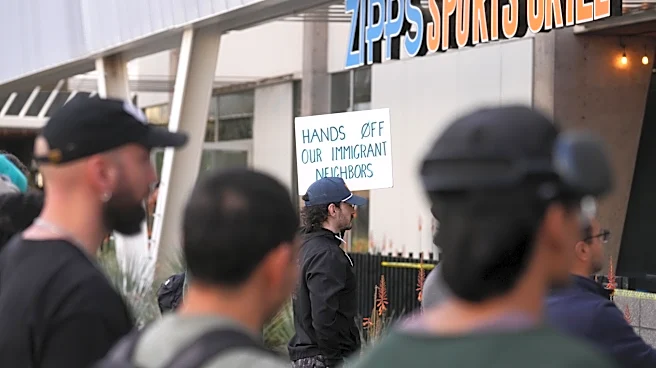
Gonzalez-Rosales is the highest-ranking Zipps manager to face federal charges following the high-profile Jan. 26 raids of 14 Zipps Sports Grill locations around the Valley.
The investigation was launched in February 2025 after federal Homeland Security Investigations agents received information that Zipps restaurants were employing undocumented workers to staff their kitchens, and that management knew employees were fraudulently using identification documents that belonged to U.S. citizens to pass mandatory employment eligibility checks, according to the criminal complaints.
As part of the investigation leading to the raids in January, Homeland Security Investigations agents audited Social Security numbers used by Zipps' employees and found dozens of instances where the same numbers were being used multiple times at other jobs in Arizona, an indication of widespread "aggravated identify theft," according to the criminal complaints.
The investigation only resulted in the criminal prosecutions of Gonzalez-Rosales, an undocumented immigrant from Mexico, and three lower-level undocumented workers. Agents detained 39 people during the operation and accused them of being in the country illegally.
During an interview with The Arizona Republic before he was deported, Gonzalez-Rosales said almost all of the 150 to 180 workers staffing the kitchens at the 14 Zipps locations were undocumented immigrants and he provided details he said showed people in the Zipps' corporate office knew its kitchen staff fraudulently used documents belonging to U.S. citizens to pass mandatory electronic employment eligibility screenings.
Gonzalez-Rosales shared the same details with federal prosecutors, according to a sealed court document The Republic was able to review. Investigators were able to corroborate "much" of what Gonzalez-Rosales told them, according to the sealed court document.
He said during the earlier interview he wondered why had no other managers had been prosecuted and said he felt like “they try to put everything on me.”
A Zipps marketing director, Tiffany Doby, said earlier she could not comment specifically on Gonzalez-Rosales' allegations because the case remained an open legal matter, but said in an emailed statement that he was trying to blame others because he faced serious criminal charges and deportation.
"He therefore has an obvious personal interest in shifting responsibility for his actions to others," her statement said.
Doby's statement also said Zipps had learned that the U.S. Attorney's Office had closed its investigation into the matter and told Zipps it was not seeking any further prosecutions. The statement called the decision "appropriate."
Gonzalez-Rosales spent more than 10 weeks in the Eloy Detention Center after serving a five-month sentence in federal prison after pleading guiltyto a single felony charge for texting a photograph of an Arizona driver's license and a Social Security card to an undocumented job applicant so the applicant could pass an E-Verify employment screening to get a job at Zipps.
During a Sept. 15 phone interview, Gonzalez-Rosales said his deportation to Mexico has been a mix of emotions. He was happy to be home with his family who he had not seen in 20 years when he left Mexico for the United States. But he was scared about his future after losing everything he had in the United States, including all of his belongings, two cars, and his girlfriend.
"I'm really sad. I'm sad and happy. Happy for my family. But you know I have 20 years there" in the United States. "More than half my life and it's just done, you know. And now I'm here," Gonzalez-Rosales said as roosters crowed in the background.
His girlfriend sent him money to buy food while he was in prison and then immigration detention, he said. But the eight months he spent in federal custody and his deportation to Mexico meant they could not continue their relationship.
"It's not so easy to have a relationship from here to there," Gonzalez-Rosales said.
A change of clothes and a cell phone his girlfriend sent him while he was in detention were the only items he was allowed to bring with him to Mexico, he said.
His girlfriend plans to sell his two cars, a Dodge Ram and VW Golf-GTI, and send him the money.
All of his clothes are in Phoenix but he said he doubts they still fit. He said he lost more than 80 pounds, mostly from the stress of being locked up in federal custody. He said prosecutors told him he was facing up to 15 years in prison after he was initially charged with multiple felonies.
"Sometimes I can't sleep for a week because, you know, I thinking about what's going on with my life," Gonzalez-Rosales said. "Like I say, I'm a good person. I'm not a bad person. Never. All the time I'm trying to help everybody, you know. And I think that's why I lost a lot of pounds, because it's a lot of stress in there."
An immigration judge ordered him deported while he was detained in Eloy. Gonzalez-Rosales said he considered appealing the decision because he had spent so many years in the United States. But he decided not to because he would have had to remain behind bars awaiting a decision at the Eloy Detention Center, where he met some detainees who had been locked up for as long as two and three years. He was told he didn't have a very strong legal case to stay.
Mexico has received more than 270,000 deportees from the United States at land ports and airports since the start of the Trump administration in January 2025 through Aug. 13, 2026, according to official data from the Mexican government.
At just airports, Mexico has received 105,619 deportees from the U.S. on more than 816 flights in 10 cities since Jan. 20, 2025, according to Mexican government data though Sept. 10, 2026.
U.S. Immigration and Customs Enforcement spokesperson Fernando Burgos confirmed ICE removed Gonzalez-Rosales on Sept. 11 after an immigration judge ordered him deported on Aug. 4. Gonzalez-Rosales is barred from returning legally for 10 years, Burgos said.
In response to a question asking why ICE is flying detainees to southern Mexico, Burgos said the agency does not comment on "specific removal logistics."
"If you enter our country illegally and violate our laws, we will find you, arrest, and ensure you do not return," Burgos said in a written statement. Under President Donald Trump and Homeland Security Secretary Markwayne Mullins, "criminal illegal aliens are not welcome in the United States," he said.
The United States has ramped up deportation flights to cities in southern Mexico as part of the Trump administration's mass deportation campaign, according to Human Rights First, which tracks ICE deportation flights through its ICE Flight Monitor dashboard.
In August, removal flights to Mexico averaged 28 flights per week, up from five per week during theearlier months of 2026 and 16 per week in August 2025, according to the group's Augustreport.
"The intent of removing most Mexican nationals via ICE Air instead of the U.S.-Mexico land border appears to be to prevent re-crossings into the United States by removing Mexicans farther into Mexico’s interior, in many cases to isolated cities with (limited) resources," the report said.
There have been 46 ICE deportation flights to Tulum in 2026, including 11 in August, according toICE Flight Monitor dashboard. Tapachula in the state of Chiapas has received the highest number of ICE flights in 2026 with 237, followed by Villahermosa in the state of Tabasco, with 227, according to the dashboard.
What's next for deported former Zipps kitchens manager?
Gonzalez-Rosales said he has no intention to return illegally to the United States. His defense lawyer told him if caught, he'd go back to federal prison.
After landing in Tulum, Gonzalez-Rosales said he and other deportees were taken to a reception center run by the Mexican government. He received a government document to help him integrate into Mexico's society. The document can be used to travel by bus and plane or as ID at the bank, he said.
He also received a debit card from the Mexican government pre-loaded with 2,500 Mexican pesos, about $150. But when he tried to use it at a bank he was told the government account that funded the debit cards had been depleted.
Some deportees arrived in Mexico without any money, Gonzalez-Rosales said. He tried to help one of them.
"I just find this guy, he's crying because he doesn't have any money," or a phone, Gonzalez-Rosales said. "And I just help him with $20. I feel so bad for him because, technically, he's lost too."
Gonzalez-Rosales stayed with an aunt in Cancun for two days before flying to Mexico City where his family lives.
His brother and his niece were waiting for him at the airport. They greeted Gonzalez-Rosales with a bouquet of white lilies wrapped in blue paper, a bottle of beer and a poster that said, "Bienvenidos."
Gonzalez-Rosales wanted to surprise his parents. He hadn't seen them in 20 years. They didn't know exactly when he would arrive. But they heard him outside.
"My mom heard my voice when I'm walking into my house and she starts screaming like, 'Oh, he is here' and she's crying, you know, she's super-happy."
Gonzalez-Rosales hasn't figured out yet what he will do in Mexico. He may try to get a job in the restaurant industry.
"That's my first option," he said. "I know I have a lot of experience. I worked in the restaurant for 20 years. I know how to do a lot stuff, so it's one of my things right now, like continue to do the same thing I was doing in Phoenix."
Or he may try to find work using his English skills.
For now, he said, "the more important thing for me is my family."
This article originally appeared on Arizona Republic: Former manager of Zipps kitchen staffs deported to Mexico