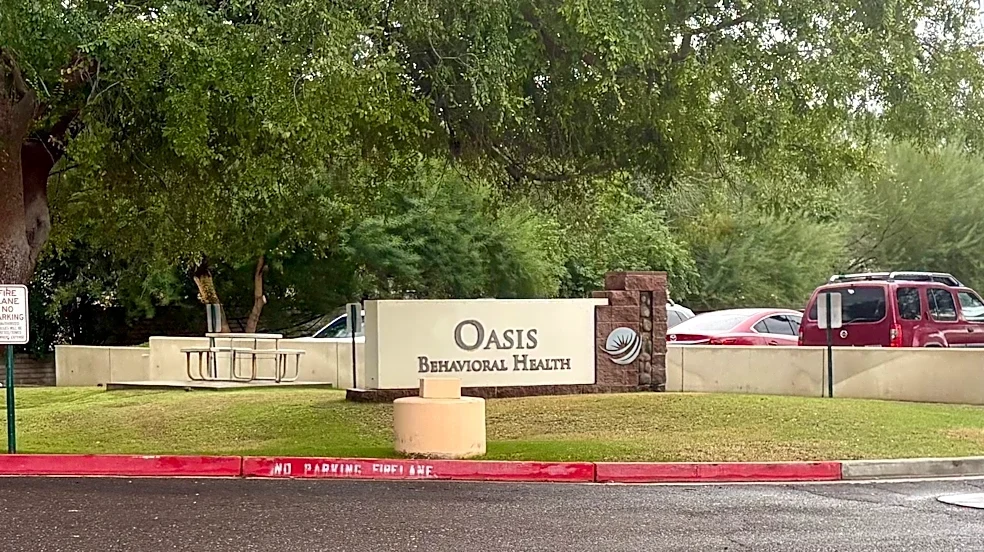







Recent reports of medication theft and assaults at a behavioral health center in Chandler add to an ongoing list of problems involving young patients at the facility, including allegations of rape, theft, runaways, and criminal property damage.
Chandler police have recorded 281 "general offense" reports from Oasis Behavioral Health's Chandler location near Arizona Avenue and Warner Road in 2026 alone, according to data provided to The Arizona Republic Oct. 13 following a public records request, which works out to an average of nearly one report per day.
The facility has a mix of adult and youth patients, but most are minors, with 75% of its 210 beds reserved for youths under 18, according to the most recent state licensing records. Adults in the facility are there
for short-term mental health hospitalizations only.
Not all of the Chandler Police Department reports were connected with suspected crimes. But others were serious, including police calls in which young patients were arrested, an instance where officers used pepper spray to try to control youths who were trying to leave the facility, and an Oct. 4 incident in which young patients assaulted police officers and staff, including a nurse who was injured badly enough to be hospitalized.
A general offense report means any incident requiring official police action, intervention or investigation and may include anything from lost property to alleged assaults and sex offenses.
"There have been times when calls for service at Oasis Behavioral Health have required a significant response from the Chandler Police Department," department spokesperson Marysol Green wrote in an Oct. 13 email. "Our communication with Oasis Behavioral Health has been open and collaborative, however, what they plan to do in reducing incidents is a better question for them."

Oasis leaders would not answer questions about what led to the Oct. 4 incident and why Oasis has been the subject of so many reports from Chandler police, including the recent serious incidents. The hospital, as of Oct. 16, had not responded to a question about what officials plan to do to reduce the risk of future problems.
"Our focus remains on caring for patients and supporting our team members. We will not speculate on potential contributing factors," Oasis spokesperson Eric Barnes wrote in an Oct. 9 email.
Admission criteria on the facility's website indicates youth and adult patients at Oasis have significant behavioral health issues.
Among admissions reasons are severe substance misuse; suicidal thoughts; prior suicide attempts; active homicidal ideation; hallucinations that present as a danger to themselves or others; and being unable to maintain adequate nutrition, shelter, safety or other essentials due to deteriorating mental health. Patients may have more than one of those issues. The facility's website says it has outpatient programs, too.
104 reported assaults, 36 sexual offenses in 2026
Between Jan. 4 and Sept. 29, Chandler police documented 104 reported assaults at Oasis, including 11 reports of aggravated assault; 18 reports of either disorderly conduct or "disturbance"; 36 reports of sexual offenses, among them 11 reports of sexual assault, including one rape and one report of sexual conduct with a minor; and four reports of property damage, including two cases of substantial property damage.
Ten of the general offense cases, including the reported rape and five other sexual assault reports, remain open; 59 cases, a majority of them assaults, are pending, while others are classified as closed, inactive due to no prosecution desired, or suspended due to a lack of leads or suspects.
There was a wide range of report types. One quarter of the reports from 2026 were classified as a "medical pick-up," which means Oasis called the police to transport its patients to a Community Bridges Inc. facility, Green said.
Community Bridges Inc., a nonprofit organization for people with mental health and substance misuse issues, has a "no wrong door policy," meaning anyone experiencing any of a range of mental health problems will be directed to the appropriate care. It also has 24/7 help and an infrastructure for screening patients who may need involuntary psychiatric treatment.
The Republic requested the general offense reports from 2026 after Chandler police issued an advisory saying that during the evening of Oct. 4, several young patients at Oasis were involved in a "large disturbance" that sent an injured nurse to the hospital, Chandler police said.
Later that same Sunday night, while Chandler police were still at Oasis investigating that disturbance, some young Oasis residents stole medications and assaulted both staff members and police officers, police said. Five youths were arrested between the two incidents, police said.
Less than three months before the Oct. 4 incidents, six young Oasis patients were arrested in three incidents that involved patients pulling a fire alarm and attempting to leave the building, according to Chandler police. Two incidents were reported on July 27. During the second, police said they were unable to restore order at the facility and deployed pepper balls.

Oasis operators have other Arizona locations
Though it is not obvious on its website, its signage or its licensing records, Oasis Behavioral Health at 2190 N. Grace Blvd. in Chandler is operated by Acadia Healthcare, a for-profit, publicly traded behavioral health chain based in Tennessee.
It provides care at multiple locations across the country, including several sites in Arizona. The company describes itself as one of the largest behavioral health companies in the U.S.
Among facilities Acadia operates in Arizona are Agave Ridge Behavioral Hospital in Mesa, an outpatient counseling clinic in Gilbert, and Sierra Tucson and Sonora Behavioral Health Hospital in the Tucson area.
Sonora Behavioral Health Hospital has been the subject of scrutiny after the 2025 death of 44-year-old Bluesky Thomas, a Gila River Indian Community member who died after an altercation with staff at the facility, where he was a psychiatric patient.
Leaders of Sonora Behavioral Health hospital agreed to pay a $10,000 fine connected to an inspection that followed Thomas' death. The state inspection found deficiencies that "resulted in systemic failures and patient harm."
Oasis is housed in a bland-looking pale orange and yellow building. While it is one building, the facility actually includes two separately-licensed areas — a 64-bed residential psychiatric treatment side that's only for youths getting longer-term care, and a 146-bed acute-care hospital for shorter-term behavioral health stays, state licensing records show.
The short-term hospital side of the facility was, until Sept. 2, mostly for adults, with 87 beds reserved for people 18 and older and 59 for individuals under 18. But hospital officials filed a Sept. 2 modification with the Arizona Department of Health Services that changed the composition of the facility's hospital side to be primarily for youths — 94 beds, and 52 for adults.
State: Oasis failed to document reports of sexual contact between patients
On Sept. 2, 2022, state health officials from the Arizona Department of Health Services issued a notice of intent to revoke the Oasis short-term psychiatric hospital license, but hospital leaders settled with the state and avoided revocation.
Oasis also had licensing problems in 2024 and 2025 when state inspectors found deficiencies in the way the facility investigated some incidents on the youth-only residential side, including incidents involving self-inflicted injury, contraband and a possible inappropriate restraint.
On March 6, Oasis leaders agreed to pay the state Health Department a $2,500 civil penalty after an inspection in December found its hospital had delayed screening exams for nine out of 20 randomly selected new patients by an hour or more, even though the hospital has a goal of screening patients for emergency medical conditions within 30 minutes of arrival.
One patient, who was later found to have psychiatric problems that made the patient a risk of "imminent harm" to self or others, waited more than three hours to be screened, state investigators found.
And on March 13, Oasis leaders signed a provider agreement with the state that acknowledging the hospital failed to ensure that orders for monitoring patients at its hospital were implemented, and that it failed to ensure that reports of sexual contact between patients were documented.
Arizona Department of Health Services officials would not say whether the state was investigating the Oct. 4 disturbances at Oasis, but "allegations like those being shared in the media are triaged as high priority and investigated to ensure licensees are not in violation of health and safety regulations," department spokesperson Magda Rodriguez wrote in an email.
Republic reporters Maritza Dominguez and Corina Vanek contributed to this article.
Reach health-care reporter Stephanie Innes at stephanie.innes@usatodayco.com or follow her on X: @stephanieinnes or on Bluesky: @stephanieinnes.bsky.social.
This article originally appeared on Arizona Republic: Why police arrive at this Arizona behavioral health facility almost daily