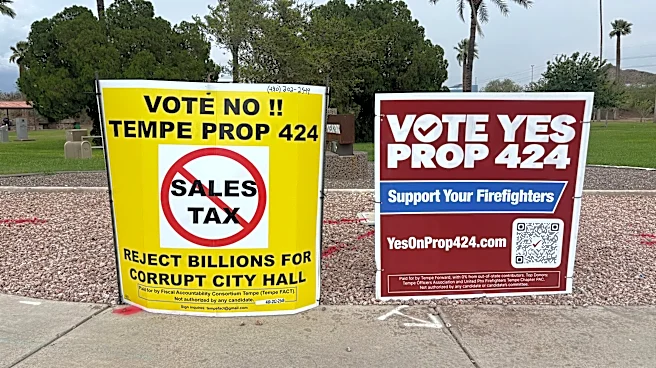






A fight over a controversial sales tax initiative will hit Tempe voters in November.
At issue is whether a 0.5% sales tax ‒ an about 50-cent increase on every $100 spent in the city ‒ is equitable for working families.
The tax is projected to raise $50 million to backfill a $24 million hole in Tempe's $342 million operating budget left by the state Legislature.
City officials have not specifically explained why they need the other $26 million but have offered some reasons like to cover future costs and expand services, rather than cut any.
"This is the wrong tax at the wrong time," said state Sen. Mitzi Epstein, who is chairing a political action committee to oppose the tax increase. "People are struggling to pay their bills ... we've got to stop
asking the middle class and those who have low income to pay for it all."
But proponents and city leaders say the tax is a necessary step to prevent drastic cuts to departments and non-essential programs and reductions to emergency, library and bus services, among others.
"Those are things we can't replace without taking some kind of action," said Shawn Swisher, an architect who lives in Tempe and chairs the city's Sustainability and Resilience Commission.
What is Prop. 424 in Tempe?
Tempe voters will have to choose whether to permanently increase the city's sales tax by 0.5%. If approved, the sales tax would rise to 2.3%, up from 1.8%.
It would make Tempe's sales tax among the highest in the East Valley but lower than in Phoenix. It equates to an about 50-cent sales tax increase for every $100 spent.
The increase would not affect groceries or food for home consumption.
The tax is projected to raise about $50 million with anyone who shops in Tempe shouldering the tax. City leaders said in the spring that the tax proposal was necessary to backfill a $24 million gap in the operating budget left by actions from the state and federal levels that deprived cities of funding. The operating budget typically includes salaries, police, fire and other things that affect day-to-day expenses.
Cities like Phoenix and Gilbert already raised taxes in response to the cuts, said Lisette Camacho, Tempe's deputy city manager and chief financial officer.

Voters will see only one question on their ballot, but the tax would be split into three different pools: $30 million for public safety and $10 million each for transit and Tempe PRE, the city-run preschool.
The sales tax is not the first reaction to the loss of revenue. Over the past two years, the city has reduced hiring, left positions unfilled, limited new projects and tightened spending across departments, Tempe spokesperson Kris Baxter-Ging said in April.
Why is Tempe's proposed sales tax increase controversial?
Epstein, a longtime Tempe resident and senator, admitted that cities are struggling with how to cope with the loss of the rental tax. She voted no on the repeal of the rental tax at the Legislature in 2023.
But she said a sales tax was not the solution.
"They're asking for too much," Epstein said, pointing to the fact the city would raise double the deficit. "I am asking people to vote no on this Prop. 424, to send it back to the drawing board, and have the City Council take another look at, okay, what's the actual dollar amount we really need to fill our budget gap?"
She added that the tax would disproportionately affect middle-to-lower income Tempe residents and shoppers because it was a blanket tax with no adjustments for income.
But proponents of the sales tax, like Swisher, said those are the people the tax aims to help.
"That transit system, by far, is beneficial to lower middle class folks that need to get to work and need to get home each day," he said. "The folks that are most likely to utilize the services that the city is able to offer and fund are going to be folks that are in those economic classes that really can benefit from being able to have their child be somewhere safe and learning while they are able to work instead of having to be at home caring for their kids."
If the sales tax does not pass, city leaders have floated ideas like charging for the Orbit bus system or charging more for street car and childcare. They have also said that reduced services could look like slower emergency response times, reduced transit frequency and scaled-back community and facility hours.
"We have to take action," Swisher said.
Ballots will be mailed Oct. 7. Election Day is Nov. 3.
Lauren De Young covers transportation and the cities of Tempe and Chandler for The Arizona Republic. Reach her at ldeyoung@azcentral.com.
Like this story? Get more East Valley news straight into your email inbox by signing up for our free weekly East Valley Newsletter, which comes out on Wednesdays.
This article originally appeared on Arizona Republic: Tempe voters to decide if half-cent hike is vital or unfair