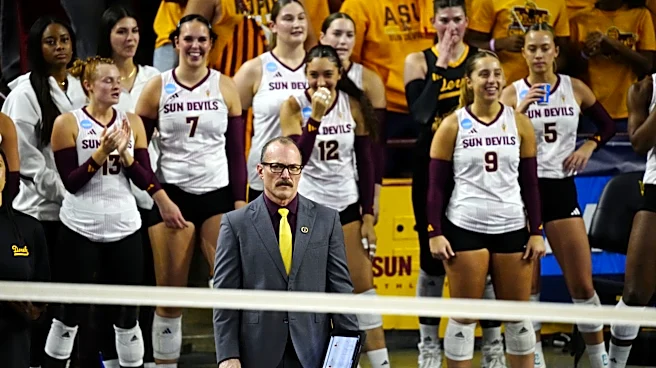







Arizona State junior middle blocker Antonina “Tosia” Serafinowska had plenty of options after she entered the transfer portal from Wisconsin. But Serafinowska wasn’t simply looking for another place to play volleyball.
“I was looking for a program that will help me grow into the athlete, person and student I want to be,” Serafinowska said.
Conversations with coach JJ Van Niel and the rest of the staff helped make ASU stand out.
“I had multiple meetings with different schools and coaches, and I just had some kind of flow and vibe with JJ,” Serafinowska said. “He was very specific with his expectations and all the coaches try to get to know us more as people, not just volleyball players.”
That experience helped separate ASU from the other contenders.
It also reflects how the Sun Devils have sustained a level of excellence despite rampant roster turnover.
New players. New faces. Same expectations.
The Sun Devils have built a program where roster turnover hasn’t meant a drop-off in success. They are 9-2 heading into Friday’s meet at West Virginia, the first Big 12 contest of the season.
The faces have changed significantly from last season. ASU graduated six players and brought in 10 newcomers this year, including five transfers and five freshmen. Just 10 players returned from last season – four starters and six non-starters.
The Sun Devils have won back-to-back Big-12 championships. Now, with another wave of transfers and freshmen joining the program, ASU entered this season as the favorite to win a third straight conference title.
The question isn’t whether the Sun Devils can replace the players they lose.
It’s how they continue to replace players without replacing the culture.
Van Niel lists three core values for ASU’s culture.
Important cultural aspects for Arizona State volleyball
“I think usually when I talk about culture, I talk about our values and one of the big ones is just being connected,” Van Niel said. “The other one would be excellence when it comes to standards and intentionality when it comes to training.”
For ASU, maintaining that culture starts before a new player ever steps onto the court.
It starts in the transfer portal.
“We’re just really selective,” recruiting coordinator Ellen Joiner said. “It’s easy to just want to get the best player, but if the best player is not the right fit for your program, that’s not going to ultimately help you.”
Talent matters, but ASU is looking for something beyond a player’s ability to put down a kill or make a big block.
“We like motivated players that are trying to be the best versions of themselves,” Joiner said.
That selectivity is intentional because the wrong addition can affect more than just a lineup.
“One bad egg can kind of ruin an entire culture, unfortunately,” Joiner said.
That makes the recruiting process about more than finding players who can contribute on the court. ASU wants players who will buy into what already exists.
“All these new players are always coming into a well-established culture,” Joiner said. “I think the foundation of the culture that we’ve already set as a program is really important.”
For Serafinowska, that foundation became apparent once she arrived in Tempe. ASU changed the way she viewed her role on a team.
“I used to be a little bit independent and focus on my stats,” Serafinowska said. “But this spring and summer made me realize volleyball is a team sport and sometimes you need to put yourself behind and put the team first.”
A shift in mindset for ASU volleyball players
That mindset is exactly what ASU’s coaching staff hopes to find in the portal and it’s also what returning players are expected to reinforce.
But Van Niel knows coaches can’t be everywhere. The culture has to exist when the coaching staff isn’t watching.
“A lot of that stuff happens in the locker room and when coaches aren’t around, so we have to have a lot of trust in our players and our veterans,” Van Niel said.
That’s where players like junior middle blocker Zoey Burgess come in.
Burgess was a transfer herself last season, switching to ASU from Kansas. After becoming one of the team’s few returning players, she’s on the other side of the transition.
“Being one of the only players that returned, it does give me a new leadership role,” Burgess said. “I take a lot of responsibility, especially with our freshmen, in making sure that everyone feels like they belong.”
Burgess knows what it’s like to be the new player trying to find a place. Now she’s helping the next group find theirs.
“I understand what it’s like to be new so just being able to be there for everybody in anything they need is really important,” Burgess said.
She isn’t trying to make everyone become the same type of player.
That’s not what ASU’s culture is about.
“Coming into a top program and being able to be accepted as who you are is really important for us as well,” Burgess said.
For ASU, the culture isn’t built around making every player fit the same mold. It’s built around bringing different people together under the same standard.
Arizona State Sun Devils working together from different backgrounds
And those differences aren’t something the program tries to erase.
“We have a lot of different people from different countries, different backgrounds and different personalities. It really makes ASU volleyball who it is,” Burgess said. “You’re here for the team and we want the whole team to succeed, so everybody has to buy into that all together.”
ASU also gives players opportunities to take ownership of that culture.
That responsibility extends beyond practices and matches.
“We have a culture committee on our team and the committee is in charge of doing things outside of what we’re doing as coaches,” Joiner said.
Those activities can be as simple as a cooking competition.
“They do things like chopped competitions which is kind of silly, but it’s just something that’s fun and not volleyball related that gets the team together, and it’s still competitive,” Joiner said.
For newcomers, those moments provide opportunities to build relationships with teammates outside the structure of practice and competition. Instead of leaving team bonding entirely to the coaching staff, players are responsible for creating those experiences themselves.
The players also have a direct say in who takes on leadership roles within the team.
“There’s a leadership committee as well with three people on it that’s voted by the team, so they choose the leaders,” Joiner said.
This structure is designed to make sure players aren’t simply following the culture – they’re helping create it.
“JJ’s always had this idea that part of our job is to develop leaders,” Joiner said. “These culture committees are a way to develop leaders.”
Building culture continuously for the ASU Sun Devils
Eventually, today’s newcomers become tomorrow’s veterans.
And the process starts all over again.
Serafinowska has already seen that firsthand through players such as senior middle blocker Ella Lomigora.
“She’s very selfless and she would just keep us together and help run practices,” Serafinowska said. “She would put her personal goals to the side for the good of the team. I feel like people like her make the program what it is.”
That’s how ASU’s culture survives the turnover.
Not because the same players stay forever.
Because the same expectations do.
Van Niel believes that responsibility ultimately belongs to the players.
“At the end of the day, it’s the players’ program as well,” he said.
For Burgess, that’s the legacy she wants to leave behind.
“I really just want to be remembered as how accepting I was, and how welcoming I was to everybody,” Burgess said.
The roster will change again. New transfers will arrive. More players will graduate. New names will appear on the back of ASU jerseys.
But if the Sun Devils have done their job, the standard won’t change.
“You get out what you put in,” Van Niel said. “So when you get everyone all in, it makes it really special.”
This article originally appeared on Arizona Republic: Arizona State volleyball maintains culture despite roster turnover