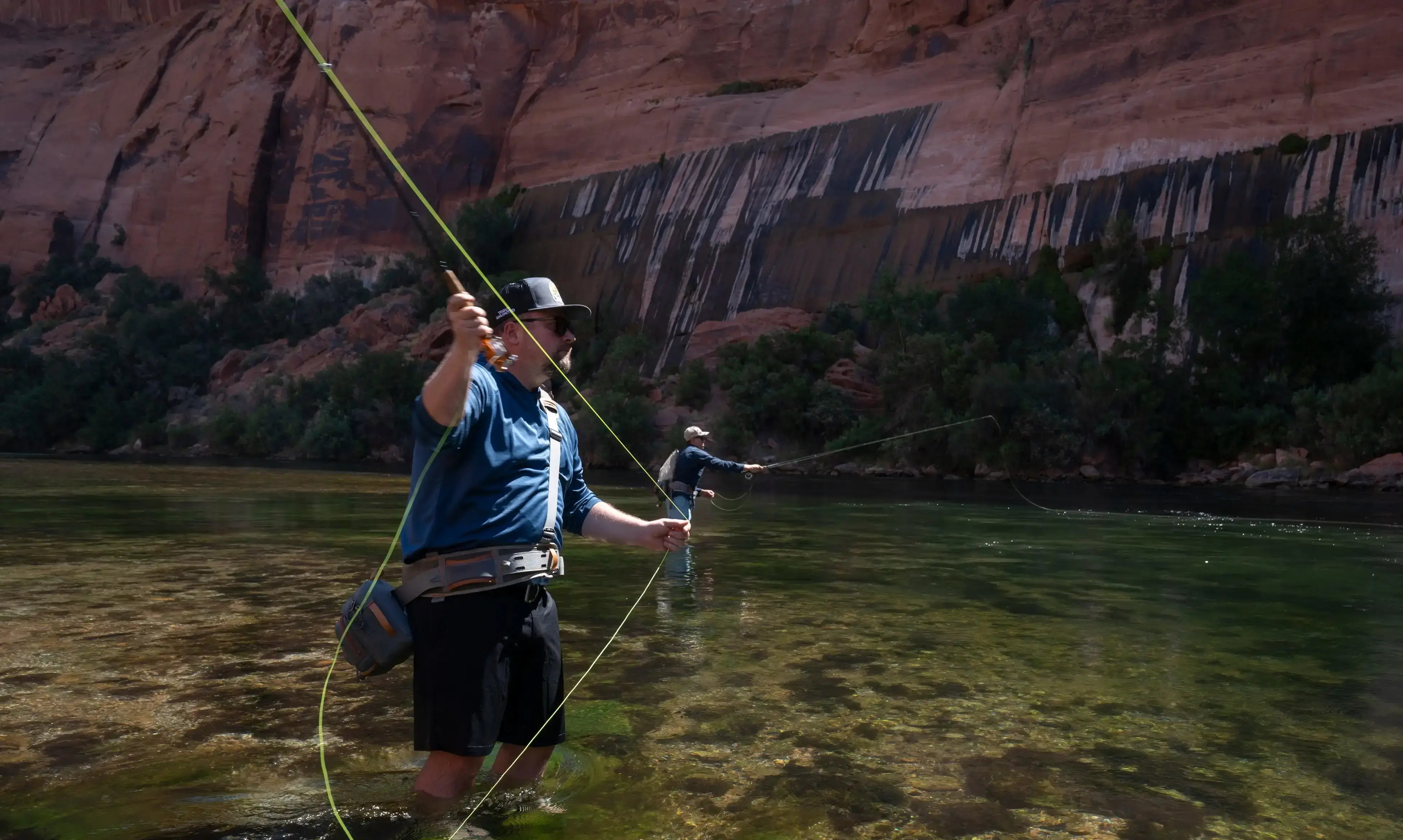




A fly fisherman from New Mexico sought solitude and a chance at catching Arizona’s state fish last fall when he steered his pickup into a gravel parking strip overlooking a stream that winds through a meadow in the White Mountains.
Instead of alpine serenity, Michael Altherr saw heavy excavators rumbling in the field, ripping into the soil to chunk out sod plugs or grasping at piled logs and dropping them into the narrow stream. It wasn’t the wilderness experience he had expected, but neither was it a sign of development that might threaten this or any future angler’s quest to add the speckled olive and golden Apache trout to their life list of species hooked and landed.
It was instead evidence of the hard work it takes to maintain fish in a warming,
drying, and frequently burning Southwest.
A contractor for Trout Unlimited was at work slowing the West Fork Black River’s flow through Thompson-Burro Meadow so it could soak into the meadow and maintain a source for fish-cooling flows through the hot summer. The river there heats to temperatures that block trout passage in summer.
The nonprofit is attempting to restore the cooler waters that flowed before the 2011 Wallow Fire clogged it with sediment, and before decades of munching by both livestock and elk eliminated the shade of streamside willows. Logs can do the job of beaver dams holding back and spreading a stream. Sod plugs can slow the water across ripples in the meadow, allowing water to sink in and return later as spring flows.
“The fish are spectacularly beautiful, the coloration,” Altherr said. Their charm, along with the land’s, partly explained why he would drive, walk and wade from his home in Los Alamos, N.M., to find them.
From trout range in the headwaters of the Gila River to threatened sucker and chub habitat in the famously overworked Colorado River toward which they and most all Arizona streams flow, the Southwest’s fish require major human interventions to hang on.
Agencies and volunteers labor to offset the scars from fires and to replant cooling vegetation in the mountains, while others lug buckets of hatchery-reared fish for release into the wilderness. In a western Colorado town this spring, high schoolers raised, kissed and released razorback suckers into a severely drought-stricken stretch of river where they hoped they might persist for future generations to see and protect.
“When we work together to protect and preserve our natural resources like the mighty Colorado River,” Palisade High School science teacher and school hatchery supervisor Patrick Steele told an all-school assembly on the banks that day, “we are also protecting the very fish that we are releasing today. So when we are down here today and we think about our fish and we kiss that fish goodbye (and) we wish it good luck, we’re also kind of committing to the responsibility of making sure that those fish have habitat for their 40-year lifespan.”
It looked to be an awesome responsibility, with the Colorado pushing only a few hundred cubic feet per second past Palisade, a frighteningly low flow at any time of year, let alone in the season when snowmelt normally swells the river. By August, when U.S. Geological Survey data say they river averages more than 1,000 cubic feet per second, the flow would briefly drop below 43, a stark reminder of how uncertain the future is for these school-reared fish who will need to find cool pools and seasonally inundated floodplains if they are to survive and spawn.
As the largest collector of water from a network of thousands of streams, the Colorado is perhaps the region’s most telling indicator of aridification. The river that forms in the Rocky Mountains has produced less water above Arizona’s Glen Canyon Dam decade by decade.
When the U.S. Bureau of Reclamation changed its 30-year yardstick for measuring average unregulated flow above Lake Powell from the 1981-2010 timeframe to 1991-2020, it shaved 1.2 million acre-feet from the average. It’s a loss of more water than has flowed through the Central Arizona Project canal to help support Phoenix and Tucson in recent years of shortage, more than the state of Utah diverts from the river and its tributaries.

Can the Southwest’s native species persist in the time of the megadrought and the megafire?
“That is the ever-present question with climate change,” Emily Keister, a native trout and chub specialist with the Arizona Game and Fish Department, said during an outing to restock Gila trout, a threatened and federally protected species, in eastern Arizona’s Blue Range. “What will happen in the future? Will they hang on?
“That’s one of the reasons we take sound active-management measures.”
A jewel of a fish
Altherr’s Apache trout pursuit came the day after he had caught and released a Gila trout in western New Mexico. There, on the Gila National Forest, massive wildfires have suffocated mountain streams with ash, requiring major restoration projects. These two trout, along with four breeds of cutthroat he had caught in Utah and Colorado, would qualify Altherr as a finisher of the Western Native Trout Initiative’s Four Corners challenge. For the dedicated angler, though, a certificate wasn’t really the point.
“It’s the challenge of getting into the backcountry and being rewarded with a fish that’s sort of like a jewel,” Altherr said.
Upon learning that the Thompson-Burro Meadow restoration crew had rounded up the fish and moved them upstream beyond a net to keep them safe from all the digging and stacking, the retired geneticist walked up a two-track path to where the stream emerges from the woods, where the elk haven’t been able to keep the willows down.

He fished there, near where the Apache-Sitgreaves National Forests border on the Fort Apache Reservation, home to the White Mountain Apache Tribe and cradle of its people’s namesake fish. The tribe is widely credited with starting the conservation movement that rescued the trout from overfishing and hybridization with non-native species.
Altherr wouldn’t land his trout or the photo evidence until the following day, when he moved on to test a headwater stream of the Little Colorado River in the Mount Baldy Wilderness. For the moment, it was enough to climb over and around boulders and under evergreens while flipping his line into the mountain stream. Dropping it onto likely pools without snaring the riverside vegetation required maximum focus.
“Willows are a pain in the ass,” he said, “but it’s part of what makes the habitat what it should be.”
He was glad someone was working to bring them back, and to reset the clock to buy these fish time in the race against a changing climate.
“What’s going on here gives me hope,” Altherr said. “But it’s hard.”
Years of drought in the West have bled into nearlythree decades of megadrought — the driest in at least 1,200 years. That it’s happening as a result of pollution-induced warming that is unlikely to reverse in the foreseeable future has caused some scientists to label it aridification, nodding to a state more enduring than cyclical dry spells.
When combined with rising threats of wildfire and warming of the water itself, these conditions make the already hot and dry Southwest a precarious aquatic environment. The same could be said of the Southwest’s human communities, which is why conservationists have stressed how their work is mutually beneficial for fish and people who need streams to keeping flowing year-round.
The habitat restoration that Trout Unlimited has pursued around the region includes stacking rocks and logs to slow streams so the water has time to saturate soils and raise the water table. That creates a cooling sponge that can keep rivers flowing through dry summers and falls, ensuring adequate water for farms and cities as well as fish.
“We do care about weird, random fish, but this water does go to Phoenix,” New Mexican Garrett Hanks said while helping with a 2024 restoration project in the Gila Wilderness. “It protects everybody downstream of here in the case of future aridification and drought.”

Eric Head, TU’s Gila trout project manager, agreed that the rocks, logs and willow plantings that his crew placed along Little Turkey Creek would eventually aid central Arizonans via the Gila River and San Carlos Lake, an irrigation reservoir behind Coolidge Dam that went dry and suffered a massive fish kill this summer.
“This is literally the water that they’re using,” he said.
Head led a 2024 work detail up the burned-out canyon along Little Turkey Creek east of Glenwood, N.M., near where the water flows past the Gila Wilderness boundary and into Willow Creek and then on toward the Gila River. The Whitewater-Baldy Fire of 2012 had killed most of its pines and streamside willows on its way to charring 465 square miles. From nearby ridgelines, the standing dead are visible across peak after peak into the distance.
Also killed by that fire: the Gila trout in Little Turkey Creek and Willow Creek. The water was “toxic” with ash, Head said, and the sedimentation, erosion and lack of cooling shade left it inhospitable to restocking from other waters or the nearby Mora National Fish Hatchery.

Fire and warm water are constant hazards for this legally threatened and protected species. It’s a hard place for cold-water species to make a living.
“We’re less than 100 miles from the Mexican border,” Head said. “It’s warm here.”
This wilderness was among the best remaining refuges for Gila trout, he said, along with the headwaters of the San Franciso River in eastern Arizona — the Blue Range zone where Keister’s crew of biologists and volunteers would later hike buckets of hatchery trout for release in a stream called KP Creek.
At Willow Creek, New Mexico rehabbed the silted-in stream after the fire, and crews used heavy equipment to recontour the eroded banks and drop boulders to anchor them. Workers pounded willow sticks into the finished banks to get a start on shading and cooling the water for the Gila trout that the state reintroduced.
Upstream in Little Turkey Creek, wilderness restrictions meant Head’s crew would have to do it all with hand tools. They carried bundles of willow sticks to where banks had sloughed into the stream, then dug holes, pounded the stick in with hammers and dipped saucepans into the creek to water their new plantings. It was a hard labor of love for a crew including state and federal resource agency employees and retirees who had suffered heartbreak when Whitewater-Baldy struck.

“It was like seeing 25 years of my career go up in flames,” said Jim Brooks, a retired U.S. Fish and Wildlife Service biologist who had worked on Gila trout restoration since the 1980s, when the fish was listed as endangered, a step worse than its current threatened designation. He contracted with Trout Unlimited to provide mules and a crew of six workers for the Little Turkey Creek project.
Fire remains the biggest threat in the warming and drying woods, Brooks said. He anticipates much hard work ahead, as fire burns deeper into the headwaters and away from easy road access. “Once fire comes in and kind of nukes the stream,” he said, “if you’re 20 miles backcountry, it’s hard to do what we’re doing here.”
The news is not all bad, and those on Team Gila trout say there’s reason to hope that this work can keep them swimming in the Southwest.
The fish’s 1987 downlisting from endangered to threatened showed how years of protection and hatchery propagation could help, U.S. Fish and Wildlife Service biologist Weston Furr said. While still a protected species, the Gila trout can and does endure some sport fishing, a reward that Furr said can help incentivize people to support funding for further conservation efforts.
“It becomes a draw for the public: ‘Come fish for the trout that no one’s caught in 20 years,’” he said. “It’s good to engage with people that way. Let them enjoy it.”
Retired Forest Ranger John Pierson’s son caught his first trout in Willow Creek, a hybrid Gila-rainbow trout. The experience made an impression, and left Pierson with a vision for restoring and protecting a pure stock of the native Gila trout, isolated from non-native rainbows. A concrete fish barrier downstream from the confluence with Little Turkey Creek should prevent rainbows from getting back into the area as Gila trout recover.
“Awesome,” Pierson said while depositing a bundle of willows streamside. “As a ranger, I personally had a passion for Willow Creek and a vision for people to be able to come up and catch Gila trout.” Then he had the unfortunate task of working as incident commander on the Whitewater-Baldy Fire. High winds drove two fires together and then across 6 miles in a day. It pained him, and delayed his goal. “That’s why I’m here,” he said, “to be part of the vision I had a long time ago.”
Human-caused climate change and its contributions to drought and megafires won’t soon reverse and ease the pressure on Southwester fish, Head said. But he is heartened by the manpower that state and federal agencies and nonprofits like his are aiming at keeping relatively cool streams for the trout.
“I think we can keep these fish alive and actually increase the numbers if we can if we can keep people on the ground doing this work in a bunch of different places so that when one fire takes out a watershed, we can still have the species over here in this other watershed,” he said, “and then we can get to repairing the watershed that got burned.”
It’s going to be a long game, he acknowledged, but it can work.
A fire's silver lining
In some cases, cataclysmic wildfires can aid in the recovery of native fish. It happens when, in places like Willow Creek, it kills off not just the native species but the stocked rainbows that can overwhelm the gene pool or browns that eat smaller trout. Destructive as it is, the fire can leave a clean slate for restoration.
In one case, according to the Arizona Game and Fish Department, a megafire allowed the state to correct an error in which it had stocked Apache trout in an area it later learned is native Gila trout range instead.

That was inKP Creek, a stream that flows southeast from its headwaters off the Mogollon Rim south of Hannagan Meadow through rugged backcountry toward the Blue River, then the San Francisco River, and ultimately the Gila River. Apache trout range begins just across the ridge along Highway 191 from KP Creek and flows west toward the Black River, state native trout and chub coordinator Alex Loubere said.
Game and Fish had dumped the fish killer Rotenone into KP Creek in the 1960s to remove non-native rainbows trout and stock Apache trout, Loubere said. It hadn’t killed off all of the rainbows, though, and a hybrid population grew as biologists researched the records and gradually released it should be Gila trout range anyway. Then the 2011 Wallow Fire, still the largest in Arizona history at more than a half-million acres, blackened much of the Blue Range. The trout died off, and the state installed barriers downstream to enable recovery of Gila trout in KP Creek.
“We used the Wallow Fire as an opportunity to reset and put the fish that are supposed to be here back in here,” Loubere said.
He joined the crew with Keister and others from his program in loading 535 Gila trout into water-filled trash bags tucked into 5-gallon bucket backpacks from a hatchery tanker truck. Then they marched them into the backcountry for release in the summer of 2024. It was the fourth such stocking in as many years, delivering a total of more than 3,000 fish. Despite the Wallow Fire’s worst, KP Creek retains shade from cliffs, old ponderosa pines, and thorny Mexican locusts. It has boulders, rubble and downed logs creating little riffles, cascades and pools. “It’s an incredible stream,” Loubere said.
Keister advised the crew to pull the bags from their packs and set them into the creek so the trout could gradually adjust to the temperature, like goldfish brought home from a county fair. A few minutes later she dipped a trout out, kissed it an released it.
It’s rewarding work, returning a creature that belongs here but was almost lost because Arizona settlers had such a taste for it, Keister said. “Colonial people didn’t enjoy the (other) native fish like suckers,” she said. “They wanted trout. So they did overfish.” And when they depleted Gila and Apache trout, they restocked with rainbows readily available from hatcheries around the West.
Undoing the damage is a calling that brings some volunteers back repeatedly. This was the third stocking trip for Skylar Spence, a fly fisher from Glendale.
“I really enjoy the outdoors and I like the idea of re-creating the streams as they used to be,” he said.

For some anglers, catching a native trout enriches the experience of angling — especially when the fish are eager to rise to a dry fly as a Gila trout can be. That’s the case for retired Arizona journalist Ron Dungan, who has pursued and studied these species for decades and wrote about them in his new book of essays called The Worst Fishing Dog Ever.
Arizona Game and Fish has the challenge of balancing public desire for catching trout — any trout including non-natives — with what Dungan considers the “moral obligation to at least try to do better” by the species that were here first. It means stocking rainbows in some popular fishing waters while protecting Apache and Gila trout from mingling with them where possible.
The proof that they and the White Mountain Apache Tribe have excelled at bringing these fish back from a dangerous slide in the last century lies in the fact that they succeeded in getting the federal government to downlist Gila trout to threatenedand removed Apache trout from the threatened and endangered list altogether.
Besides ending the overfishing, Dungan said, conservation biologists figured out how to remove the trout from burned-out streams for safe-keeping and propagating in hatcheries; tag them so it’s clear which stream they came from; then return them there when vegetation recovers. It works, but it might be necessary to keep at it for as long as the Southwest keeps warming, drying and burning.
“We’ll be caring for these fish in perpetuity,” Dungan said.
Pucker for a sucker
High school senior Violet Gray rolled her blue jeans on May 1 and walked into the Colorado River while hoisting a dip net holding a footlong razorback sucker. She dangled the net into the ruddy water to keep her captive wet, then waited for the first fish kisser to step up.
When a younger boy approached the river’s edge, she extended the net toward him so he could grab the hatchery-raised fish and send it on its way into its native waters there in Palisade, Colo.

“You gotta make sure you give him a good kiss, OK?” she said. “Oh, yeah!” some in the crowd cried out as he sent the fish on its way.
Gray is among Palisade High students who gathered razorback sucker fry from the Ouray National Fish Hatchery last autumn and worked every day through the academic year as fishery technicians tending them in three 240-gallon tanks in a riverside shed behind their school. They check chemistry, change filters, stock and set automated feeders and periodically weigh the fish to recalibrate their feeding. Students also gauge river health, such as by netting insects that the Colorado produces and that reintroduced fish may eat.
It started for Gray when she took Mr. Steele’s river dynamics class in junior year. Now it might be leading to a career in conservation, as plans to study biology in college.
“You hear about conservation efforts all the time, but to actually be a part of it and see the fish grow and take care of them and be a contributing factor to the health of the river, it’s just awesome and feels cool,” Gray said.
The annual fish release is both a conservation effort and a celebration of a job completed, and it is a spectacle. Most of the school shows up, complete with cheerleaders, mascots and a rock band from the student body. Hundreds line up to “pucker for a sucker,” as Steele calls the kiss. This year they released 160 suckers and 10 bonytail chubs, also rare Colorado River natives.
Jubilant as the gathering was, Gray worried about the low water. She and her mother would normally paddleboard on this stretch of river in spring, she said, but it was too low this year. She could only hope that water managers could figure out a way to keep more water flowing in the river to help the suckers, now and over their potentially decades-long lifespans. It will be a tough task in a peach-growing town in a vast agricultural valley that diverts a bigger fraction of the remaining river the drier the Colorado Rockies get.
“It's hard because people need the water to grow food,” she said. “Honestly, we could probably cut down on, like, giant lawns, which take water out of our river, but they do a good job of recycling it back in up here. So I don't know if we need to find a different source for irrigation or just cut down. I'm just not exactly sure what the key would be.”
The razorback, named for the prominent keel extending from its head to dorsal fin, is a bottom feeder native only to the Colorado River Basin. Disrupted first by the dams and then by transplanted predatory sportfish such as bass, its population landed on the endangered species list in 1991. Federal, state and tribal fishery programs have since undertaken major hatchery restocking and predator control efforts and even helped wild fish navigate waterfalls to reach spawning grounds in some cases.
The Trump administration downlisted their plight from endangered to threateneda couple of months after Gray and friends released their specimens. The action set off criticism from some conservationists who say all the conditions that first harmed the population remain in place, and now are in combination with worsening flows.

“The razorback sucker would cease to exist without the dumping of thousands of hatchery-raised fish into rivers each year,” Taylor McKinnon, Southwest director for the Center for Biological Diversity, said after the downlisting announcement. “Hatchery and habitat restoration programs are bass feeding programs that don’t tackle the underlying problem of non-native fish eating all the razorback’s larvae and juveniles.”
Arizona Game and Fish, one of the partner agencies working to restore razorbacks, released a statement celebrating the reclassification while also acknowledging that changes in flows and persistent threats from non-native species will require continued collaboration to preserve the species.
“Downlisting the razorback sucker from endangered to threatened is a testament to the dedication and commitment of the many conservation partners who have worked together for more than 30 years to recover this remarkable native fish,” said Julie Carter, chief of the department’s aquatic wildlife branch.
The view from Grand Junction, Colo., a few miles downstream of Palisade, was not promising on the afternoon of the high schoolers’ fish release.
“It’s been low before, but not this low,” said Hannah Holm, Southwest director of strategic projects and partnerships for the advocacy group American Rivers. “Not in April.”
She was standing on a pedestrian bridge over the Colorado at Las Colonias Park and looking downstream. What would normally be a braided channel funneling some of the springtime runoff through a narrow “lazy river” tube-floating run on the right had instead shifted all of its flow to the deeper bend at left and connected a brushy island to the rest of the dryland park.
This year was the worst on record for snowpack in the river’s’ headwaters, and it delivered one of the worst flows on record. The bad years are stacking up and outnumbering the good, Holm said. Adult razorback suckers and other native fish may survive a summer like this by moving to deeper pools or heading up the Gunnison from its nearby confluence with the Colorado, she said.
Eventually, though, and soon, Colorado will need to institute a new water conservation program that holds back some water for release downstream through this stretch and on toward Lake Powell when it’s most needed in summer, Holm said. A new federal plan for maintaining water in Powell provided for a pool there to bank such water savings, and the U.S. Bureau of Reclamation has dedicated funds to incentivizing conservation to help fill it.
Maintaining healthy flows will take a lot of investment, Holm said, including for new technologies to help farmers get by with less water. Otherwise, the fish that future Palisade High School students raise may have nowhere to swim and hide.
“This year was outside the bounds of what anybody was expecting,” Holm said. “Our worst case just got worse.”
Trouble at Lees Ferry
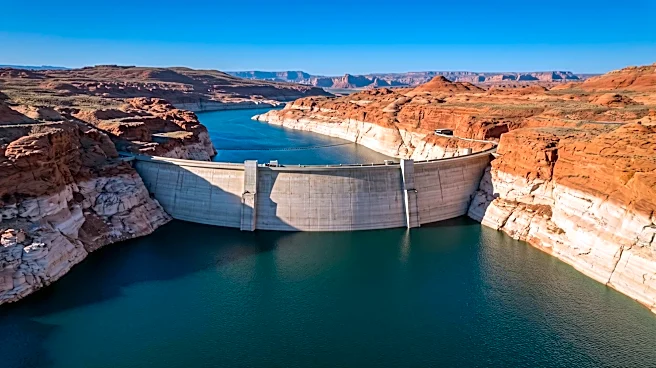
Decades of drying are also taking their toll below Glen Canyon Dam, in the scenic river stretch just above Grand Canyon. As Lake Powell’s storage has dropped below a quarter of its capacity and its surface waters have crept within about 40 feet of the penstocks that feed water to the hydroelectric plant and the river below, the river has warmed up.
Most of the government attention to this problem in recent years has been on protecting Grand Canyon’s native humpback chubs from warm-water predators that slipped through the dam’s turbines from Lake Powell. But as the river warms, it has also taken a toll on a welcome and intentionally planted non-native species, a rainbow trout population that attracts traveling anglers and sustains several guide services.
Chubs can thrive in warm water, but so can the invaders. In 2024 and 2025, the Bureau of Reclamation poured colder water through the dam’s river bypass tubes — a deeper outlet than the hydropower intakes — to prevent smallmouth bass from spawning there. As a side benefit, it rejuvenated the rainbow trout fishery in the Lees Ferry stretch below the dam.

This year, with water so low that it threatened to cut off hydropower production if Reclamation didn’t hold more of it back, Interior Secretary Doug Burgum ordered the agency to nix the cooling flows.
Federal officials said they would do their best to prevent a spike in the bass invasion threatening chubs, by physically altering backwater spawning habitats, catching and removing bass, and perhaps using chemical fish killers where bass congregate. But there is little they can do for the trout as summer water temperatures rise into their danger zone in the 70s.
Angler catch rates have declined to levels not seen in more than 30 years as drought and warming accelerated. Where Lees Ferryboat anglers in the early 2010s reported catching around two fish per hour from boats and slightly fewer when on foot, both types of angler have averaged less than one every two hours in the last few years, according to Arizona Game and Fish data presented at a Glen Canyon Dam Adaptive Management Program meeting in August. The department’s goal is to keep anglers catching at least a fish an hour.
“It’s definitely not what it used to be,” Mesa resident Jackson Lafferty said this spring after an afternoon of fly fishing at Paria Beach just downstream of Lees Ferry. He had caught three rainbows that day, though the action wasn’t what he recalled from most of his 15 years of fishing trips there. Neither was the size of the trout, he said.
He’ll keep coming back, he said, if only for the reflection of the orange cliffs off the riffles.
“Even if you don’t catch anything, it’s probably as pretty a place as you can step into a trout stream.”
Some fear it won’t be a trout stream for long with the government ending its cooling flows.
“It’s going to kill all or most of the trout,” said Jim Strogen, who represents Trout Unlimited and recreational interests on an advisory committee for the adaptive management program.
Quizzed on that prospect at the committee’s August meeting, Grand Canyon Monitoring and Research Center biologist Brian Healy said the warmth could suppress reproduction but the healthier adult fish should be able to weather it — for a time.
“A couple years in a row of really warm water could be pretty rough,” Healy said.
During a June boat outing with Trout Unlimited, guide Skip Dixon said his work has gotten harder at Lees Ferry since he started in 1999. “Back in those days, the population was almost 50,000 fish per mile,” he said. “And I'm skeptical now we're even a thousand per mile.”
Lately, he said, the warmth is making the surviving trout harder to find and catch.
“They’re not in traditional areas that they should mathematically be in,” he said. “At this particular (flow rate), those fish should be in ankle-deep, but they’re not. They’re all holding deep right now, anywhere form probably 7 to 25 feet, trying to stay in the cool water.”
He can find them, he said, using longer leaders or sinking line. He has made thousands of trips upriver, so he knows where the holes are. As drought’s effects keep accumulating, though, he fears for the future.
“I'm scared because Lake Powell has never been this low,” Dixon said. “This is historic. So we're dealing with a problem that we've really never seen before.”

Refilling nature's sponge
For those seeking to save the Southwest’s fish, there is no quick fix. The solutions start far upstream, and they’re the same for fish as for people, said Sarah Porterfield, Colorado River program director for Trout Unlimited. They include forest thinning, stream restoration, wet meadow protection.
“How can we take care of this system that takes care of us?” she said. ”How can we help ecosystems to function and be healthy?”
It starts with restoring lands so they can hold water and release it when its needed most.
Within Arizona, the 128-acre Thompson-Burro Meadow project is the top restoration priority for Trout Unlimited, and will cost about $1.8 million in both public grants and private donations. The first phase was the digging and moving of material to slow the flow. At the project site last fall, Trout Unlimited state lead for Arizona, Nathan Rees, pressed his boot against the streamside proof to show that it was already working. His foot sank in. “It’s this big sponge again,” he said.

Next, workers are building around the meadow to keep elk out for several years, and replanting willows to shade the water.
It’s a needed upgrade to help Apache trout get from a shaded canyon downstream on the Black River through the meadow and to spawning grounds on the Fort Apache Reservation. Summer water temperatures up there are in the 60s, Rees said. “That’s really the stronghold of Apache trout habitat is up there on the reservation.” Getting there is critical for a species that, though removed from endangered status, still swims in only about a tenth of its historic range in the state, Rees said.
Up to now the trout have not been able get past the deadly 80-degree waters crossing the meadow.
In the future, Rees said, they will make it. “It’s worth the investment,” he said.
The models that Trout Unlimited has consulted suggest that they’ll keep making it to their mountain stronghold even as the Southwest warms, he said, so long as the meadow stays wet and the stream is shaded.
Brandon Loomis covers environmental and climate issues for The Arizona Republic and azcentral.com. Reach him at brandon.loomis@arizonarepublic.com.
Environmental coverage on azcentral.com and in The Arizona Republic is supported by a grant from the Nina Mason Pulliam Charitable Trust.
Follow The Republic environmental reporting team at environment.azcentral.com and @azcenvironment on Facebook and Instagram.
This article originally appeared on Arizona Republic: Can fish survive West's megadrought? They'll need help from humans