
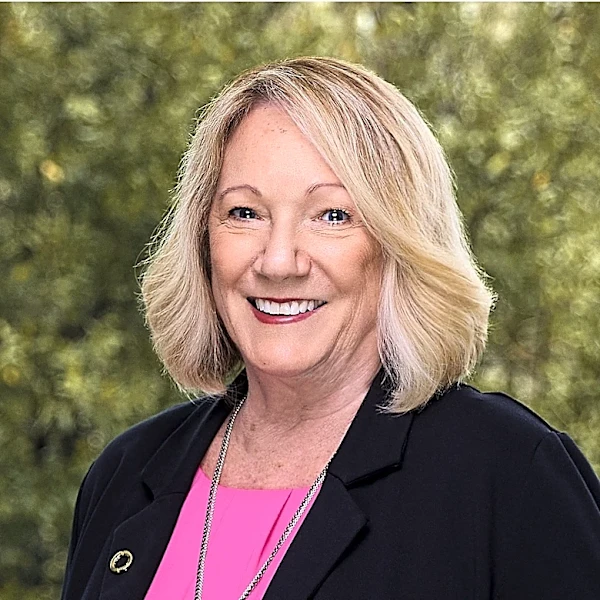





Arizona Corporation Commission candidates Clara Pratte and Jonathon Hill are calling for an investigation into whether Arizona Public Service Co has shifted the cost of electricity demand from data centers onto Arizona households.
They say customers should be repaid if regulators find they have.
The executive director of the Arizona Corporation Commission, however, wrote that he disagreed with claims that residential customers were on the hook for hundreds of millions in costs attributed to large load customers and that APS was already being scrutinized under a pending rate case.
Pratte and Hill spoke at a Oct. 7 news conference at Strip Mall coffee shop, flanked by residents of Robson Ranch and the business's owner, who was hit with pricy electric
bills this summer.
“It’s already pretty hard to operate a small business here in Arizona, and the risk of utility bills continuing to rise is probably our greatest one facing us today,” Strip Mall coffee and Monsoon Market owner Koral Casillas said. “While I can shop around for cheaper costs for coffee beans and paper goods, I am sadly stuck with my utility provider.”
In November, Democrats Pratte and Hill will vie for two seats on the Arizona Corporation Commission. They are joined on the ballot by two Republicans: incumbent Kevin Thompson and state Rep. Ralph Heap. Early voting started this week.
The candidates’ call for increased transparency came after the publication of an independent analysis by a citizen consumer advocate claiming that residential customers had taken on some of the energy costs associated with data centers. The analysis was subsequently reported on by 12News.
The report claims that a small group of Arizona Public Service Co.’s largest customers have driven the majority of the demand seen by the utility and that residents have had to shoulder some of that cost themselves, by taking on a disproportionate burden from the utility's Power Service Adjustment.
The allegations were vehemently denied by APS, which quickly put out statements about “misleading claims” around data centers and their impact on bills.
A spokesperson for APS wrote in an email to The Arizona Republic that the reporting on the analysis “oversimplifies” the utility’s Power Supply Adjustment surcharge.
The adjustment, which is applied on customer bills, varies based on fuel costs and the amount of power purchased by the utility to meet demand. The cost of fuel and purchased power varied due to surging costs from the Ukraine war, power plants retirements, and high energy use during the summer months, among other factors, Hanks wrote.
“It assumes that because customer sales grew and fuel costs increased, one caused the other,” spokesperson Jill Hanks wrote. “That’s not how the PSA works, and it ignores the many factors that drove higher fuel and power costs between 2022 and 2025.”
Hanks added that the utility has made a "Responsible Development" pledge and is proposing to go further in its current rate case, ensuring that any new power purchase agreements to meet demand from large customers is "directly assigned" to the customers driving it.
"APS has also proposed additional customer protections, including a 45% base rate increase for extra-large customers and changes that would allow costs to be reviewed and assigned more directly as growth occurs on an annual basis," Hanks wrote.
For the report's author, the explanation doesn't hold water.
"APS thus asks the Commission to accept two seemingly irreconcilable propositions," Abhay Padgaonkar wrote. "On one hand, the existing PSA framework can shift costs to classes that did not cause them. On the other, APS claims it somehow avoided those cost shifts 'up to this point' without the benefit of the proposed direct-assignment mechanism it now says is needed to prevent them."
In a statement, Arizona Corporation Commission Executive Director Doug Clark affirmed APS' claims. He wrote the commission disagrees with the results of the analysis and questioned why Padgaonkar did not formally intervene in APS’ pending rate case.
Because the regulatory body is currently acting in its quasi-judicial role in the rate case, in which APS is pursuing a roughly 14% increase, Clark wrote that the commission is unable to comment on the evidentiary record.
“However, historical data on the record in prior rate cases has shown that commercial/industrial customers have been subsidizing the costs for residential customers,” Clark wrote. “With the recent growth of AI, data centers and manufacturing demands, the Commission maintains a ‘growth pays for growth’ principle for new high-load customers to ensure those customers are funding any new power grid infrastructure and energy costs required to serve them.”
Padgaonkar said he doesn’t feel the existing ratemaking docket is sufficient to address the questions he’s raised. He believes the commission should bring in an independent analyst to determine which customers are driving costs and who’s covering those costs.
He added that APS’ rate case is also coming to a close.
“It’s the regulator’s job to hold their feet to the fire,” Padgaonkar said.
Hill similarly said the commission needs to take a look beyond what’s been filed in the rate case.
“The fact that this is even a possibility, and the data is not immediately available to show us whether this is happening or not is an absolute failure of the current commission,” Hill said.
This article originally appeared on Arizona Republic: Democratic candidates seek probe of data centers’ impact on APS bills