




An Arizona Corporation Commission candidate is at risk of disqualification from a public campaign financing program, according to an email obtained by The Arizona Republic in a records request.
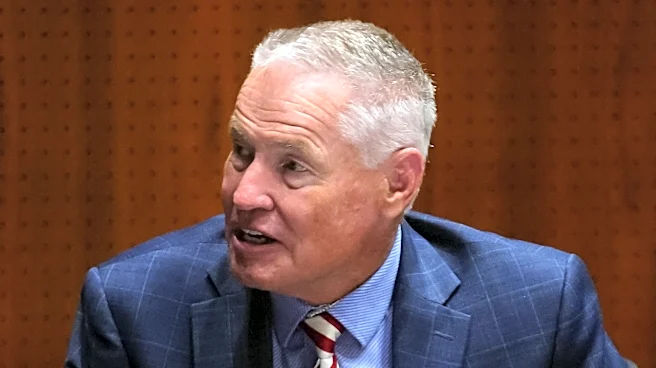
State Rep. Ralph Heap on July 20 qualified for public financing through the Citizens Clean Elections program, records show. The next day, the Republican challenger bested incumbent Nick Myers in a close primary race.
But just a few days after Heap’s win at the polls, Citizens Clean Elections Commission executive director Tom Collins delivered bad news. There was “substantial evidence” that Heap’s campaign finance reports didn’t fully reflect the cost or the funding source of campaign signs supporting the Turning Point-endorsed candidate, Collins wrote in an email
to the candidate’s legal counsel.
Meanwhile, Heap’s financing from Clean Elections is on ice for other reasons. The program is waiting for him to submit a statement validating the accuracy of his campaign finance reports before releasing funds. Unless Heap withdraws from the program, he is also prohibited from raising private money while the public dollars are held up.
Lisa Everett, a Republican organizer and candidate for Dysart Unified School District school board, filed a complaint about what she felt were discrepancies between the number of signs supporting Heap versus the spending indicated in his campaign finance reports, which show an expenditure of roughly $650 on signs at a local sign shop. Another line item shows a little over $262 spent at a print shop on "communications - advertising" but the medium of the advertising is unclear.
A spokesperson for Democratic candidates Clara Pratte and Jonathon Hill confirmed the two candidates spent more than $41,000 each on printing and installing 600 large, double-sided street signs and rebar, but noted the cost might be slightly higher than average because the campaign used a union print shop. Myers told The Arizona Republic that he and fellow incumbent Kevin Thompson reused large street signs from the 2022 election, but spent roughly $5,000 to print 1,000 smaller yard signs.
Heap did not return calls from The Arizona Republic on Monday and Tuesday. In a brief response letter dated July 27, Heap’s attorney wrote that he was still reviewing the complaint and currently is “unable to concede the allegations in the complaint letter." Attorney Tim La Sota did not return The Republic's request for further comment.
Questions over campaign signs
Everett, a supporter of Myers and Thompson, said she took notice of Heap’s large street signs around the Phoenix metro. Even on a trip to Flagstaff, Everett said Heap’s signs lined the streets.
Interested in the funding source, Everett pulled up Heap’s campaign finance report.
“This doesn’t add up,” she recalled thinking, seeing just a small amount spent on signs.
Everett wrote in the complaint that she had been “unable to determine” how the printing and installation of the signs was paid for — likely a “significant” sum for Heap’s campaign.
Over the past week, Everett said she’s noticed that many of Heap signs around the West Valley have been taken down.
Myers said he “100%” thinks the signs made a difference in the July primary.
Another Clean Elections candidate, Myers said he and Thompson couldn’t access the majority of their funding until qualifying for public financing. The two candidates had volunteers install old signs from the 2022 election, before printing a couple batches of smaller yard signs.
“So he had his out months before we did,” Myers said. “And that name recognition definitely plays a part.”
Myers said Heap told him at an event earlier this year that he had bought roughly 1,000 signs.
Myers said following controversies over utilities trying to move the needle on Arizona Corporation Commission candidates and the creation of a new ethics code for commissioners, candidates for the powerful regulatory board typically pursue public financing.
It’s difficult to seek outside donations for the regulatory board besides insiders. Self-funding, Myers said, can also be dicey if any of a candidate’s income comes from utility stocks or similar sources.
“To get funding for a no-name office like the Corporation Commission is just next to impossible without going to the utility, and that’s just not appropriate,” Myers said.
Going the clean elections route cuts the “drama,” Myers said.
“It trades it for other drama, as you can tell,” Myers said. “But yeah, it makes things easier from a campaign finance and an optics perspective."
Thompson, Myers also face complaint
Thompson and Myers are also facing their own sign-related complaint filed July 15. The complaint, filed by Alex Logvin, claimed that the pair of candidates had failed to disclose the full costs for signage or payments to a consulting firm whose number was included on the signs. It also alleged that the candidates had both received a handful of individual contributions in excess of a $220 individual donation limit.
Logvin said he became interested in campaign finance as a result of a surprisingly fierce Salt River Project board election, and started learning about laws regarding election-related signage.
He's filed several complaints with both the secretary of state and Clean Elections, including an additional complaint against Myers and Thompson with the SOS regarding the size of the disclosure text.
"The Corporation Commission, even though it should get more attention than it actually does, it's a relatively smaller race in the grand scheme of things, and I was just shocked by the sheer volume of signs for those two," Logvin said.
In a response dated July 20, Thompson and Myers dismissed the complaint as one in a “pattern of retaliatory filings” from Logvin submitted just a few days before the Republican primary on July 21.
“That timing, and the escalating severity of each successive filing built from the same handful of photographs, is not the profile of someone raising a genuine compliance question as it arises,” they wrote.
The missing expenditures had a simple explanation, they wrote: The signs referenced in the complaint were reused from the 2022 election. The phone number for the Resolute Group, included on the signs, was out of date. Campaign finance shows 2022 payments to the consulting firm. The individual contributions were currently under review, they wrote, and if any are found to be in excess of early limits, a refund will be processed and a corrective amendment will be filed.
Logvin said he had not yet seen the response.
"I'm not surprised that they pushed back," Logvin said. "I haven't had, in fact of everything that I've submitted, I've only had one group reach out and be like, 'Hey, we had no idea we were doing it wrong, we want to fix this.'"
In January, a complaint was also filed against David Marshall, who planned to run with Heap. The complaint alleged Marshall had inappropriately transferred funds from an old campaign account into his war chest for the Arizona Corporation Commission race. The complaint was closed in April when Marshall withdrew from the race to accept an appointment as the Navajo County recorder.
Through the state’s Clean Elections program, candidates for Corporation Commission can qualify for $147,836 for the primary election and $221,915 for the general election in 2026. To qualify, candidates have to submit at least 1,500 qualifying $5 contributions.
They’re also subject to certain restrictions. Participating candidates can’t take money from political action committees and they’re limited in the amount of small “seed” donations they can raise. Once qualified, a candidate cannot raise additional funding on their own.
“You’re agreeing to amount limits, no large donations from individuals, and you’re agreeing to overall limits on how much you can raise and spend before you qualify for funding,” Collins said.
This cycle, all five candidates qualified for public financing.
Campaign finance complaints have to be sworn and notarized, before being reviewed by staff. If accepted, staff will ask for a response. After an investigation, the five-member commission will rule on whether there’s evidence of a violation, at which point penalties can be assessed.
Myers said he isn’t heartbroken about the July 21 primary loss to Heap, but believes the fallout of an investigation and any fines or other censure could increase the chances that a Democrat takes one or both of the commission seats.
“I think what you’re going to see with all of the hubbub, is you’re probably going to get a Democrat in that seat,” Myers said.
Alaina Mencinger covers energy, utilities and technology. Reach her at Alaina.Mencinger@usatodayco.com.
This article originally appeared on Arizona Republic: Heap's public campaign financing at risk after election complaint