




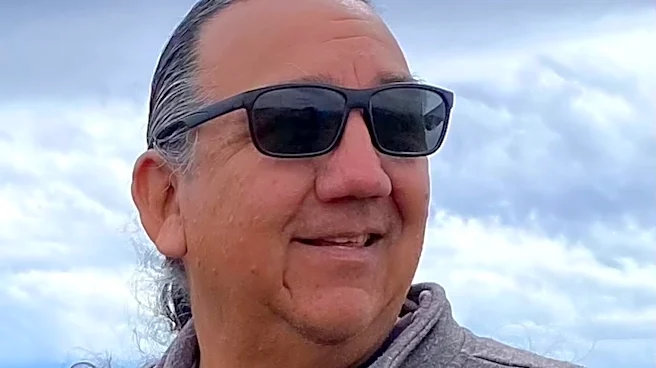

Sam Meranto's contentious probate case took another ugly turn when his wife put the elderly Phoenix infomercial legend in a memory care unit against his wishes. But a judge's recent ruling provides hope for a resolution.
From the 1970s into the 1990s, Sam was a household name in the Valley, in large part because of his ubiquitous late-night TV infomercials and print advertisements for his guided meditation business.
Maricopa County Probate Judge Kerstin LeMaire ruled Sept. 22 that Cynthia Meranto, who is Sam's wife, will no longer be his temporary guardian, conservator and sole trustee. Instead, LeMaire appointed private fiduciary Leslie Mann-Damon of Next Steps for Families to temporarily oversee Sam's care and finances, noting that Mann-Damon is known
to have a quiet and gentle demeanor.
"There's been a lot of chaos," LeMaire said. "I am cautiously very optimistic. ... We need to bring down the temperature."
The case, which has been going on for more than six months, has been cited by some of Sam's supporters as a reason why probate court needs more scrutiny. Unlike the Meranto situation, most probate cases happen away from public attention and can drain the estates of vulnerable people while the probate process drags on.
For Sam, 94, being away from home and in a restrictive facility where he found it impossible to socialize was the realization of what he's expressed fearing ever since March 9, when Cynthia filed a petition seeking full control of his personal care, living arrangements, medical treatment and finances in the middle of a rancorous family fight.
Sam repeatedly has said he is scared his wife wants to put him in a facility to die. In court filings, Cynthia said she was forced to file the petition because of her stepchildren, whom she has accused of manipulating Sam.
The costs of going through the probate process, which in this instance includes numerous lawyers and other professionals who are charging hundreds of dollars per hour, are all coming from assets and savings that Sam and Cynthia have spent decades amassing.
As of July 16, the case had already cost the Meranto estate more than $100,000, according to a court filing from Cynthia's attorney, Carol Soderquist. As Sam himself has pointed out, he never wanted to go to probate court in the first place and still doesn't think he needs a guardian or conservator.
Guardian ad litem: 'I don't ascribe bad motives to anyone involved'
Another hearing was set for Oct. 14, but at the suggestion of Soderquist, the hearing may become a settlement conference instead.
"There's a lot of misunderstanding, hurt feelings. I don't ascribe bad motives to anyone involved," guardian ad litem Steven L. Evans testified before LeMaire made her ruling. "I'm not here to impugn any of the parties."
The court-appointed guardian ad litem is tasked with investigating and representing Sam's interests.
Evans had filed the petition asking for the appointment of Mann-Damon because someone from outside of the family was needed, at least temporarily because "the current situation is not in Sam's best interest."
As long as Cynthia and Sam's children continue distrusting and undermining one another, it's not going to be good for Sam, Evans explained. Mann-Damon is needed "to calm things down while we figure out what should happen on a permanent basis," he said.
The bitter family dispute is between Sam's second wife Cynthia, who has been married to Sam for more than 40 years, and her stepchildren, who are Sam's three remaining living children (his three others have died): Jeffrey, known as Rico, Jason and April. Evans said in his observation, both sides of the family dispute have been having trouble separating Sam's care from the money involved in the case.
Soderquist told LeMaire during the Sept. 22 hearing that there was no reason why Cynthia should not continue as the temporary guardian and conservator because "none of her actions have been done with malice" and what's more, she's been doing the job for free, unlike a private fiduciary.
"She did everything she could do," Soderquist said. "She is trying to make sure Sam is safe and protected."
LaVoy disagreed, noting that Cynthia left Sam in the memory care unit for weeks, even after she knew it wasn't the best place for him.
The case took a turn for the worse when Sam spent nearly three weeks in the locked, restrictive memory care unit in Peoria, despite evidence that he did not need to be there.
A Sept. 2 letter from the facility to Cynthia said Sam's level of cognitive functioning, independence, communication and ability to articulate "are not consistent with the population and service model for which our service model is designed."
"She has her own financial interests to look out for," LaVoy said. "How do we know she's not looking out for herself? ... She is not impartial. She's partial. He's an elderly man and he's not long for this world."
Sam's probate case began March 9 when Cynthia filed a petition for an emergency appointment of a temporary guardianship and conservatorship "due to Sam's incapacity" and a request that the guardianship and conservatorship over Sam eventually become permanent. Her petition said that before she resorted to the court, she previously had tried going through the police department and the Arizona Attorney General's Office.
Sam and Cynthia have not lived together since July 2025 when Sam had a bad fall and was hospitalized and later sent to a care facility. Neither Sam, his children nor Cynthia have disputed the fact that on Feb. 10, 2026, Rico and Jason took Sam home from the facility and moved him into a family home.
Memory-care experience 'like One Flew Over the Cuckoo's Nest,' Sam says
Cynthia testified Sept. 22 that she placed Sam in the Peoria facility because he needed a rest after falling Aug. 22 and being hospitalized. He had been agitated and spent hours talking on the phone and she thought he needed a break, though she acknowledged it was not the right place for him. Since Sept. 16, Sam has been back at home with 24/7 caregivers.
Sam gave up his beloved iPhone when he got into memory care, and felt so lonely that some of his friends secured another one for him, which he used to place calls to his lawyer, LaVoy, to an Arizona Republic reporter, to his children, and to his former caregiver, Kathy Hamilton.

Though upset about being in memory care, Sam told The Arizona Republic on Sept. 19 that he still tried making friends in the unit, to no avail.
"Nobody would talk to you. They'd just look at you and smile or something, no conversation at all. You'd hear people scream in the middle of the night, yelling, screaming. It was like 'One Flew Over the Cuckoo's Nest,' you know, Jack Nicholson, remember that movie?," he said, referring to the 1975 motion picture directed by Milos Forman.
"Everybody was off the wall. You couldn't carry on a conversation with any of them. It was terrible," Sam said. "It was like being in prison. Taking a 94-year-old person and locking them up, taking away their toys, their credit card, their money, that's what they've had me going through."
While at the memory care facility, Sam scored 27 out of 30 on a popular mini mental state examination that health professionals use as a tool to screen for cognitive impairment and dementia.
While the test is not the sole measure of cognition, Arizona forensic psychiatrist Dr. Jack Potts testified during a Sept. 10 court hearing that Sam's score indicated no evidence of any severe or even moderate level of dementia.
Reach health-care reporter Stephanie Innes at stephanie.innes@usatodayco.com or follow her on X: @stephanieinnes or on Bluesky: @stephanieinnes.bsky.social.
This article originally appeared on Arizona Republic: Judge removes all family control in bitter Sam Meranto probate case