




Our park had disappeared.
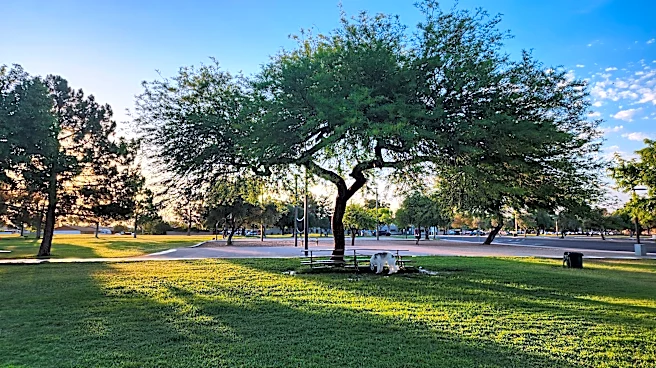
When Sweetwater Park in Phoenix closed for renovation, 19 acres vanished behind chain-link fencing overnight.
Not literally, of course. The trees were still there. The sprinklers continued their familiar rhythm across the grass. Birds flew over the new 6-foot chain-link fence without giving it a second thought, and coyotes still slipped through the opening between the park and the school as though nothing had changed.
The only ones locked out were the people.
For years, Phoenix Parks and Recreation had talked about improving the park. Every few months someone would mention that construction was about to begin. Like so many neighborhood rumors, it became something we talked about without ever believing it would happen.
Then,
one morning, 19 acres disappeared behind chain-link fencing.
I knew I'd miss my daily walk. I knew my borzoi, M, would need another place to stretch her 22-inch-long legs. What surprised me was how much I missed the people.
Within hours, text messages began flying among the regular dog walkers.
"Has anyone found another place to walk?"
"Maybe the canal?"
"What about the park on Hayden Road?"
At first, I thought we were searching for another park.
Eventually, I realized we were searching for one another.
A few days later, I met a man walking his pug whom I recognized by sight but had never really spoken with. We stood looking through the fence before he asked the same question that had been rattling around in my head.
"Couldn't they just close the section they're working on and leave the rest of the park open?"
I smiled.
"I've been wondering the same thing."
Maybe there are safety or construction reasons that make that impossible. If so, I'd genuinely like to understand them. But it also made me wonder whether, on a project expected to last many months, there might be opportunities to phase the work so that a portion of a neighborhood park could remain open.
Because parks are more than open space.
They're where ordinary relationships take root.
They're where someone notices your aging dog is walking a little slower. Where a newcomer is welcomed without ceremony. Where neighbors become friends through hundreds of brief conversations that, by themselves, seem unremarkable. Over time, those moments quietly weave a community together.
When the fence went up, the community didn't disappear.
It adapted.
Someone hosted a backyard play date. Another suggested meeting for coffee after an early walk. A friend invited us over to see her remodeled kitchen while serving the latest cake she'd mastered. We still haven't found another park that feels like ours, but we've continued finding one another.
The dogs, of course, adjusted almost immediately.
It's the humans who are taking a little longer.
As construction continues, I'm sure we'll eventually discover another trail, another patch of grass, another place to throw a tennis ball. But I hope this experience also raises a broader question.
When improvements to a neighborhood park take months or even a year -- is there a way to complete the work in phases, allowing people to safely use portions that aren't under construction?
If there is, perhaps we preserve more than a walking path.
Perhaps we preserve the quiet connections that make a neighborhood feel like home.
Patricia Berry is a Phoenix artist, photographer and writer. She is completing Mornings at the Park, a collection of essays exploring community, dogs and the ordinary moments that quietly shape our lives.
This article originally appeared on Arizona Republic: Behind chain-link fence, a Phoenix neighborhood found itself | Opinion