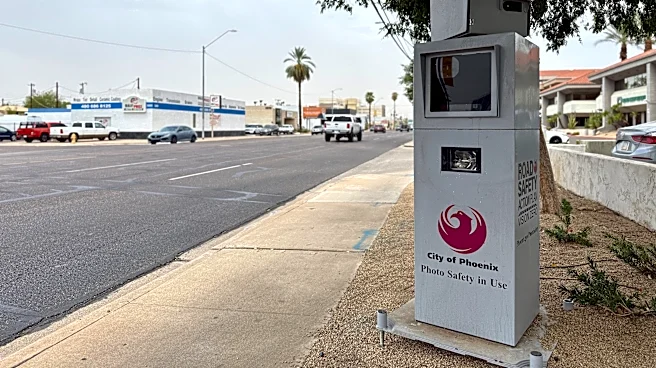



Arizona voters will soon decide whether state agencies and cities can use photo radar to catch red-light runners and speedy drivers.
Proposition 319 is among the handful of races and ballot measures in the Nov. 3 election.
If it passes, local governments could no longer use photo enforcement programs without their residents’ approval first.
It comes as cities face mounting pressure from their residents who question the use of cameras to police communities.
Supporters of the measure want voters to have a say on whether police departments can use the cameras and believe such programs are used as revenue-generators for municipalities.
Those against the proposition argue that traffic cameras reduce violations and deadly car crashes at a time when Arizona
has been branded as one of the deadliest states for pedestrians and one of the most dangerous for fatal crashes involving red-light runners.
The last day to register to vote in the Nov. 3 election is Oct. 5.
Ballots go out Oct. 7, allowing early voters to mail in their ballots or drop them off at some locations.
Here’s what to know about Proposition 319.
What would Proposition 319 do?
Voting yes on Proposition 319 would ban new photo enforcement programs across the state.
If the measure passes, cities that have an existing system in place before Dec. 31, 2026, must hold an election in November 2027 to let their voters decide whether the program should continue.
A city whose voters reject the existing program next fall will have 90 days to stop using photo radar.
A city whose voters uphold the existing program, however, must go back to them for approval every 10 years.
What are proponents, opponents saying about Proposition 319?
State Sens. Wendy Rogers and Mark Finchem, both Republicans, brought the ballot measure to the Arizona Legislature.
They sponsored the legislation approving the proposition’s placement on the statewide November ballot as public discomfort grows over privacy concerns and law enforcement’s use of cameras to ticket people.
Whether cities can use automated ticketing systems that “prioritize fines over fairness” should be up to their residents, Rogers said.
“Automated enforcement removes discretion, undermines due process and turns routine driving into a revenue stream,” she said in a news release. “That’s not how law enforcement should work in Arizona.”
A handful of organizations such as AAA Arizona, Arizona Public Health Association and the League of Arizona Cities and Towns oppose the measure.
While they agreed that traffic cameras shouldn’t be used to create speed traps and raise city revenues, they argued that the systems are life-saving tools that reduce crashes caused by red-light runners.
“As Arizona grows and our roads become more crowded, we cannot afford a sweeping ban on a tool that, when implemented responsibly, is proven to save lives,” Michelle Donati, AAA Arizona’s director of Government Affairs, said.
Traffic engineers like Michael Grandy of Gilbert echoed the sentiment, arguing that communities should be able to use the available tools to address traffic safety.
“This ballot measure is an overreach by the state Legislature to try to assert state control over localized safety issues.”
What do cities have to say about Proposition 319?
Many of the Valley cities that have photo enforcement programs haven’t taken a firm position on Proposition 319.
Scottsdale Police Chief Joe LeDuc said he respects the community’s right to decide the future of the city’s photo enforcement program.
“We believe it is a valuable tool that helps reduce dangerous driving, prevent collisions and keep our roads safer,” he stated in an email. “We hope the community supports keeping photo enforcement so we can continue to use it responsibly as part of our broader traffic safety efforts.”
Mesa spokesperson Casey Blake said regardless of what voters decide in November, the city will maintain its goal of reducing fatal and serious-injury crashes by 30% by 2030.
“Mesa will continue using roadway improvements, education, traffic enforcement and other strategies to improve safety on our streets,” she stated.
How much money do these cameras generate for cities?
Major Valley cities including Chandler, Mesa and Scottsdale have used photo enforcement programs for years to slow down lead-footed drivers and deter red-light runners.
Phoenix and Tempe did as well until about 2019 and 2011, respectively. Both, however, recently revived their respective programs. Phoenix’s program is currently only used to capture speeding violations, not red-light incidents.
Between fiscal years 2021 and 2025, Scottsdale and Mesa each collected an average of nearly $3 million annually from traffic camera violations, the cities’ financial records showed.
Chandler collected a yearly average of $922,000 over the same five-year period, according to the city.
How do cities spend photo-enforcement revenue?
Much of those dollars go toward their programs’ annual expenses, such as vendor costs, equipment maintenance, and police and court operations.
“The program is designed with a focus on safety and aims to be as revenue‐neutral as possible,” Chandler spokesperson Matthew Burdick said.
Any leftover revenue is generally reinvested in other traffic-safety improvements.
“In recent years, those investments have included pedestrian and bicycle safety improvements, enhanced mid-block crossings, traffic signal upgrades, school-zone safety improvements and traffic-calming projects,” Blake of Mesa said.
What happens when traffic cameras capture a violation?
When a driver is caught speeding by a camera and receives a violation notice in the mail, they can generally choose to admit responsibility and pay the fine or deny responsibility and request a hearing.
If they qualify, they can also attend defensive driving school.
Depending on how fast a car is speeding, the driver could face fines ranging between $200 and nearly $500.
The Arizona Republic has reported, though, that drivers caught speeding past photo radar cameras routinely ignore their tickets in the mail.
City citation data from Scottsdale revealed that over the past five and a half years, nearly half of Scottsdale’s photo enforcement cases were dismissed because drivers failed to respond to the notice and couldn’t be served their civil traffic citations.
Have those programs made roads safer?
When Tempe restored its traffic cameras in 2024, Mayor Corey Woods pointed to a 2017 study that showed a 23% decrease in total crashes in Scottsdale after red-light cameras were installed.
The same study found there was a 65% decrease in crashes at intersections with red-light cameras.
According to another report by the Insurance Institute for Highway Safety, cameras in large cities reduced the rate of fatal red-light-running collisions by 21%.
Like this story? Get more East Valley news straight into your email inbox by signing up for our free weekly East Valley Newsletter, which comes out Wednesdays.
Shawn Raymundo covers Scottsdale and Maricopa County. Reach him at sraymundo@gannett.com or follow him on X @ShawnzyTsunami.
This article originally appeared on Arizona Republic: Proposition 319 asks voters whether photo radar cameras should stay