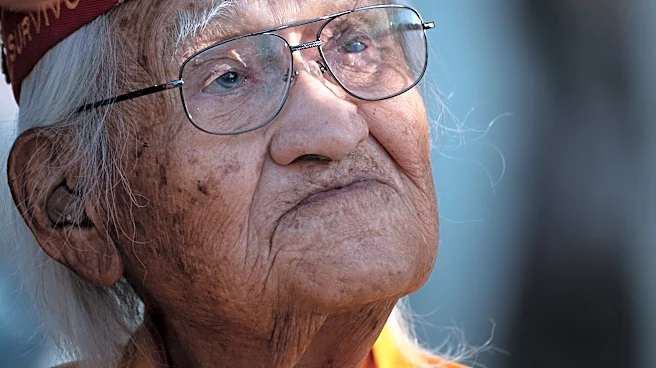



Thomas H. Begay was just 16 in 1943 when he persuaded his mother to put her thumbprint on his application to join the U.S. Marines. Two years later, Begay was relaying vital communications on the beach of Iwo Jima, taking the place of another Marine who had perished during the first days of the pivotal battle that helped turn the tide toward Allied victory in the Pacific Theater of World War II.
Begay expected to be a gunner, but because he spoke the Navajo language fluently, he was moved into training as a Code Talker.
Begay, now nearly 100, was helped from his wheelchair to stand during the presentation of the colors during the 44th annual Navajo Code Talker Day commemoration Aug. 14 at the eponymous memorial in Wesley Bolin Plaza at the Arizona
State Capitol.
About 100 people braved 90-degree temperatures to honor the men who put their lives on the line and used a Native language — one the nation had once fought to suppress — to help win the war.
In Window Rock, the Navajo Nation capitol, another ceremony honored the Code Talkers.
Annabelle Smallcanyon, who is descended from Navajo Code Talker George Willie, Sr., and Kellen Little, the descendent of fellow Code Talker and, later, Arizona state legislator Arthur Hubbard Sr. sang the national anthem and the Marine Corps hymn in Diné.
David Bean, a Puyallup tribal member and chairman of the Indian Gaming Association, said many Native languages were taken from Native peoples during the boarding school era.
"The warrior spirit of protecting our families was part of our success in war," he said.
During the first 48 hours of the Iwo Jima battle, Bean said, six Navajo Code Talkers relayed more than 800 messages "with no mistakes."
Ganado Veterans Organization Vice-Commander Lawrence Lano said that, as Japanese Emperor Hirohito surrendered to the Allies, he is rumored to have said, "The Navajos defeated us."
Colton Shone, a Navajo reporter for KTVK and KPHO, honored the Navajo Code Talkers and said "It's about the power of the language to keep the people together."
The San Carlos Apache Veterans Association presented the colors and provided a three-round gun salute.
During the presentation of a proclamation issued by Gov. Katie Hobbs, Code Talker descendants laid a wreath and flower display at the foot of the Code Talker Memorial, which features a large bronze statue created by Navajo sculptor Oreland Joe.
Code Talkers essential to winning battles
Nearly 535 Native men from more than 20 tribes used their languages to help win World Wars I and II for Allied forces. Of those, about 420 were Navajos.
Philip Johnston, the son of a missionary who grew up in Leupp and learned Navajo, contacted the U.S. Army after the Japanese attacked Pearl Harbor in December 1941 and drew the U.S. into the war. Johnston heard about how the Army used Comanche Code Talkers and thought the Navajo language could also be of service in the war effort.
But it was the Marines who decided Navajos were just the ticket to create an unbreakable code after nearly all their previous codes were deciphered.
The first cohort of 29 Navajos were recruited in Flagstaff in 1942, and using the language the United States had done its best to eradicate, created unique terms for military equipment and maneuvers. For example, "fighter plane" was “da-ha-tih-hi” or "hummingbird."
Later, another 400 young Diné men joined their ranks.
The work of the hundreds of code talkers was essential to the Allied victory in World War II. But the Navajo Code Talkers are best known for the harrowing days of the Pacific battles. They relayed essential intelligence during every major U.S. Marine Corps assault in the Pacific from 1942 to 1945, including Iwo Jima.
Later, 5th Marine Division signal officer Major Howard Connor would say, “Were it not for the Navajos, the Marines would never have taken Iwo Jima.”
Keeping the story alive
Keeping the story of the Code Talkers' heroism alive has had its ups and downs. The records of all the Code Talkers' exploits were classified for 23 years, until 1968. The soldiers returning home were not allowed to tell what they did or how their actions turned the tide of battles.
After the records were declassified, their exploits became legend. The Code Talkers including the Navajos were acclaimed as heroes. Congressional Gold Medals were distributed by tribe, and Congressional Silver Medals were awarded to individual service members in 2001 by President George W. Bush. They also earned standard military decorations like Purple Hearts and Silver Stars after their classified World War I and World War II missions were declassified.
Books, movies, documentaries and events like the Aug. 14 commemoration help keep their story fresh in the public eye and to Indian Country.
That story dimmed a bit when the Defense Department removed references to the Code Talkers, but quickly restored them after a public outcry in 2025.
Just two of the estimated 420 Navajos who served as Code Talkers were still living, Begay and former Navajo Nation Chairman Peter MacDonald.
Debra Krol reports on Indigenous communities at the confluence of climate, culture and commerce in Arizona and the Intermountain West. Reach Krol at debra.krol@azcentral.com. Follow her on X, formerly known as Twitter, @debkrol and on Bluesky at @debkrol.bsky.social.
This article originally appeared on Arizona Republic: With the 'power of the language,' Navajo Code Talkers helped win WWII