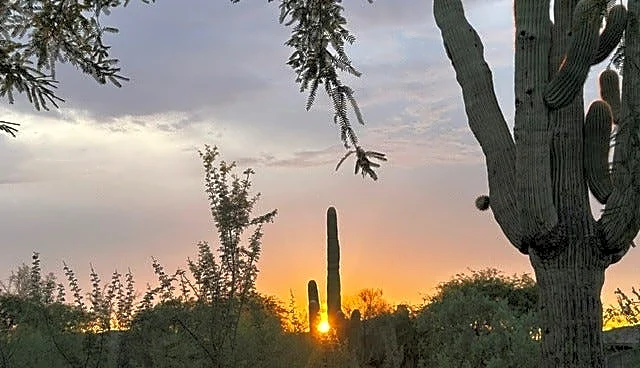







Saguaro cacti, a defining symbol of the Sonoran Desert, are disappearing from metro Phoenix at a concerning rate as the region continues to grow and temperatures continue to rise, according to Arizona scientists.
A team of scientists and volunteers at the Desert Botanical Garden
in Phoenix is working to understand how fast the cacti are disappearing, what is driving the losses, and how to protect them.Preliminary findings from a community monitoring effort shared with the Arizona Republic show that one in every 10 saguaros disappear every year. This means they could completely disappear from the Valley in just a decade, according to Tania Hernandez, a scientist at the botanical garden who leads the research and conservation efforts.
"Our preliminary
data does tell that they are disappearing at a really accelerated rate in the whole Valley," Hernandez said. "So we are at a stage of better understanding why they are disappearing."
Researchers are investigating whether extreme heat, urban development, landscaping practices or a combination of factors could be contributing to their decline.
The losses could have lasting consequences for the broader Sonoran Desert ecosystem. Saguaro cacti are considered a keystone species because their fruit is a critical source of food and hydration for the wildlife in the area, especially during the dry summer months. Their bloom, a round flower with lush white petals, is also considered one of the most beautiful flower species of the Sonoran Desert and was designated Arizona's state flower in 1931.
"The saguaro is so culturally important. It's such an icon that identifies us," Hernandez said. "If we lose it, we are going to lose this big part of our identity."
Metro Phoenix could have no saguaros in 10 years
Since 2022, thousands of volunteers have gone out in neighborhoods all across metro Phoenix to track the presence and health of saguaros over time as part of an initiative at the Desert Botanical Garden called theSaguaro Census.
More than 3,800 volunteers have participated in the census over three and a half years, said Billie Fraser, a lead volunteer at the garden who graduated in April with a master's degree in plant biology and conservation from Arizona State University.
Fraser's graduate thesis, co-directed by Hernandez, helped establish the Saguaro Monitoring Program, a long-term effort building on the census to track how the condition of saguaros changes over time, particularly in an urban environment experiencing extreme heat. The preliminary findings suggest saguaros are disappearing at an alarming rate.
"We've only got one year of data, and looking at such a long-lived species, that's really nothing ... but we are noticing that we are losing a lot of individuals who aren't as old as they typically would get," Fraser said.
The study still has a few weak points, Fraser said. Volunteers initially documented missing saguaros without systematically counting newly established ones, making it difficult to determine the net change in the population. This year and in the coming years, researchers plan to revisit neighborhoods across the Valley to look for new saguaros.
"That is going to give us a much better estimate," Hernandez said.
Researchers also cannot yet determine how many missing saguaros died, were removed or transplanted, but because moving an adult saguaro is expensive, Hernandez said the latter is potentially the least likely explanation for saguaros disappearing.
Even with the study's limitations, both Hernandez and Fraser stressed that the early findings are concerning.
“We do know at least from this first year that we've lost around 30% of our study population," Fraser said. "But that's again very preliminary. We still need lots of years of data."
Soaring temperatures could be killing saguaros
Researchers initially suspected Phoenix's rising temperatures and urban heat island effect could be major factors in the saguaro losses.
The urban heat island effect occurs when built-up areas absorb and retain more heat than surrounding natural landscapes, contributing to higher temperatures, particularly at night. That nighttime heat could be especially challenging for saguaros, which use a water-conserving photosynthesis process adapted to the desert environment.
Saguaros typically keep their stomata, the small openings that allow gas exchange, closed during the day to conserve water and open them at night. When nighttime temperatures remain high, the plants may keep their stomata closed, or if they open them, they risk losing too much water, Fraser explained.
"That means that they're probably suffocating in a way," she said.
Other urban conditions could also affect their health. Concrete and asphalt can compact the soil around saguaros, while improper watering and planting too close to buildings may create additional stress.
Saguaro cactuses are not currently classified as endangered, but Hernandez believes the species deserves greater protection.
"Even though the species, as of right now with the knowledge we have, is not endangered, we think it should be classified as endangered," Hernandez said.
Fraser's thesis also raised concerns about whether saguaros can adapt quickly enough to climate change. Their genetic diversity may not be changing at a fast enough pace to keep up with changing conditions, while other environmental pressures continue to affect the population.
Human intervention and development may also be at fault
Although the research team initially suspected heat was the primary driver of saguaro losses, the plants' observed condition suggested the explanation might be more complicated.
About 65% of the saguaros assessed were in good condition, 28% were in fair condition and 8% were in very bad condition, according to the study's preliminary findings. That suggests extreme heat alone may not explain the number of saguaros disappearing.
Episodic extreme heat waves could still be contributing to additional losses, Fraser said. But the research also points to human behavior as a possible factor.
In Arizona, damaging or destroying protected native plants, including saguaros, is regulated by state law. But Hernandez said urban development and landscaping decisions may still be contributing to their decline.
"At the beginning, we all thought it was related to the heat island effect, or climate change combined with heat island. But our preliminary data also tell us that behavior, human behavior, is something that is also affecting (saguaros)," Hernandez said.
As Phoenix expands, more buildings and apartment complexes are replacing natural landscapes, she said, without a corresponding increase in green spaces and native landscaping.
"The city's growing massively. We all can see more buildings, more and more apartment complexes ... but we don't see more and more green spaces. We don't see more and more native landscaping practices," Hernandez said. "So that's the ultimate goal. We're going step by step."
Removing saguaros from private properties without replacing them, along with poor landscaping practices, could be even more important contributors to their loss, Hernandez said.
"They are not growing in parks, on the side of the road. … They're in people's yards, on our private properties," Hernandez said. "It is the people, the citizens, who are also the stewards of saguaros in the city."
Hernandez urged developers and landscapers to preserve saguaros whenever possible and incorporate native plants into their designs.
"Use saguaros as your landscape," she suggested. "Use native plants as your landscape, and bring back the desert to the city."
She also called for stronger enforcement of existing protections.
"We would love to have more protection for saguaros because even though there are laws that protect them, they are not enforced really strongly," she said. "We would need stronger laws to protect them."
Community 'kindness' is at the heart of conservation efforts
Beyond monitoring the losses, the Desert Botanical Garden's Saguaro Initiatives program is working to preserve the species through seed collection, research and community participation.
Saguaros are a crucial part of the Sonoran Desert ecosystem. According to the Arizona-Sonora Desert Museum, numerous species, including birds, bats, tortoises, javelinas and coyotes, rely on saguaro fruit for food. Saguaro also provide habitat for wildlife, making their survival important to the broader ecosystem.
“If they're not doing well, then a lot of other things are not going to be doing well too,” Fraser said. “They've also just become a cultural icon. They're kind of a symbol of the West.”
Conservation projects at the garden include the saguaro nursery and seed bank, two connected conservation projects that focus on collecting and preserving saguaro seeds, studying how to store and germinate them, and raising seedlings with the help of volunteers.
In June 2024, Hernandez, along with volunteers in the United States and Mexico, collected saguaro fruit from approximately 230 cacti across multiple locations. Volunteers cleaned the seeds, and Hal Hoover, a garden volunteer who has helped lead the nursery and seed bank efforts, cataloged them for storage in a seed lab.
Once the seeds germinate and the seedlings are transferred into trays, volunteers take the trays home to care for the young saguaros before returning them to the garden.
"They sign up for a three-year stint to take care of little devils, and then bring them back to us," Hoover said.
Once the saguaros are big enough to be transplanted, they go to the garden's horticulture team to grow larger before eventually becoming available for adoption.
About 12,000 seedlings were in volunteers' care as of October 2026, Hoover said, with 126 trays being maintained in the field or in people's homes.
The effort relies on people's willingness to dedicate their time, effort and space at their homes to growing the next generation of saguaros.
“This is all from the love of the community. This is because people care,” Fraser said. "We wouldn't have anywhere near these numbers if it wasn't for the people who love their desert and who love the saguaros in their neighborhoods.”
Hernandez said that kind of participation is essential to conservation.
"This is truly pure kindness of a project," Hernandez said. "There cannot be conservation without community. But it is really rare to find a situation in which a whole community gets together to protect and save a species. And it is happening here."
Researchers also hope continued monitoring will help them identify the main causes of saguaro losses and inform future conservation policies, including how the plants are replanted or transplanted.
Fraser said collecting more data and raising awareness could help conservationists advocate for better protections.
Linda Arandas, a volunteer at the garden, encouraged more people to participate in the effort.
“We want the community to get involved; we need their support," she said. "This is all volunteer-led. If people are interested in supporting Saguaro Initiatives, let the garden know. It's very important right now."
For Fraser, the work is about protecting a species that defines the region and ensuring it remains part of the desert for generations to come.
"We just feel like the saguaro conservation is one of the most important things we can be involved with right now. So I think that's why we all do it," Fraser said.
This article originally appeared on Arizona Republic: Phoenix could lose its iconic saguaros, scientists say. Here's why