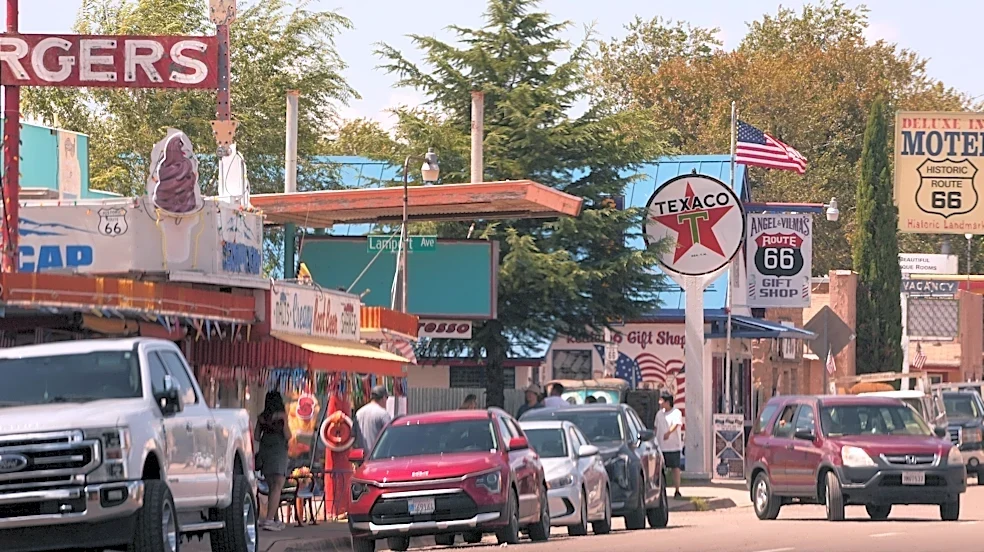





SELIGMAN, AZ — It was a sunny Thursday morning in a sleepy mountain town with only 550 residents. The prospect of a quiet, slow day in a place seemingly untouched by modern technology shattered as tourists bustled in and out of storefronts. The sound of voices, the hum of cars and 1970s and 80s rock music blurred into a soundtrack to the commotion.
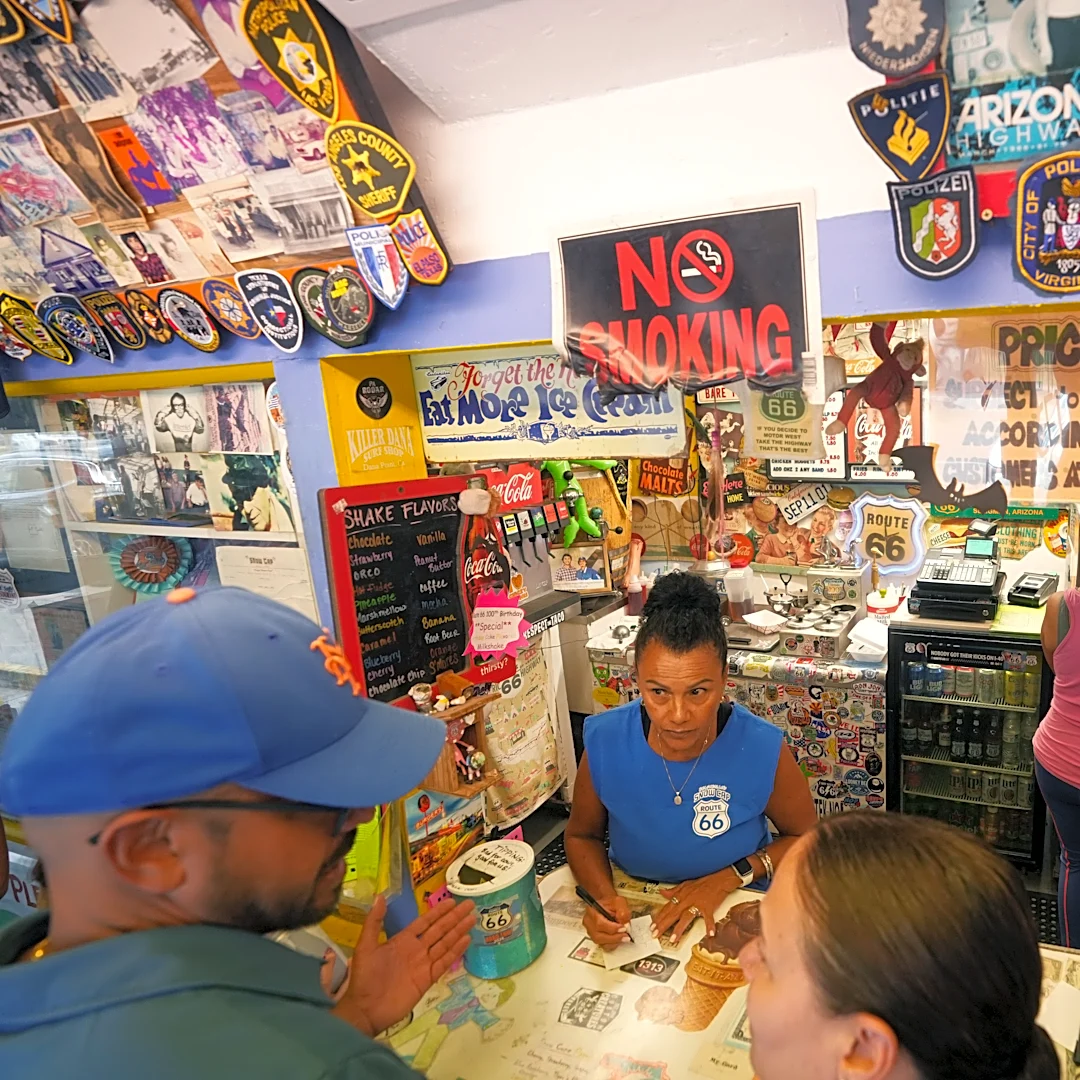
A line stretched around the front of a burger and ice cream stand that opened in the 1950s, and customers packed shoulder-to-shoulder inside the small yellow shop waiting for their chance to order.
It was a typical day for residents of Seligman, 75 miles west of Flagstaff.
The thing that drew people to the small town in the middle of a hot Arizona summer was Route 66, which is turning 100 in November.
"Why are they here?" said Angel Delgadillo, a 99-year-old resident of Seligman who has been hailed as Route 66's savior. "This is the town where Route 66 got its historic rebirth. The second and third and fourth generations, they're learning so much about Route 66. How beautiful."

Route 66 was the lifeblood of rural communities across northern Arizona, like Seligman, Lupton and Truxton. During the road's heyday, cities and towns boosted their economies by catering to travelers. It brought about the iconic imagery that is quintessential Route 66: cafes, neon lights, mom-and-pop diners, motor hotels.
Today, communities along Route 66 generate more than a billion dollars a year in direct travel-related spending, according to a 2023 report provided by the Historic Route 66 Association of Arizona. Visitors to Flagstaff accounted for more than half of that spending.
Overall, Route 66 tourists bring in $99.3 million in local and state tax revenue. Between 2019 and 2023, visitor spending increased by 6.3% on average, with it only expected to increase exponentially as towns prepare for the centennial this November.
It wasn't always like that.
In the 1970s and 1980s, the interstate system cut off towns from a direct access point for tourists.
Some towns, such as Seligman, figured out how to survive by embracing the nostalgia of Route 66. Others, like Lupton, adapted to remain a roadside stop, while a handful of towns, like Truxton, almost disappeared from the map.
“Yes, we got faster roads,” said Sean Evans, a longtime Route 66 historian based in Flagstaff. “The downside was we hurt a lot of people in the small towns along the way.”
In cities like Flagstaff and Kingman, population had reached a "critical mass," Evans said, and weren't as acutely affected.
But in places like Truxton, along the western loop of Route 66, the pain of being abandoned is heard in the whine of old, rusted metal street signs buffeted by the wind. It's seen in the chipped paint on the lone neon sign; in the old, malfunctioning gas station, the faint red paint still trying to hold on.
Today, small, rural, isolated towns that could cash in on the Route 66 brand were able to thrive; others weren’t so lucky.
The thriving: Seligman, Arizona
Route 66 is one of the only economic engines for the small, northwest Arizona town of Seligman.
Seligman is quintessential Route 66: a small, rural town; large, neon signs; tourist attractions and gift shops. Tourists, both domestic and international, flock there to experience a piece of Route 66 history.
"Business is booming in Seligman," said Delgadillo, who has lived nearly his entire life in the town.
But in the 1980s, the interstate system rendered Route 66 defunct. I-40 cut off places like Seligman from tourism as speedy travel trumped a slow, meandering road trip.

Seligman nearly faded into history.
"Most folks don’t know what it’s like to be forgotten,” Delgadillo said, recounting how business shuttered and residents fled in the aftermath of I-40. “We were forgotten.”
Seligman ‒ and Route 66 ‒ exist largely because of Delgadillo's efforts to revitalize interest in the historic roadway. He campaigned to convince state officials to grant Route 66's historic designation in Arizona in 1987. Simply having the historic label created an economic boom that revived a town on the brink of death, Delgadillo said.
A year later, business was good again.
Today, the town has fully embraced the kitsch of Route 66 in an effort to keep history and its economy alive.
Seligman is home to giant signs declaring the town the "birthplace of historic Route 66," as well as preserved vintage cars, retro and modern gas stations, old service shops and historic homes.
The town symbolizes a wider Route 66 rebirth. In 2016, Arizona launched a $17 specialty black-and-white license plate bearing the Route 66 shield. Between 2021 and 2026, more than $4 million has been raised for the Historic Route 66 Association of Arizona.
The association's 2023 report did not specify Seligman's overall contribution to Arizona's economy. But seven similar towns, such as neighbor community Ash Fork, collectively contributed about $26.8 million, and places like Winslow and Holbrook each added about $37 million.
The abandoned: Truxton, Arizona
About 45 miles west of Seligman, drivers come across an assortment of dilapidated, worn-down buildings, not a soul in sight.
Truxton was once a hub of activity for those driving along Route 66.
"Where once 12,000 cars went, no one went," Evans said. "Businesses died, the people moved out, and you wind up with abandoned buildings and all that. It happened in Holbrook, in Winslow, Williams and Flagstaff."
It happened in Truxton, a 4-square-mile unincorporated community of just over 100 residents along the western loop of Route 66 in Mohave County.

Truxton was founded in 1951 in anticipation of a large dam that was planned nearby, which never happened. What kept the settlement afloat was Route 66.
The first business to open was a garage and service shop. A flood of new travel-focused businesses, including cafes and motels, soon followed.
But only three years after the town was founded, the federal government launched a national superhighway system. The route chosen for I-40 fell 20 miles south of Truxton and severed the town from travelers, its lifeblood.
When I-40 bypassed the area in 1978, it devastated the local economy. Much like in Seligman and many other rural towns along the way, people and businesses left.
"It structurally altered the towns," Evans said.
Unlike Seligman, Truxton never recovered.

Crumbling abandoned buildings haunt the town like ghosts. A 1950s neon sign for the shuttered Frontier Cafe and Motel still stands, its light blue paint chipping away. Two derelict gas stations, one painted red and the other blue, are operated as convenience stores, survivors of a bygone era.
On a Thursday afternoon in late August, no Route 66 enthusiasts visited. Only one person was seen, climbing through a rusted, broken fence.
The evolver: Lupton, Arizona
Against the backdrop of a towering, copper-colored mountain, a collection of old, wooden, cabin-like buildings sat at an exit off I-40 near the Arizona-New Mexico border, 284 miles east of Truxton.
Most cars zipped by on the freeway. Few pulled off.
Sixty years ago, thousands of tourists stopped at David Yellowhorse’s family trading post as they traveled along what was then Route 66.

Lupton is economically similar to some of the small communities included in the group of seven in the 2023 report than a place like Seligman. It is most comparable to Topock, a community on the California border: a tiny state-line highway outpost sustained by travelers, rather than a Route 66 destination with a broad tourism economy.
A member of the Navajo Nation, Yellowhorse grew up in the Yellowhorse Trading Post. His father and uncle made good money selling Native American jewelry, art and trinkets to travelers who wanted a taste of the Wild West. At nine years old in 1965, Yellowhorse gave donkey rides to travelers for a quarter.
“This highway is paved with gold,” Yellowhorse recalled his grandfather telling his dad. “Treat these people good on this road, and they’ll take care of you.”
When Yellowhorse's family first opened the trading post, they had to fight negative stereotypes depicted in popular Western movies and books, which portrayed Native Americans as violent savages.
But when I-40 was built 350 feet from the shop, it cut off the direct route that landed cars in its parking lot. Tourists stopped coming as frequently. They had to attract customers another way.
The life-sized butter-colored horse atop the trading post's roof to capture the gaze of the curious wasn't enough. It meant adopting the Route 66 brand, too.
“We adapt. We adapt to the conditions,” Yellowhorse said.

His younger sister, Tasbah Glasses, now operates his family’s trading post, yards away from where it originally stood. She calls the place home.
The small knick-knacks in the trading post are now emblazoned with the Route 66 shield and help preserve the nostalgia for the America of yesterday. Embracing the Route 66 brand is part of the reason the Yellowhorse family, from uncles to grandchildren, have been able to stay in their little slice of paradise.
"There are all these things along the road to see that you previously would have whizzed past, but now they're ... worthy of visitation," Evans said. "Route 66 pulls people."
Lauren De Young covers transportation for The Arizona Republic. Reach her at ldeyoung@azcentral.com.
This article originally appeared on Arizona Republic: Some Route 66 towns thrive, but others have faded. Take a road trip across Arizona